



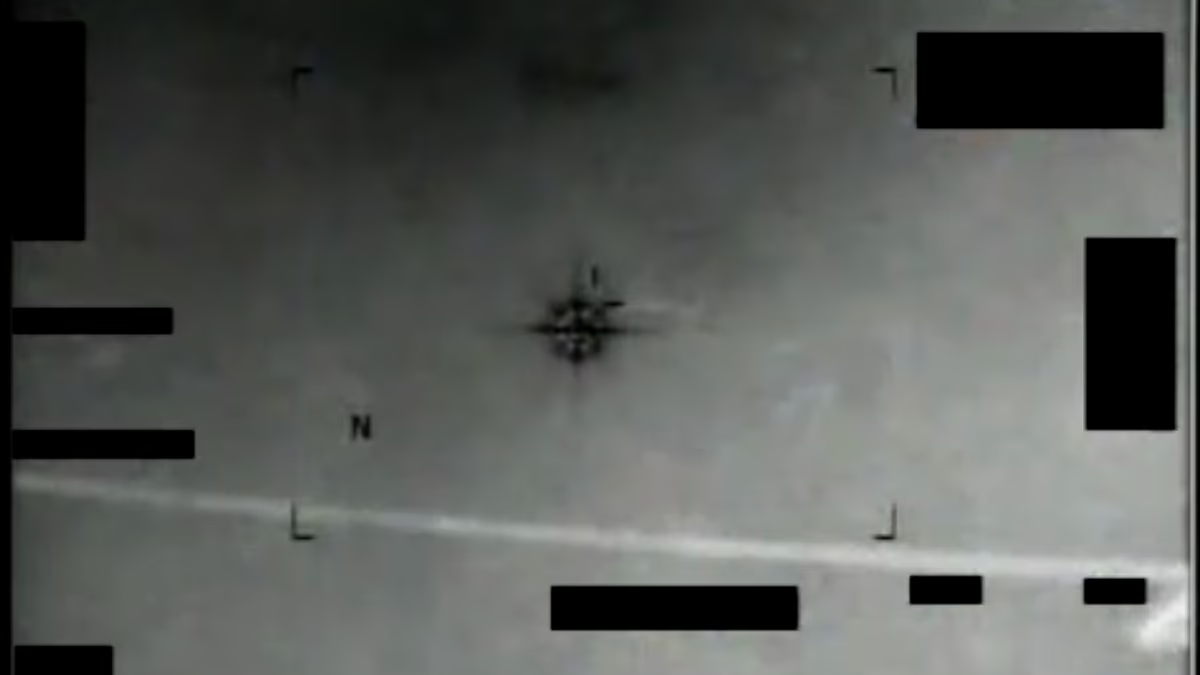
In a significant step toward greater transparency, the U.S. government has recently declassified and released a new batch of files related to Unidentified Aerial Phenomena (UAP), including Pentagon footage capturing mysterious objects in American skies. This release, part of an ongoing initiative to address public and congressional interest, offers a rare official glimpse into incidents that have long been the subject of speculation and intrigue. The newly public videos and documents, spanning several years and multiple geographic locations, depict objects displaying flight characteristics that appear to defy conventional understanding of aerodynamics and propulsion. This move signals a notable shift from decades of official secrecy and dismissiveness, acknowledging that these phenomena represent a legitimate area for investigation and concern, both for national security and scientific inquiry.
The heart of this release is a series of videos captured by advanced sensors on U.S. Navy aircraft, showing objects with no visible wings or propulsion systems executing maneuvers at incredible speeds. Described by pilots as seeming to defy physics, these UAPs exhibit instantaneous acceleration and the ability to rotate or move against the wind in ways that challenge explanation. The footage, often stabilized and clarified from its original classified forms, shows these enigmatic objects as simple, blurred shapes—typically resembling flying spheres or cylinders—streaking across the screen. Crucially, these are not grainy, distant shots but high-fidelity recordings from the world’s most sophisticated military tracking systems, which failed to conclusively identify the objects. This technological context makes the mystery all the more profound, suggesting these are not merely weather balloons, drones, or optical illusions easily dismissed by standard instrumentation.
Releasing this information is not merely an academic exercise; it is deeply rooted in national security. For years, military pilots who encountered these phenomena reported being hesitant to come forward for fear of professional ridicule, creating a potential gap in America’s situational awareness. The formal investigation aims to determine whether these UAPs represent advanced technology from a terrestrial adversary, such as China or Russia, that has leapfrogged known scientific capabilities. Alternatively, if they are not foreign craft, their presence in restricted military training airspace poses a significant aviation safety hazard. By declassifying these cases, the Pentagon seeks to destigmatize reporting, encourage pilots to come forward without fear, and systematically collate data to ascertain if there is a tangible threat to service members or the homeland that requires a new defensive strategy.
Beyond the halls of the Pentagon, this official acknowledgment opens a new chapter for scientific exploration and public discourse. For generations, the topic of UFOs was relegated to the fringes, associated with conspiracy theories and pop culture. The government’s transparency initiative fundamentally alters that dynamic, lending credence to the idea that there is a genuine, unresolved physical phenomenon at play. Scientists, now armed with official data instead of anecdotal reports, can begin to apply rigorous analysis to the flight characteristics, energy signatures, and material evidence (where available). This creates an unprecedented opportunity for astrophysicists, engineers, and atmospheric researchers to explore novel possibilities in physics and propulsion, potentially leading to breakthroughs in our understanding of the natural world—or the technological landscape of our planet.
Of course, the journey toward full understanding is fraught with complexity, and the new data does not point to a single, simple conclusion. The UAP Task Force and its successor, the All-domain Anomaly Resolution Office (AARO), have stated that the explanations likely fall into a handful of categories: advanced earthly technology, atmospheric or optical phenomena, classified U.S. programs, or, as a final and currently unverified category, something entirely other. Most cases are eventually resolved with conventional explanations, but a small, persistent percentage remains truly “unidentified” even after exhaustive analysis. This lingering uncertainty is what fuels both caution and curiosity. It underscores the necessity of continued, calm, and evidence-based investigation, separating genuine mystery from misidentification and ensuring public trust through factual updates rather than sensationalism.
Ultimately, this release of Pentagon footage and files marks a pivotal moment in the long history of humanity looking to the skies with wonder. It represents a mature, if cautious, admission from the world’s most powerful military that some aerial encounters remain beyond immediate explanation. By moving these discussions from the shadows of secrecy into the light of official inquiry, the U.S. is fostering a more informed and rational public conversation. Whether the final answers point to breakthrough physics, unexpected geopolitical rivals, or something more profound, the process itself reaffirms a commitment to knowledge over ignorance. As this transparency initiative continues, it promises not just solutions to specific mysteries, but a renewed example of how democratic societies can confront the unknown with rigor, openness, and a shared sense of curiosity about our place in a vast and puzzling universe.