


The 61st Venice Biennale emerges as a profound and timely counterpoint to our era of relentless noise and division. Under the guiding vision of the late Cameroonian-Swiss curator Koyo Kouoh, this edition, titled ‘In Minor Keys’, represents a courageous recalibration. It consciously turns away from what Kouoh termed the “anxious cacophony of the present chaos” to instead amplify softer, more profound frequencies of human experience: emotion, quietude, and deep connectivity. Following her passing in 2025, Kouoh’s curatorial team has faithfully realized her concept, which serves not only as the framework for the central exhibition featuring 111 artists across the Giardini and Arsenale, but also as an inspirational theme for many national pavilions. The Biennale thus becomes a unified, polyphonic composition inviting the global art world to listen more intently, to feel more deeply, and to reconnect with what is essentially human.
At the heart of ‘In Minor Keys’ is an enveloping atmosphere that is soulful, sensory, and spiritual. Kouoh structured the central exhibition around interconnected motifs—Shrines, Procession, Schools, Rest, and Performances—all woven together by core values of nurture, intimacy, and reflection. This is not an exhibition built on grand declarations or overt polemics, but on affinities and unconscious connections between artists and movements, an expansion of what Kouoh called “relational geography.” Visitors are explicitly invited to move through the spaces in a meditative state, to “tune in sotto voce.” This constitutes a radical act of resistance in a world where, as Kouoh wrote, time is treated as “corporate property.” The Biennale itself becomes a sanctuary from accelerated productivity, a deliberate space for slowing down and re-engaging with the inner self and with others on a more meaningful level.
A beautiful and poignant expression of this philosophy is the creation of gardens and oases throughout the exhibition. Kouoh conceived of “an archipelago of oases,” physical and imaginative spaces rich with memory and emotion. These include reconstructions or evocations of seminal artistic sites: Issa Samb’s vibrant courtyard in Dakar, Marcel Duchamp’s secretive final studio, and Werewere Liking’s theatrical cooperative in Abidjan. The garden motif extends into both the literal and metaphorical, serving as a place of sustenance. Linda Goode Bryant’s Still Life, for instance, manifests as a functioning urban farm tended by formerly incarcerated women, intertwining growth, care, and social healing. Similarly, the ‘Schools’ motif celebrates artist-led organizations like Raw Material Company in Dakar or the GAS Foundation in Lagos as intellectual and creative gardens—places dedicated to sharing knowledge, convening community, and sowing seeds of intent outside commercial pressures.
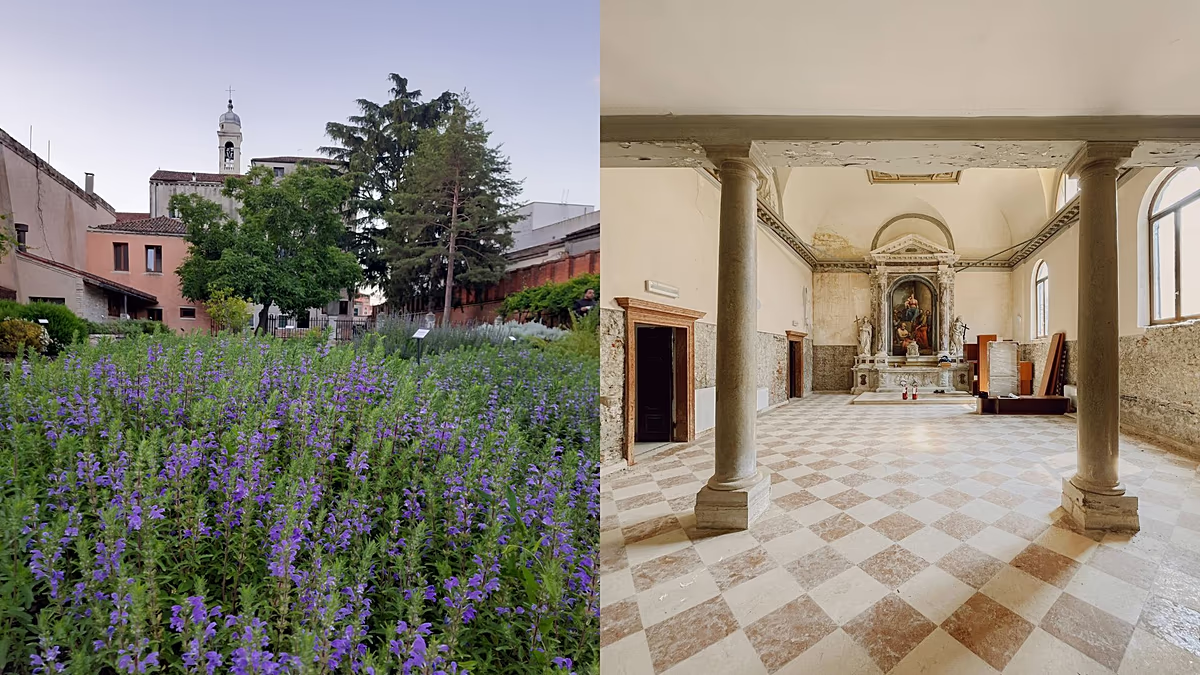
This spirit of contemplative connection powerfully resonates within several national pavilions. The Holy See Pavilion transforms into a site for spiritual reflection through a sound-based experience inspired by the mystic Hildegard of Bingen, allowing visitors to listen to a “sonic prayer” within a serene 17th-century garden. Qatar’s presentation, designed by artist Rirkrit Tiravanija as a welcoming tent, becomes a dynamic space for cultural exchange, featuring film, performance, sculpture, and a culinary program by Palestinian chef Fadi Kattan. These pavilions reject spectacle in favor of creating environments for gathering, dialogue, and sensory immersion, aligning perfectly with the Biennale’s overarching call for grounded human interaction.
In vibrant contrast, yet equally focused on community, Kouoh’s ‘Procession’ motif celebrates collective joy, ritual, and the carnivalesque. This section explores gatherings that range from circadian celebrations to ancestral communions, featuring artists like Nick Cave, Daniel Lind-Ramos, and Ebony G. Patterson. Here, carnival is presented as a powerful, temporary subversion of established power relations—a “stitch in time” where norms are scrambled. This theme of playful and critical disruption continues in works that reimagine art history and literature by artists such as Johannes Phokela and Sammy Baloji. Furthermore, participation is key. The Japan Pavilion, with Ei Arakawa-Nash’s Grass Babies, Moon Babies, invites visitors to actively care for baby dolls, changing diapers and receiving personalized poems, transforming the audience into a collective of caregivers and emphasizing nurture as a participatory, public act.
Ultimately, the 61st Venice Biennale stands as Koyo Kouoh’s generous and healing legacy. The very architecture of the central exhibition, by Wolff Architects, draws inspiration from the lush, magical realism of Gabriel García Márquez and the haunting, spiritual depths of Toni Morrison, favoring sensory experience over didactic instruction. This edition succeeds in creating a rare and precious ecosystem within the often-frantic art world circuit. It is a Biennale that values the whisper over the shout, the circle over the hierarchy, and the seed over the immediate harvest. By inviting us all to move in minor keys, it offers not an escape from the world, but a more resonant, connected, and humane way of being within it. It is a profound reminder that in times of cacophony, the most revolutionary act can sometimes be to listen, to rest, and to nurture our collective garden.