



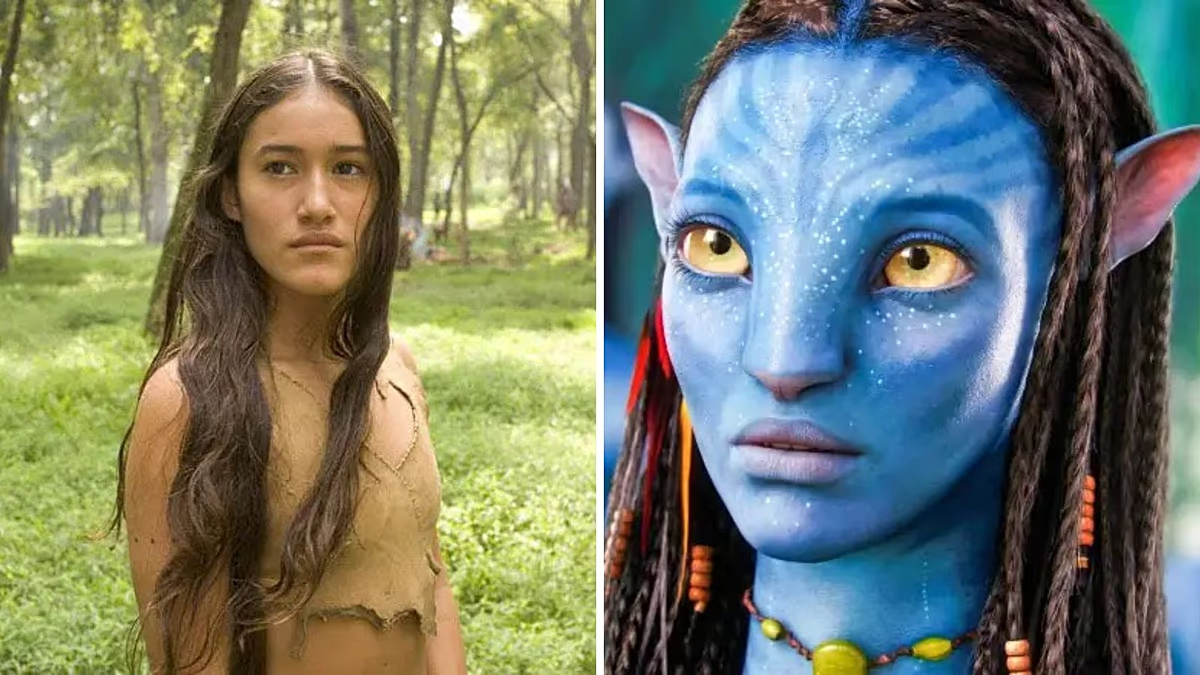
Of all the places one might expect to find a story of appropriation, a blockbuster franchise celebrated for its pro-Indigenous, anti-colonial narrative seems an unlikely candidate. Yet, this is the central and profound contradiction at the heart of a new lawsuit that has sent ripples through Hollywood. Indigenous actress and activist Q’orianka Kilcher, widely recognized for her poignant portrayal of Pocahontas in Terrence Malick’s The New World, has filed suit against famed director James Cameron. The core allegation is as modern as it is personal: Kilcher claims that Cameron and his production teams systematically extracted and utilized her unique facial features and biometric identity to create the digital blueprint for Neytiri, the iconic Na’vi heroine of the Avatar films, without her knowledge, consent, credit, or compensation. This legal action challenges not just a single act, but the very ethics of creative inspiration in the digital age, posing a difficult question: can a filmmaker ethically champion Indigenous causes on-screen while allegedly exploiting the individual identity of an Indigenous artist off-screen?
The lawsuit paints a detailed picture of the alleged exploitation, beginning in 2005. Kilcher asserts that after seeing her image in an LA Times advertisement for The New World, Cameron “extracted her facial features” and directed his design team to use her likeness as a foundational model for Neytiri. This process, the suit claims, was a “deliberate, non-expressive commercial act” that went far beyond vague inspiration. It involved the technical appropriation of her specific biometric data—the precise geometry of her face—integrating it into the film’s production pipeline to craft a character who would become a global symbol. For Kilcher, the injury is compounded by the franchise’s public stance. The suit describes Avatar as a series that “presented itself as sympathetic to Indigenous struggles, all while silently exploiting a real Indigenous youth behind the scenes.” This creates a painful dissonance; the very storytelling that resonates with audiences for its message of respect and defense of Indigenous sovereignty is now accused of being built upon a foundational act of disregard for an Indigenous woman’s sovereignty over her own image.
For years, Kilcher alleges, she was completely unaware of this hidden connection. The revelation came not through a legal document, but in a moment that initially seemed like a flattering acknowledgment. In 2010, at an event following the record-shattering release of the first Avatar, Cameron presented her with a personal gift: a signed sketch of Neytiri. His accompanying note read, “Your beauty was my early inspiration for Neytiri. Too bad you were shooting another movie. Next time.” At that moment, Kilcher interpreted this as a kind, if casual, compliment—perhaps a loose inspiration tied to missed casting opportunities. She was a supporter of the film’s environmental and anti-colonial themes. “Millions of people opened their hearts to Avatar because they believed in its message and I was one of them,” she stated. The sketch felt like a connection to a story she admired, not evidence of a commercial process in which her identity had been used as a raw material.
However, the lawsuit contends that this “personal gesture” was, in fact, a cryptic clue to a much deeper and more systematic use. The phrase “early inspiration” belied a comprehensive technical process, one that Kilcher believes crossed a “major line.” Her statement clarifies the breach: “I never imagined that someone I trusted would systematically use my face as part of an elaborate design process and integrate it into a production pipeline without my knowledge or consent. That crosses a major line. This act is deeply wrong.” The distinction she draws is critical. Inspiration is a fluid, celebrated part of art; the non-consensual, technical integration of a person’s specific biometric identity into a digital asset for a billion-dollar franchise is an act she frames as a violation. What she once saw as a casting-related comment, she now views as the tip of an iceberg of appropriation.
The legal remedies Kilcher seeks are substantial, reflecting the scale of the alleged infringement and the unprecedented profits generated by the Avatar franchise. Her lawsuit calls for compensatory and punitive damages, as well as “disgorgement of profits” attributable to the use of her likeness—a legal mechanism that would require Cameron and the studios to surrender earnings linked to Neytiri’s creation. Beyond financial compensation, she seeks injunctive relief, potentially affecting future use of the character, and “corrective public disclosure,” which would force a formal acknowledgment of her role in Neytiri’s genesis. This case arrives at a moment of heightened sensitivity around the rights of performers, particularly concerning digital replication. Kilcher is herself connected to this cutting-edge debate, as she is rumored to star in an upcoming film noted for using AI to generate a version of the late Val Kilmer. This juxtaposition highlights the complex landscape where artists navigate both the potential and the peril of new technologies.
Ultimately, Q’orianka Kilcher’s lawsuit transcends a simple dispute over likeness. It is a challenge from an activist who has spent her career advocating for Indigenous rights on global platforms, including Amnesty International and the United Nations. By taking this stand, she forces a conversation about the line between homage and theft, between collective storytelling and individual identity, and about the ethical consistency demanded of narratives that profit from the symbolism of oppression. Whether her claims will be validated in a court of law remains to be seen. But in the court of public opinion, she has already raised profound and uncomfortable questions about power, consent, and the true cost of inspiration in an industry capable of rendering a human face into the cornerstone of a digital empire.