

Paragraph 1
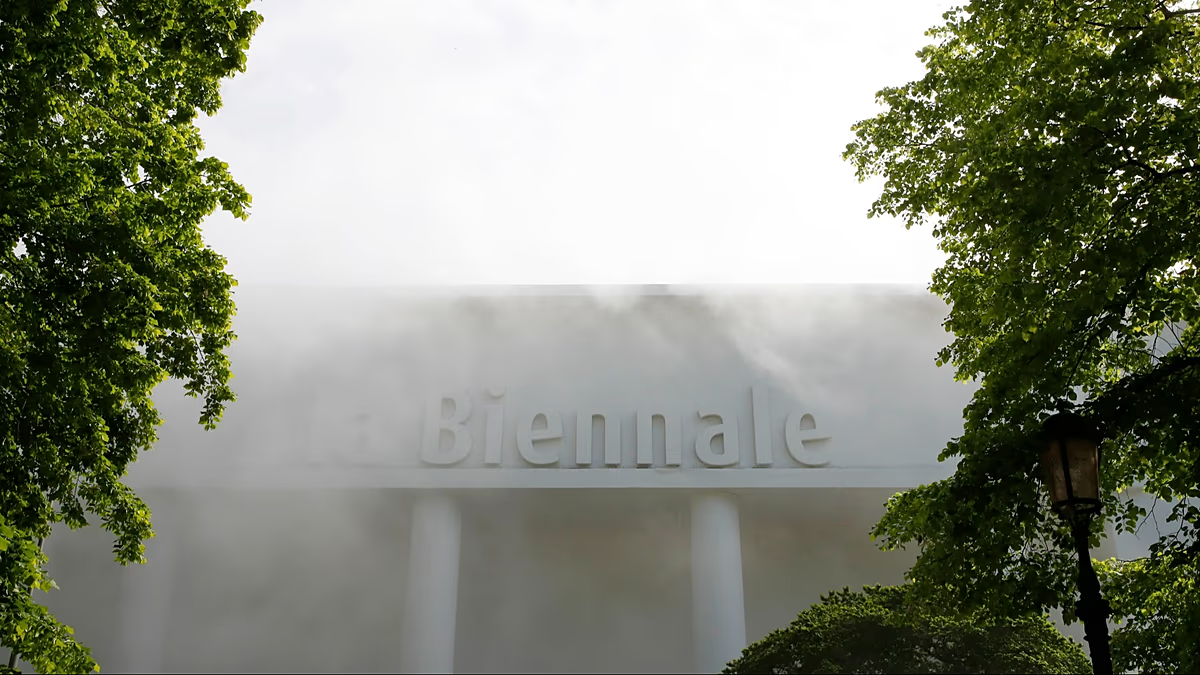
In a significant and abrupt cultural decision, Iran has withdrawn its national pavilion from the prestigious Venice Biennale, the famed international art exhibition often described as the “Olympics of the art world.” The announcement came via a brief, formal statement on the Biennale’s official website merely days before the event’s public opening this weekend, leaving the global arts community to speculate on the reasons behind the last-minute exit. The statement simply confirmed that “the Islamic Republic of Iran will not participate” in the 61st International Art Exhibition, titled In Minor Keys, offering no further explanation for the sudden departure. This move effectively silences Iran’s official artistic voice on one of the world’s most prominent cultural stages, a platform where nations have historically engaged in nuanced dialogue through creativity and expression.
Paragraph 2
While the Biennale’s organizers have remained silent on Iran’s specific motivations, the withdrawal occurs against a backdrop of severe and ongoing geopolitical strife that makes the decision, sadly, unsurprising to many observers. The Middle East remains a tinderbox of tension following the recent war involving the United States, Israel, and Tehran. Although a fragile ceasefire has held for nearly a month, the region is far from stable, with almost daily verbal exchanges, threats, and a tangible military stalemate symbolized by international commercial vessels stuck in the strategic Strait of Hormuz. In this climate, where political and military posturing dominates headlines, cultural participation in an international forum can become untenable or be wielded as a political statement, suggesting Iran’s retreat may be intertwined with these broader, unresolved conflicts.
Paragraph 3
Iran’s departure is not an isolated incident but rather another layer of controversy for a Biennale edition already marred by profound difficulty and discord. This year’s exhibition has been fundamentally shaped by tragedy and contentious invitations. The artistic vision for In Minor Keys was to be guided by curator Koyo Kouoh, whose recent and untimely death sent shockwaves through the art world, casting a pall over the preparations. Compounding this loss, the organizers’ decisions to extend invitations to both Russia and Israel—nations actively engaged in internationally condemned wars—ignited immediate and fierce backlash, placing the Biennale squarely at the intersection of art, ethics, and global politics.
Paragraph 4
The institutional crisis deepened dramatically last week when the entire international jury tasked with awarding the Biennale’s top prizes resigned en masse. In a powerful act of protest, these esteemed jurors declared they could not, in good conscience, evaluate entries from countries whose leadership is subject to international arrest warrants for alleged crimes against humanity—a clear reference to the invited nations at the heart of the controversy. This collective resignation represents an unprecedented challenge to the Biennale’s authority and raises fundamental questions about whether major cultural institutions can or should remain neutral sanctuaries for art when the participating states are accused of grave atrocities.
Paragraph 5
This vacuum of official judgment has forced a radical democratization of the awards process. With no jury in place, the two coveted Golden Lion prizes—for the best national pavilion and the best individual artist—will now be decided by public vote. This shift transfers artistic authority from a panel of experts to the collective voice of the exhibition’s visitors, a move that is both innovative and contentious. It reframes the awards as a populist plebiscite rather than a curated critical evaluation. Furthermore, the award ceremony itself has been postponed from this month to November, extending the period of uncertainty and public engagement and symbolizing an exhibition in a state of adaptive flux.
Paragraph 6
Ultimately, the 2026 Venice Biennale is unfolding as a stark reflection of our troubled times. What began as a celebration of artistic achievement has become a microcosm of global conflict, ethical reckoning, and institutional soul-searching. Iran’s silent withdrawal, the void left by a beloved curator, the schism caused by controversial invitations, and the jury’s principled exodus collectively tell a story far beyond art. They narrate a moment where the walls between the gallery and the world outside have utterly collapsed. The decision to hand the highest honors to the public vote may be a pragmatic solution, but it also signifies a profound moment of redefinition for one of culture’s oldest institutions, questioning how art is judged and what role it plays when the world is, quite literally, at war.