



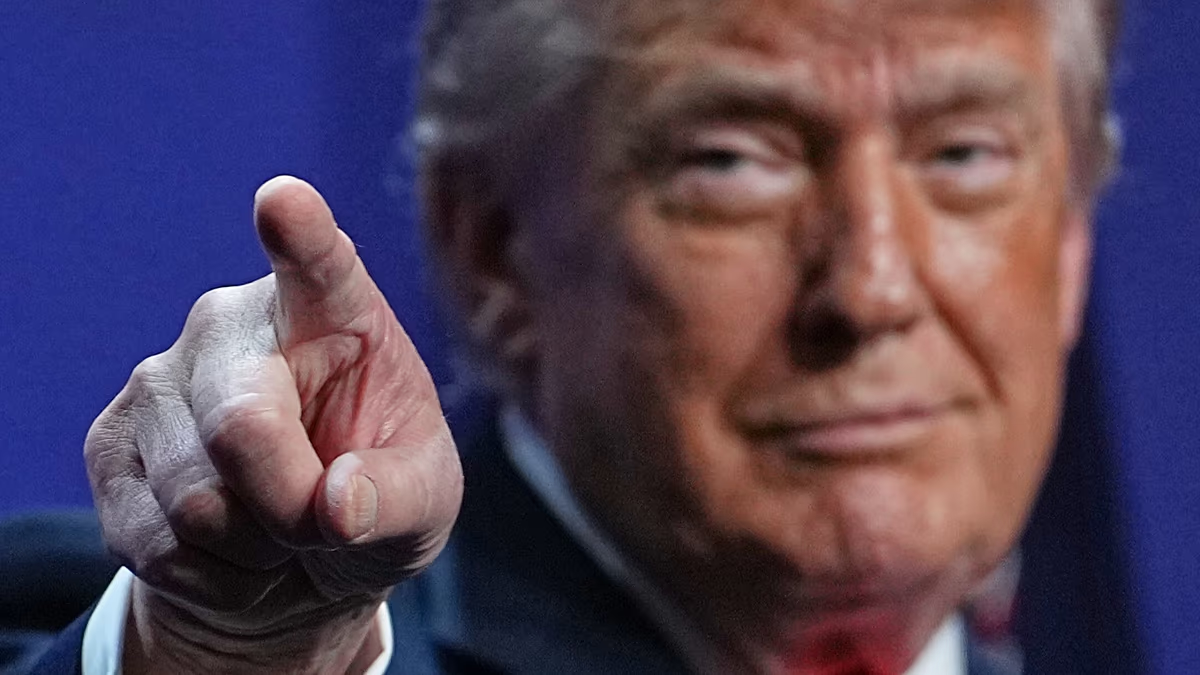
In a recent campaign rally held at The Villages in Florida, former President Donald Trump once again returned to a familiar and personal theme: defending his cognitive sharpness. Addressing a crowd of supporters, the 79-year-old reiterated his claim to have “aced” a series of mental assessments, a boast seemingly aimed at countering the persistent public and media scrutiny regarding his age and mental fitness. His decision to spotlight this issue, unprompted by a direct question from the audience, underscores how central these concerns have become in the contemporary political dialogue, particularly as he positions himself for another presidential run. By framing his cognitive abilities as not just intact but exceptional, Trump attempts to transform a potential vulnerability into a point of pride and distinction.
To illustrate the nature of these tests, Trump described them with a mix of simplicity and implied complexity. He began with an example he deemed “very easy”: identifying a bear from a list of animals including a lion, giraffe, and shark. He then contrasted this with what he presented as the more formidable final segment of the exam. “There’s a very standard test, but very tough around those last 10 questions,” he told the audience, adding, “I’m in a room of brilliant people, but a lot of you wouldn’t have been able to answer those 10 questions.” His chosen example of a “tough” question was a multi-step arithmetic problem: starting with the number 99, multiplying by 9, dividing by 3, adding 4,293, dividing by 2, subtracting 93, and finally dividing by 9. He concluded with familiar bravado: “There aren’t a lot of people that get it right. I got it right.”
However, this specific anecdote immediately sparked widespread skepticism and became a focal point for online commentary and fact-checking. While the arithmetic sequence he described does indeed resolve to approximately 244.666 (99 x 9 = 891, ÷ 3 = 297, + 4293 = 4590, ÷ 2 = 2295, – 93 = 2202, ÷ 9 = 244.666…), the very nature of the question struck many observers as incongruous for a clinically recognized cognitive screening tool. Standard assessments like the Montreal Cognitive Assessment (MoCA) do include elements of calculation, but they are typically far simpler, designed to quickly evaluate basic functions, not to serve as a complex math puzzle. The theatrical delivery and the specific numbers chosen led many to question whether Trump was accurately recalling a real test or constructing a rhetorical example to demonstrate his supposed intellectual prowess.
The doubts about his account were almost instantly compounded by a subsequent statement he made during the same speech. While touting “record-setting discounts” for Americans, Trump made a glaring error in describing them, citing “400 per cent, 500 per cent and 600, 700, and even sometimes, 800 per cent reductions.” He then attempted to clarify, stating, “Some people would say it’s 80, 90, 70 – it depends on the way you phrase the statement – but it could be 500, 600 per cent, it could be 90 per cent, it doesn’t matter.” This revealed a fundamental misunderstanding of percentages, as a 100% reduction means an item becomes free, and reductions over 100% are mathematically incoherent in this context. This mistake did not go unnoticed, drawing pointed criticism from political figures like Senator Elizabeth Warren and Governor Gavin Newsom, who highlighted the error to underscore questions about his grasp of basic concepts.
The online reaction to this sequence of events was a blend of ridicule, concern, and weary familiarity. Social media platforms were flooded with memes, corrections, and satirical takes, with the arithmetic problem being worked out in real-time by thousands. The juxtaposition of the “I aced the test” claim with the immediately following percentage gaffe created a perfect storm for critics, who saw it as evidence undermining the very assertion he was trying to prove. This episode transcends a mere gotcha moment; it reflects the deeply polarized environment where every statement is dissected, and where assertions of fact, especially those pertaining to a leader’s capability, become immediate battlegrounds for political narratives. For his supporters, it may be dismissed as another example of Trump’s unconventional style; for his detractors, it is clear evidence of a troubling pattern.
In the end, this rally moment is a microcosm of the broader political culture. It highlights how personal attributes like cognitive health have become frontline issues in electoral politics, debated not in doctors’ offices but on rally stages and social media feeds. Trump’s insistence on narrating his own mental acuity tests, complete with questionable examples, speaks to a campaign strategy that directly engages with perceived attacks by attempting to overwhelm them with confidence. Meanwhile, the fervent public dissection of his mathematical claims—even the lighthearted trans-Atlantic aside on “math” versus “maths” that followed in some reports—shows an audience intensely engaged in parsing every word for meaning and error. The true takeaway may not be found in the answer to 99 multiplied by nine, but in the undeniable fact that in today’s political arena, such performances are no longer sidelights; they are central to the story we tell about our leaders and the vigor with which we debate their fitness to serve.