



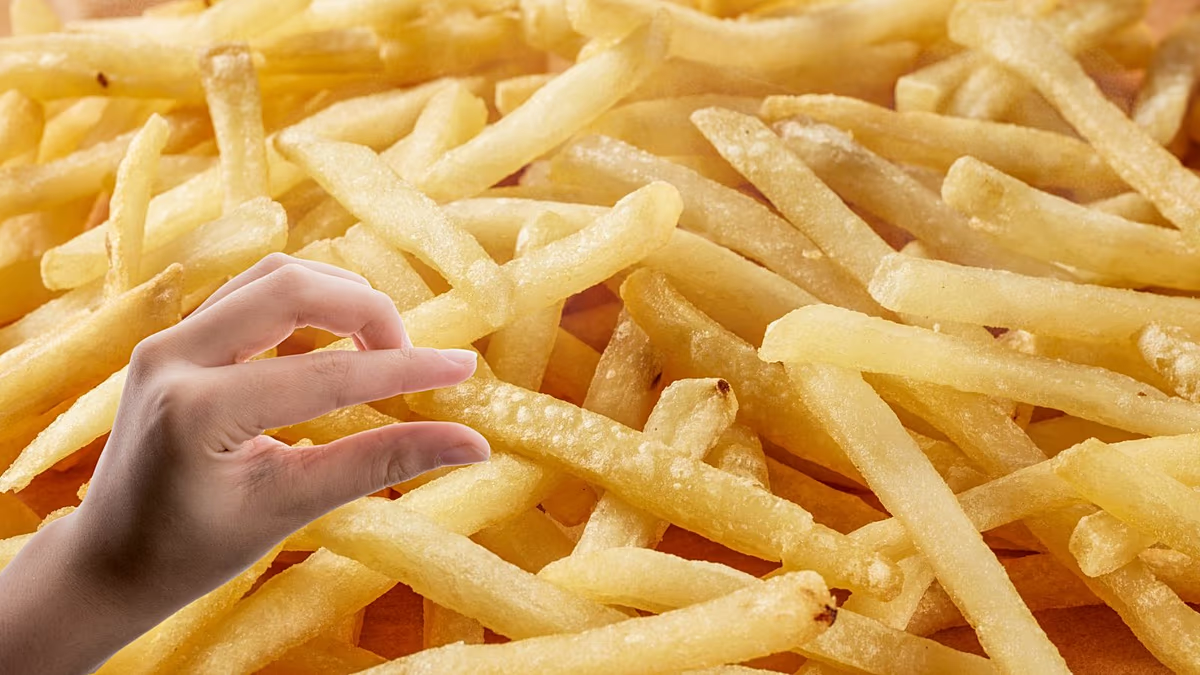
Of all the foods that forge connections across dinner tables, few are as universally cherished as the humble chip. Golden, crispy, and savoury, a shared portion represents a simple, joyful communion. Yet, nestled within this bond of golden grease lies a common betrayal: the act of the chip thief. We know the scene well. A companion solemnly refuses your offer to share, claiming contentment with a healthier alternative. But once the fragrant, steaming fries arrive, their resolve crumbles. What begins as a tentative request for “just one” inevitably escalates into a series of polite pilfers, leaving you, perhaps upon returning from a brief absence, staring into a basket holding nothing but a few sad, soggy stragglers. This specific, mundane transgression sparked curiosity among researchers at the Russian Medical Academy, leading them to investigate a tantalizing question: could the very act of stealing, that moral transgression, actually enhance the pleasure of the food itself?
To explore this idea, researchers designed a clever experiment involving 120 participants, as detailed in the journal Food Quality and Preference. The study methodically measured the perceived deliciousness of the same chips under different social conditions. Participants first tasted chips served directly to them, establishing a baseline. They then ate chips offered freely by another person. The critical phase followed, where individuals were asked to secretly steal chips from a fellow participant in two scenarios: one with a high risk of getting caught, and another with a low risk. After each tasting, they rated the chips on qualities like flavour, crispiness, and saltiness on a scale of one to nine. The results were strikingly consistent: the stolen chips were rated the highest. Moreover, the perceived reward intensified with the danger; chips taken in the high-risk scenario were rated as 40% more flavourful, crispier, and saltier than those simply handed over. The thrill of the sneaky act, coupled with a dash of guilt, seemingly seasoned the fries better than any salt shaker could.
This phenomenon can be partly explained by what psychologists term a “scarcity mindset.” When we perceive something as limited or in danger of being lost—like a finite basket of fries being raided by a friend—our brain can shift into a more competitive, impulsive mode, hyper-focusing on acquiring that resource. The forbidden element supercharges this effect, a principle often called the “forbidden fruit effect.” When a treat is placed off-limits, either by social rules or by another person’s ownership, our desire for it is powerfully amplified. The study suggests that in the moment of transgression, this mindset can even temporarily dampen our empathy for the victim of our snack theft. The combined neurological rush of securing a scarce, forbidden item under perceived risk creates a potent cocktail that hijacks our reward circuits, making the chip not just a tasty snack, but a prize.
The researchers concluded that their findings help expand our understanding of how everyday, minor transgressions engage these deep-seated reward pathways in the brain. It provides a fascinating lens into behavioural psychology, illustrating how context and action are inextricably linked to perception and pleasure. The act of stealing transforms a simple potato product into a multisensory experience layered with risk, strategy, and triumph. This isn’t merely about hunger; it’s about the engaging narrative we create around consumption. The study peels back the layers on the complex thought processes that underpin even our most casual eating habits, revealing that how we get our food can be as important to our enjoyment as the food itself.
Of course, this scientific insight offers little consolation to the perennial victim of chip theft, who may still view the empty basket with a sense of betrayal. Yet, for the culprit, it provides a delightful, if not entirely absolving, excuse. The next time a hand sneaks across the table, they can claim, with some academic backing, that the chip’s enhanced deliciousness was simply irresistible—a perfect storm of crunch, salt, and psychological intrigue. The stolen fry wasn’t just eaten; it was earned, making its flavour uniquely intense.
Ultimately, this playful research underscores a deeper truth about shared human experiences. The low-stakes drama of the shared chip basket is a miniature theatre of desire, restraint, and social negotiation. It reminds us that our foods, especially those as simple and shared as fries, are rarely consumed in a vacuum. They are embedded in stories, relationships, and tiny psychological games. So, while science has now explained why your friend’s stolen chips taste better, the age-old advice still holds: if you want to enjoy your full portion in peace, it’s best to guard your basket vigilantly—or, more wisely, simply order two.