


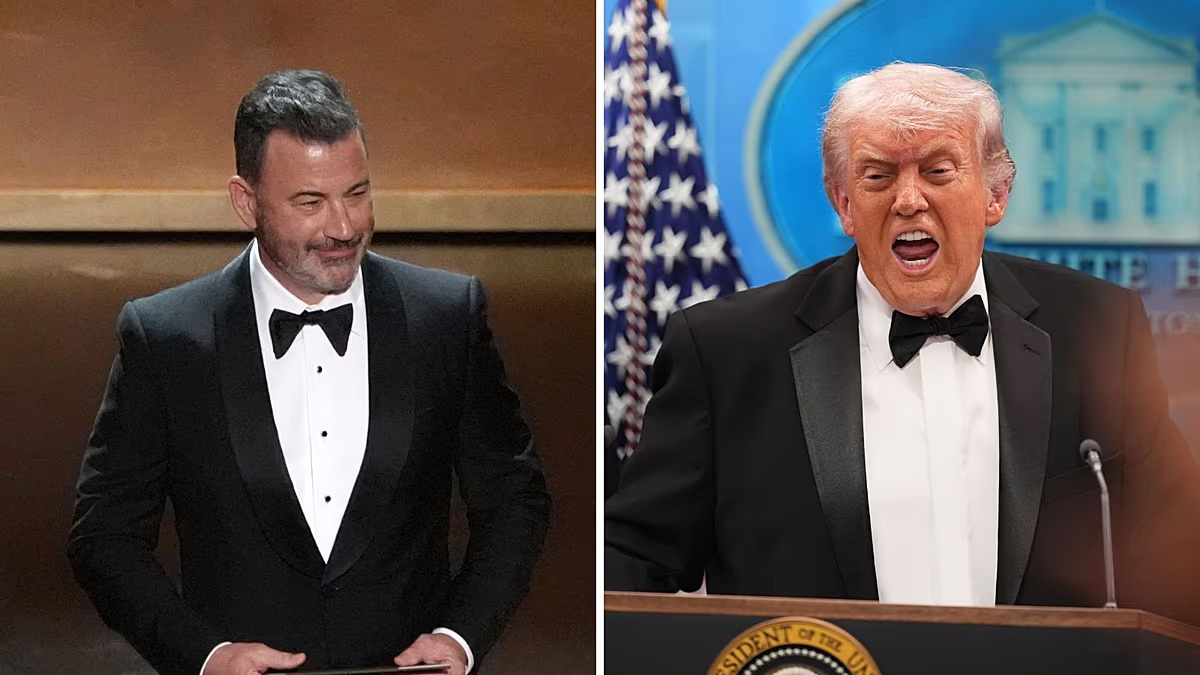
In an unprecedented move that has sent shockwaves through American media and political circles, the U.S. Federal Communications Commission (FCC) has accelerated license renewal reviews for Disney-owned ABC television stations, a decision widely interpreted as direct retaliation against talk show host Jimmy Kimmel. Originally scheduled for October 2028, these reviews have been abruptly brought forward following intense political pressure from the Trump administration, which has publicly demanded Kimmel’s dismissal. The flashpoint was a monologue on Jimmy Kimmel Live! in which the host made a joke about former First Lady Melania Trump, saying she had “a glow like an expectant widow” in the days preceding the White House Correspondents’ Dinner, an event later marred by a shooting. While Disney has stated its commitment to complying with FCC regulations and defending its First Amendment rights, the agency’s intervention represents a stark escalation in the long-running conflict between the entertainment industry and political figures who perceive satirical commentary as a personal and national threat.
The reaction from the Trump family was swift and severe. Melania Trump took to social media to condemn Kimmel’s “hateful and violent rhetoric,” arguing that his words were corrosive and intended to deepen America’s political divisions rather than serve as harmless comedy. She called on ABC’s leadership to finally take a stand against behavior she deemed “atrocious.” This is not the first time Kimmel has faced such demands; he was briefly taken off air last year following comments about political commentator Charlie Kirk. In his defense, Kimmel clarified that his joke about Melania was a “very light roast” focused on the couple’s significant age difference, vehemently denying it was any form of call to violence. “It was not by any stretch of the definition a call to assassination,” he stated. The online backlash to Melania’s statement was immediate, with many users accusing her of hypocrisy and highlighting the disproportionate response to a comedian’s standard satirical fare.
The FCC’s order has ignited a fierce constitutional debate, placing the principles of free speech and press freedom squarely in the spotlight. Democratic FCC Commissioner Anna M. Gomez lambasted the decision as a “political stunt,” declaring it “unprecedented, unlawful, and going nowhere.” She urged broadcast companies to challenge the order head-on, asserting that the First Amendment was firmly on their side. This sentiment was echoed by advocacy groups like the Freedom of the Press Foundation, which characterized the FCC’s actions as a direct “attack on the First Amendment.” The foundational American guarantees concerning freedom of expression, religion, assembly, and petition now form the core of the legal and philosophical battle brewing between the regulatory body and the network, setting a precarious precedent for government intervention in editorial content.
Amidst the political and legal turmoil, prominent figures from the entertainment world have rallied to Kimmel’s defense, emphasizing the essential role of comedy and satire in public discourse. Actor and filmmaker George Clooney offered a robust defense of Kimmel at the recent Chaplin Award Gala, succinctly noting that “jokes are jokes.” Clooney drew a pointed parallel to a remark made by White House Press Secretary Karoline Leavitt ahead of the Correspondents’ Dinner, where she anticipated “some shots fired tonight in the room” in reference to planned political jabs. “She was making a joke. Fair enough,” Clooney stated, arguing for consistency. He acknowledged the perils of extreme rhetoric in contemporary politics but insisted that distinguishing between metaphorical comedy and genuine incitement is crucial for a healthy democracy.
This controversy transcends a single comedian’s monologue; it touches on deeper anxieties about power, media integrity, and the chilling effect of political retribution on creative expression. The accelerated license review process acts as a potent tool of intimidation, suggesting that broadcasters could face punitive regulatory measures for airing content that displeases the sitting administration. For a network like ABC, this creates an untenable position: navigate the treacherous waters of political appeasement or invest significant resources in a protracted legal fight to uphold its constitutional rights. The situation underscores a dangerous blurring of lines where regulatory oversight, designed to ensure public interest, is potentially wielded as a cudgel to silence criticism and satire.
Ultimately, the clash over Jimmy Kimmel’s joke encapsulates the intense cultural and political polarization defining modern America. It is a conflict between the prerogatives of a comedian to critique power and the desire of political figures to control their public narrative and retaliate against perceived disrespect. As Disney prepares its legal response and advocacy groups sound the alarm, the outcome will resonate far beyond late-night television. It will serve as a critical test case for the resilience of the First Amendment in an era where political discourse is increasingly fraught, and the boundaries of acceptable speech are constantly contested. The nation now watches to see whether comedic satire will be upheld as a protected pillar of free expression or curtailed by the leverage of governmental authority.