



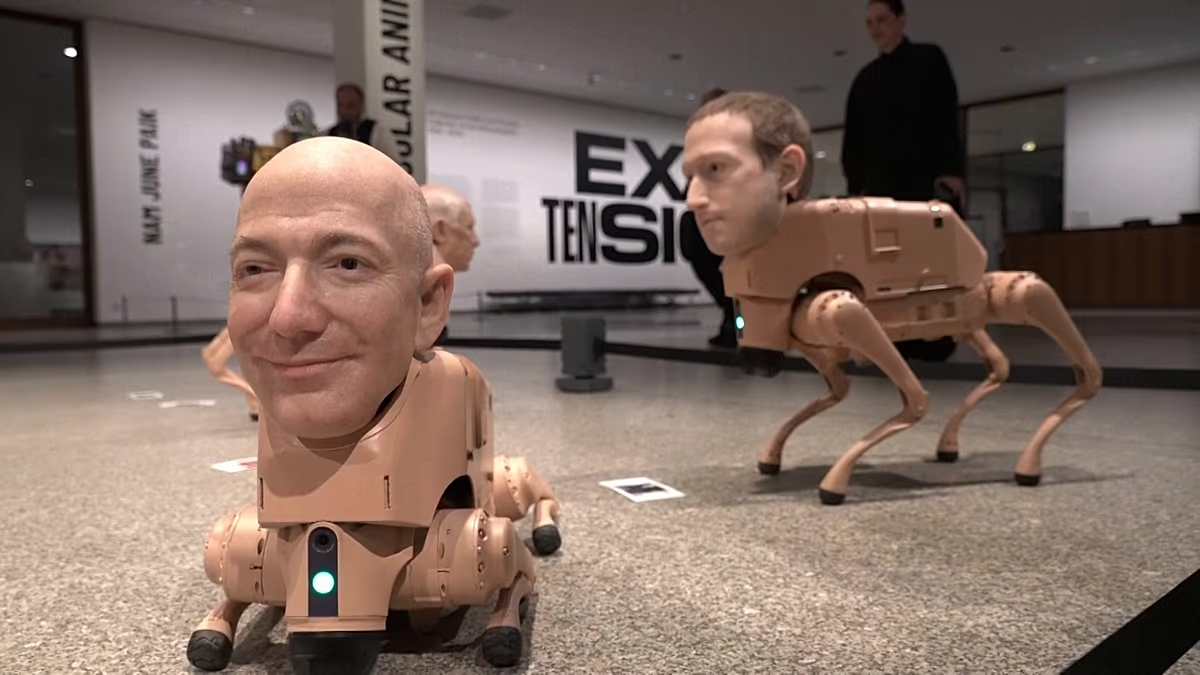
In the stark, modern expanse of Berlin’s Neue Nationalgalerie, a pack of strange creatures roams. These are not living beings, but robotic dogs, their mechanical bodies moving with a restless, programmed energy. What renders them truly uncanny, however, are their faces. Silicone masks, crafted with hyper-realistic precision, depict some of the most influential—and controversial—figures of our time: tech titans Elon Musk, Mark Zuckerberg, and Jeff Bezos stare blankly ahead. They are joined by artistic icons Andy Warhol and Pablo Picasso, and even by the creator of this spectacle himself, the digital artist known as Beeple. This is “Regular Animals,” an installation by Mike Winkelmann (Beeple) that serves as both a dazzling technological feat and a sharp, satirical mirror held up to our algorithmic age.
The spectacle deepens as the machines perform their primary function. Each robot is equipped with cameras, acting as its eyes. It captures snippets of its surroundings—the gallery architecture, the watching visitors, other robots. This visual data is then fed into an artificial intelligence system, which processes and transforms it according to a pre-set aesthetic linked to the face it wears. The culmination of this act is deliberately, provocatively absurd: with a whirring sound, each robot “digests” this information and excretes a small, printed piece of AI-generated art. The Picasso dog produces a fractured, cubist interpretation; the Warhol dog outputs a repetitive, pop-art styled image. The act reduces the profound creative process to a mechanical bodily function, a crude and humorous metaphor for how content is now consumed and produced.
Beeple’s central thesis, explained alongside the exhibition, is a profound commentary on a seismic shift in cultural power. He argues that for centuries, humanity’s perception of reality was shaped by the visions of artists and thinkers. Picasso’s fragmented forms changed how we see dimension; Warhol’s soup cans altered our understanding of art and consumerism. Today, however, that formative power has largely been transferred to the owners of digital platforms and the opaque algorithms they command. What we see on our screens—the news, the art, the social interactions—is curated by lines of code designed by a handful of corporations. These “Regular Animals,” these billionaires-tuned-technocrats, now wander the landscape of our attention, defining our reality not with brushes, but with binary decisions.
This shift carries an alarming democratic deficit, a point Beeple underscores with chilling clarity. When a visionary artist or a political leader wishes to change society, they must engage with institutions, build consensus, and navigate public discourse. The new algorithmic curators face no such checks. “They just wake up and change these algorithms,” Beeple notes. A single update can alter the flow of information, reshape public opinion, or silence voices for billions of people, all without a vote, a hearing, or a transparent explanation. The installation embodies this unease: the robots operate autonomously, following their own internal logic, their “excretions” a literal output of a process we witness but do not control. They are powerful, fascinating, and fundamentally unaccountable.
The choice of Beeple as the artist for this reflection is particularly apt. He is not an outsider to the digital realm but one of its most celebrated pioneers. A graphic designer who founded the “everyday” movement in digital art, he famously created and posted a new piece of art online every single day for over a decade. His groundbreaking sale of a purely digital artwork for $69 million at Christie’s cemented his status as a central figure in the NFT and digital art revolution. He is, in many ways, a product of the very ecosystem he critiques. By including his own likeness among the robotic pack, he implicates himself in this new world order, acknowledging his own role and influence within the digital landscape that “Regular Animals” scrutinizes.
Curator Lisa Botti’s decision to house this work in a major museum is significant. She positions the museum as a vital arena for society to confront and dissect the forces reshaping it. “Regular Animals” is not just an art show; it is a public forum in mechanical form. It makes the abstract, invisible power of algorithms tangible, visceral, and strangely grotesque. As visitors watch the Musk-faced dog churn out an image or the Zuckerberg-bot patrol its territory, they are forced to grapple with the absurdity and the enormity of our current moment. Beeple’s work, in the end, is a potent reminder that while technology evolves at a breakneck pace, our ancient need to understand who shapes our world—and to question their motives—remains fundamentally, importantly human.