



The global artificial intelligence landscape continues to accelerate at a breathtaking pace, and a significant new contender has just entered the ring. On April 24, 2026, the Chinese AI company DeepSeek unveiled a preview of its latest large language model, DeepSeek V4. This announcement directly contributes to the intensifying technological race, showcasing the company’s commitment to advancing AI capabilities while strategically focusing on efficiency and accessibility. The release is built upon the foundation of attention DeepSeek garnered last year, when its earlier models demonstrated remarkably strong performance at a fraction of the computational cost of many established U.S. rivals. Based in Hangzhou, DeepSeek is positioning itself not just as a competitor, but as a pragmatic innovator challenging the status quo of how powerful AI is built and deployed.
DeepSeek’s new model comes in two distinct flavors, each designed for specific needs. The flagship is DeepSeek V4-Pro, a larger, more powerful model aimed at tackling complex and demanding tasks. Alongside it, the company released V4-Flash, a streamlined version engineered for speed and reduced operational costs, making advanced AI more accessible for applications where instant response is critical. The company proudly announced that in benchmarks testing world knowledge, V4-Pro significantly outpaces other open-source models and is competitive with top-tier closed-source systems like Google’s Gemini-3.1-Pro. Perhaps its most groundbreaking claimed feature is its support for a “one-million token context length.” In simpler terms, this means the AI can digest and reason over immense amounts of information at once—entire lengthy novels, extensive codebases, or vast collections of documents—before formulating a response, a capability that dramatically expands its potential uses.
This leap in context length is paired with a focus on practical economics. DeepSeek isn’t just chasing raw power; it’s championing efficiency. The company proclaimed a “welcome to the era of cost-effective 1M context,” arguing that V4 achieves this world-leading long-context capability with drastically reduced demands on computing power and memory. By making the model available for download and free testing on the open-source platform Hugging Face, DeepSeek reinforces its reputation for a more transparent and community-oriented approach compared to rivals who keep their core technology under lock and key. This openness allows developers worldwide to experiment with, adapt, and integrate V4 into their own projects and popular AI agents, extending its utility far beyond DeepSeek’s own chatbot interface.
DeepSeek’s rise to prominence has been both rapid and disruptive. The company first turned industry heads in late 2024 with its open-source V3 model, which delivered surprising performance while using less sophisticated hardware than its American counterparts. This momentum continued into January 2025 with the release of R1, a reasoning model that DeepSeek claimed matched the abilities of OpenAI’s ChatGPT but at a lower cost. However, this ascent has not been without controversy and geopolitical friction. Several nations, including Italy, the United States, and South Korea, have banned the use of DeepSeek by government agencies, citing national security concerns. Germany took the further step in 2025 of banning the app from Apple and Google stores, alleging illegal data transfers to China.
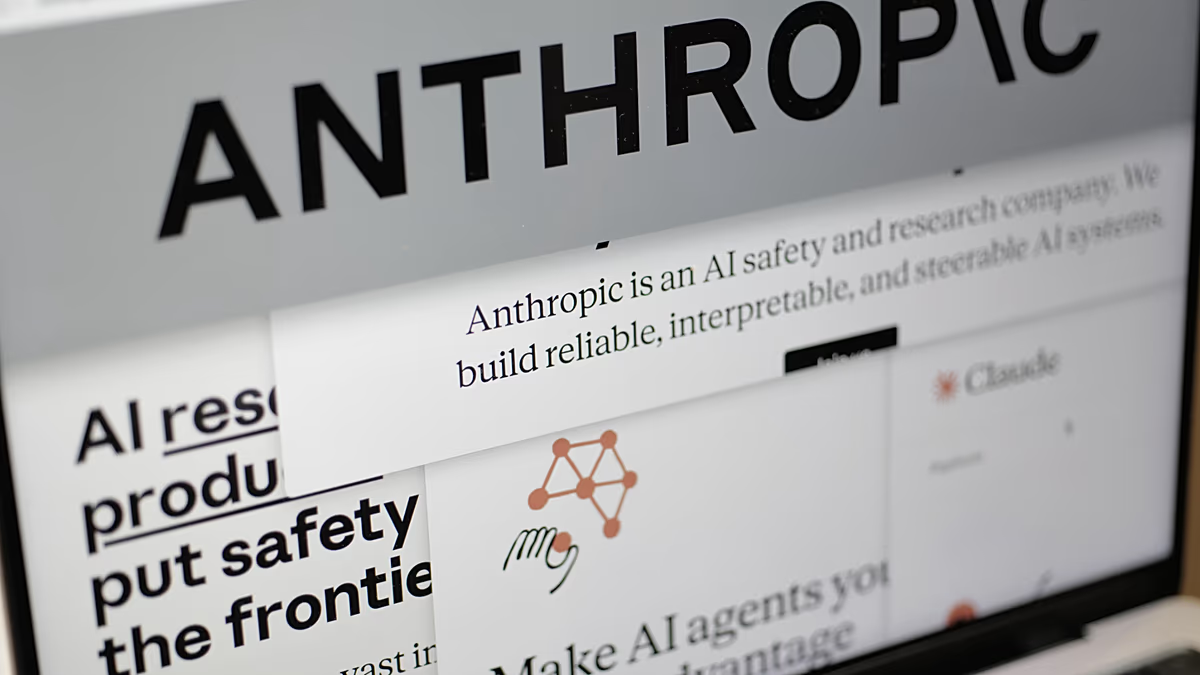
The timing of the V4 release is particularly charged, arriving in the midst of heightened tensions. It was launched just one day after U.S. giant OpenAI debuted its own latest model, GPT-5.5, which it touted as its smartest and most intuitive creation yet. Furthermore, it followed fresh accusations from the White House alleging China of orchestrating industrial-scale intellectual property theft from American AI labs. Leading U.S. firms like OpenAI, Anthropic, and Google have specifically warned about “model extraction attacks” — a technique where a company’s proprietary AI is queried relentlessly to create a copycat model — and have pointed to Chinese firms, including DeepSeek, as practitioners of this method. This creates a backdrop where every technical advance is also viewed through a lens of strategic competition and mistrust.
In conclusion, the unveiling of DeepSeek V4 represents more than just a technical milestone; it is a significant move in the complex, multidimensional chess game of global AI dominance. The model itself, with its formidable long-context prowess and emphasis on cost-effectiveness, challenges the resource-intensive paradigms of Western leaders. Yet, its release is inextricably linked to the broader narrative of technological sovereignty, espionage allegations, and trade restrictions. As DeepSeek continues to push the boundaries of what open, efficient AI can achieve, it simultaneously forces a global conversation about the future of innovation: whether it will be defined by open collaboration, closed competition, or a deeply divided landscape where technological prowess and geopolitical rivalry are forever intertwined. The race is not only about who builds the smartest AI, but also about who defines the rules of the road.