



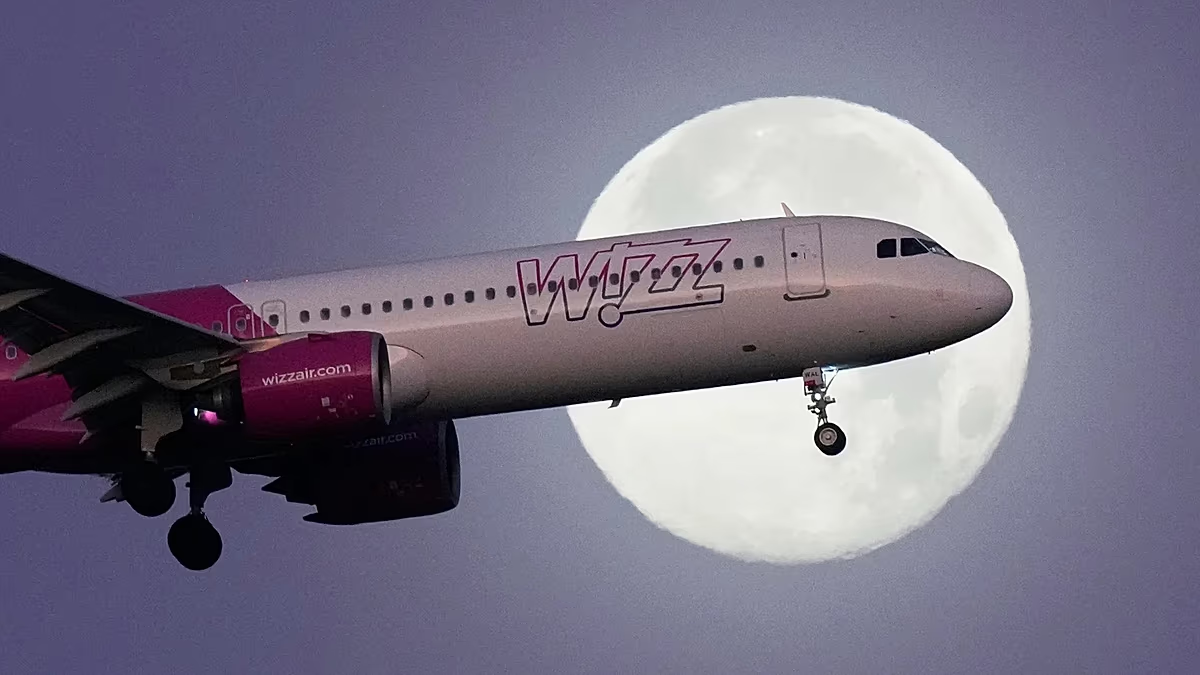
In an industry where the passenger experience has been meticulously segmented, the announcement that Wizz Air will equip its entire fleet with Elon Musk’s Starlink satellite internet marks a significant shift. The Hungarian ultra-low-cost carrier (ULCC) has declared it will bring the service to its aircraft starting in 2027, directly challenging the long-held notion that such high-speed connectivity is the exclusive domain of full-service and long-haul airlines. This move places Wizz Air at the forefront of a growing, yet still selective, wave of adoption across European aviation. By aligning itself with a technology leader like Starlink, Wizz Air is signaling an ambitious evolution of its brand philosophy. As Ian Malin, the airline’s Chief Commercial Officer, stated, “Ultra-low-cost travel has always been about making opportunities accessible to more people. In 2027, we’re taking that philosophy into the space era.” This frames inflight connectivity not as a luxury, but as the next essential amenity to be democratized for the budget traveler.
Wizz Air is not alone in recognizing this potential for the budget segment, though it is making one of the most comprehensive commitments. Notably, Eurowings, another European low-cost operator under the Lufthansa Group umbrella, is slated to begin its own Starlink rollout later this year. This creates a fascinating competitive dynamic within the budget sector. While the question of which ULCC is truly “first” may depend on technicalities of deployment scale and timing, the direction is clear: a new battleground for passenger loyalty is opening in the skies above Europe. However, critical details of Wizz Air’s plan remain undisclosed, most importantly whether the internet service will be offered free of charge or as a paid add-on. This decision is paramount for an airline whose brand is built on razor-thin margins and cost-conscious customers. The ultimate value proposition—whether connectivity is bundled into the fare or sold separately—will determine how deeply this venture resonates with its passenger base and impacts its financial model.
The broader context for this announcement is one of meteoric growth for Starlink’s aviation division. As SpaceX, its parent company, prepares for a high-profile debut on the Nasdaq stock exchange, its commercial aviation partnerships are expanding at a remarkable pace. The service has already gained considerable traction with major U.S. carriers, including American Airlines, Southwest, United, and Alaska Airlines, establishing a strong foothold in the world’s largest aviation market. Furthermore, prestigious long-haul operators like Singapore Airlines and Emirates have signed on, leveraging the technology to enhance their premium offerings. In Europe, the adoption curve has been steepening, with airBaltic claiming the title of first European airline to launch the service in February 2025, quickly followed by legacy carriers such as Air France, SAS, and British Airways. This global rollout underscores a growing industry consensus on the reliability and performance of satellite-based inflight internet.
In Asia, the momentum continues, with South Korea’s Hanjin Group—encompassing Korean Air, Asiana Airlines, and three budget carriers—announcing a major Starlink deal in December 2025. Their rollout, expected from the third quarter of 2026, indicates that the technology is becoming a global standard airlines feel compelled to adopt to remain competitive. This makes the calculated hesitation of Wizz Air’s most direct European ULCC rivals all the more striking. Ryanair, the continent’s largest budget airline, has explicitly ruled out Starlink for the foreseeable future. CEO Michael O’Leary has pointed to the significant installation costs, the potential “fuel drag” from the equipment, and the short average duration of Ryanair’s flights as reasons the economics simply don’t add up. Similarly, EasyJet has confirmed it has held talks with Starlink but concludes that the financial case does not yet stack up for its model. This divergence highlights a fundamental strategic rift within the budget airline sector regarding the value and priority of inflight connectivity.
For Wizz Air, this bold investment comes at a pivotal financial moment. The airline is due to release its results for the 2026 financial year, having previously guided the market to expect a break-even or slightly positive profit outcome. The commitment to a fleet-wide Starlink installation represents a major capital expenditure that will be scrutinized by investors. The airline’s ability to successfully integrate this cost while maintaining its ultra-low-cost base will be a key test of its operational and commercial strategy. The move can be interpreted as a forward-looking bet on the future of air travel, where seamless connectivity is no longer a perk but a baseline expectation, even on short-haul budget routes. It is a gamble aimed at differentiating Wizz Air’s product, potentially attracting a more digitally-dependent clientele, and increasing ancillary revenue opportunities—if the service is paid—all while staying true to its mission of expanding accessibility.
Ultimately, Wizz Air’s partnership with Starlink is more than a simple service upgrade; it is a statement of intent. By bridging the gap between ultra-low-cost travel and cutting-edge technology, the airline is attempting to redefine the boundaries of its market segment. While rivals Ryanair and EasyJet watch cautiously from the sidelines, prioritizing immediate cost calculus, Wizz Air is betting that the long-term benefits of customer satisfaction, brand perception, and competitive differentiation will outweigh the substantial upfront investment. As 2027 approaches, the industry will be watching closely to see if this venture proves to be a visionary step into the “space era” of budget travel or a costly lesson in the delicate economics of being a ultra-low-cost carrier. The success of this endeavor will hinge on those unanswered questions of pricing, passenger uptake, and the delicate balance between enhanced experience and the sacred low fare.