


In an era defined by the breathtaking ascent of artificial intelligence, a rare and remarkable consensus is emerging across the ideological spectrum: the public must have a stake in this transformative technology. From AI mogul Sam Altman and progressive firebrand Bernie Sanders to former President Donald Trump, these vastly different figures all advocate for some form of public benefit from the AI boom. Their unexpected alignment underscores a fundamental recognition that a technology poised to reshape economies, security, and daily life cannot be an exclusive private domain. Yet, as their recent interactions reveal, this superficial agreement masks a deep and contentious divide over the crucial details—most notably, how much of a stake the public should claim and what form that ownership should take. The debate has moved from philosophical discussions to concrete policy proposals, placing Washington and global capitals at the center of a defining struggle over the future of power and prosperity in the 21st century.
The contours of this debate were laid bare in a recent, nearly hour-long meeting between OpenAI CEO Sam Altman and Senator Bernie Sanders. At Sanders’ invitation, Altman visited the senator’s office to discuss a bold proposal: that the public take a 50% ownership stake in major AI companies, with the resulting profits funding a national wealth fund. While Altman expressed support for the general principle of public benefit, he stopped short of endorsing the 50% threshold, a level that would grant substantial public decision-making power. This high-stakes discussion highlights the growing political pressure to ensure the AI revolution does not merely concentrate wealth but distributes its gains. The anxiety fueling this pressure is palpable, particularly among younger generations; polls show about 70% of college students view AI as a threat to their future employment. As Sanders’ spokesperson later noted, no agreement was reached, with Altman leaving the meeting calling it “great” but acknowledging, “we obviously don’t agree on everything.”
This American deliberation is echoing loudly across the Atlantic, where European governments are taking even more direct and sweeping action to assert control. European Commission President Ursula von der Leyen recently unveiled a proposal that would bar tech giants like Amazon, Microsoft, and Google from the EU’s most sensitive government contracts while aiming to triple European data centre capacity within seven years. Her statement captured the strategic imperative driving these moves: “We cannot afford to depend on others for the technologies that keep our hospitals running, our energy grids stable and our services secure.” Similarly, the UK has launched a £500 million Sovereign AI Fund to invest directly in domestic companies and reduce foreign reliance. These initiatives reflect a deep-seated belief that critical technological infrastructure is too vital to be left solely in private, often foreign, hands—a logic now being rigorously applied to the AI domain.
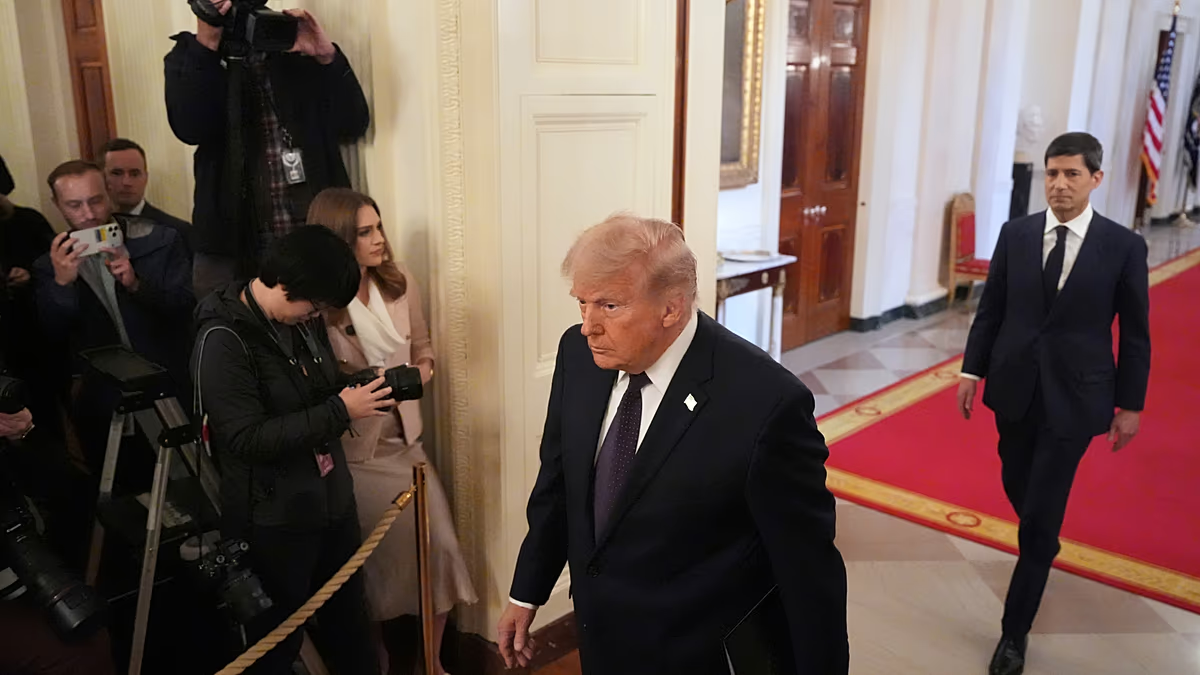
Perhaps the most politically startling voice in this chorus is that of Donald Trump, who recently mused about a partnership “where the American people can benefit from the success of AI.” Speaking to reporters, he described a vision where the public becomes a partner in the AI revolution, calling it “a beautiful thing.” When journalists pointed out the parallel with Sanders’ ideas, Trump pointed to similarities in their voter bases, stating, “as far as economics are concerned, we have certain things that aren’t that far apart.” This stance distinguishes him from traditional Republican orthodoxy on government intervention and is consistent with his administration’s actions, such as taking a stake in chipmaker Intel. His comments reveal how the disruptive nature of AI is scrambling long-held political binaries, creating unexpected alliances around the need for state involvement in guiding technological development.
History offers a powerful lens through which to view this contemporary standoff. Today’s debates over AI governance mirror past conflicts that arose when other transformative technologies—like railroads and electricity—became essential to modern life. In the late 19th century, public fury over the exploitative practices of railroad “robber barons” led to the first federal industry regulations and landmark antitrust legislation. Europe’s postwar experience provides another template; governments nationalized critical industries like energy, coal, and finance, arguing that infrastructure too powerful to fail was too important to remain in private hands. In France, for instance, the fragmented and inefficient private electricity system was consolidated into the state-controlled Électricité de France. The core argument then, as now, was about who should benefit from a technology that underpins societal function—a question being resurrected with urgent relevance for the AI age.
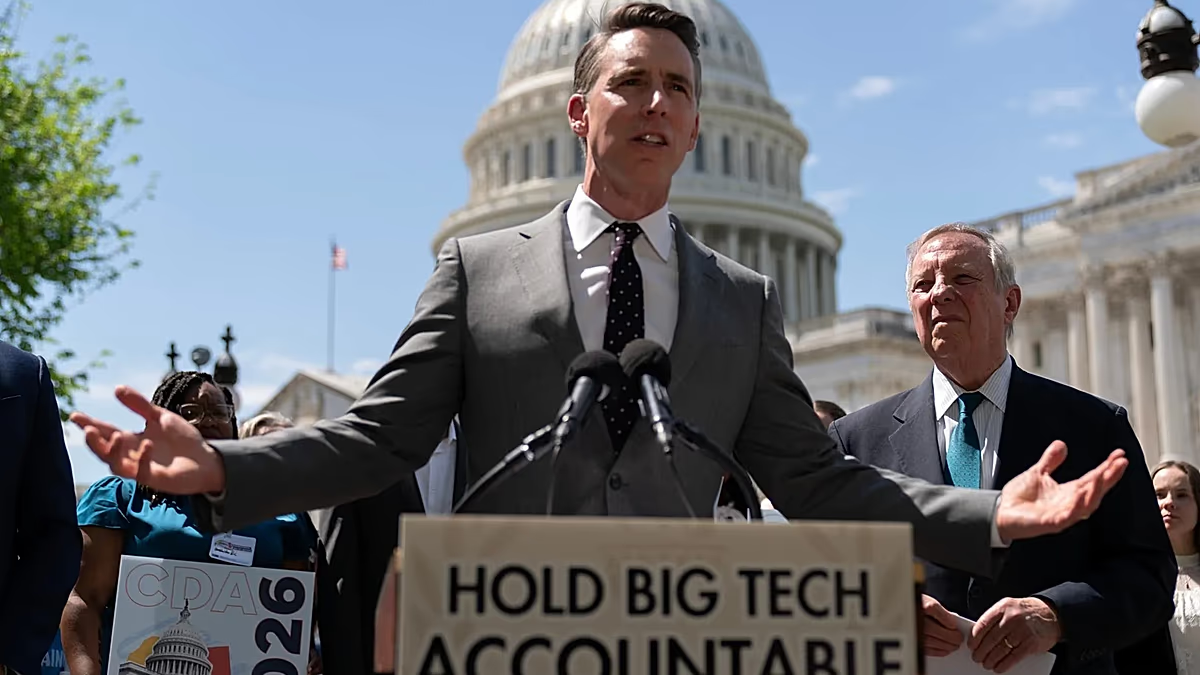
As the discussion evolves from principle to policy, the path forward remains fraught with complexity. Beyond ownership stakes, proposals are emerging to manage AI’s risks and externalities. Some, like AI firm Anthropic, suggest mechanisms for coordinating pauses in development if systems grow too powerful. Politicians like Republican Senator Josh Hawley have called for halting data centre expansion until companies bear the full cost of their substantial energy and water usage. The Trump administration has instituted processes to review national security risks before advanced AI systems are released. For proponents of public oversight like Bernie Sanders, these developments signal a shift in the wind. “Even these guys are beginning to catch on that there are legitimate concerns that have to be dealt with,” he noted with satisfaction. The fundamental question is whether the architects of this technology and its governmental overseers can forge a workable model—one that harnesses AI’s incredible potential while ensuring its prosperity and power are shared, not concentrated. The answer will define the next chapter of the digital age.