

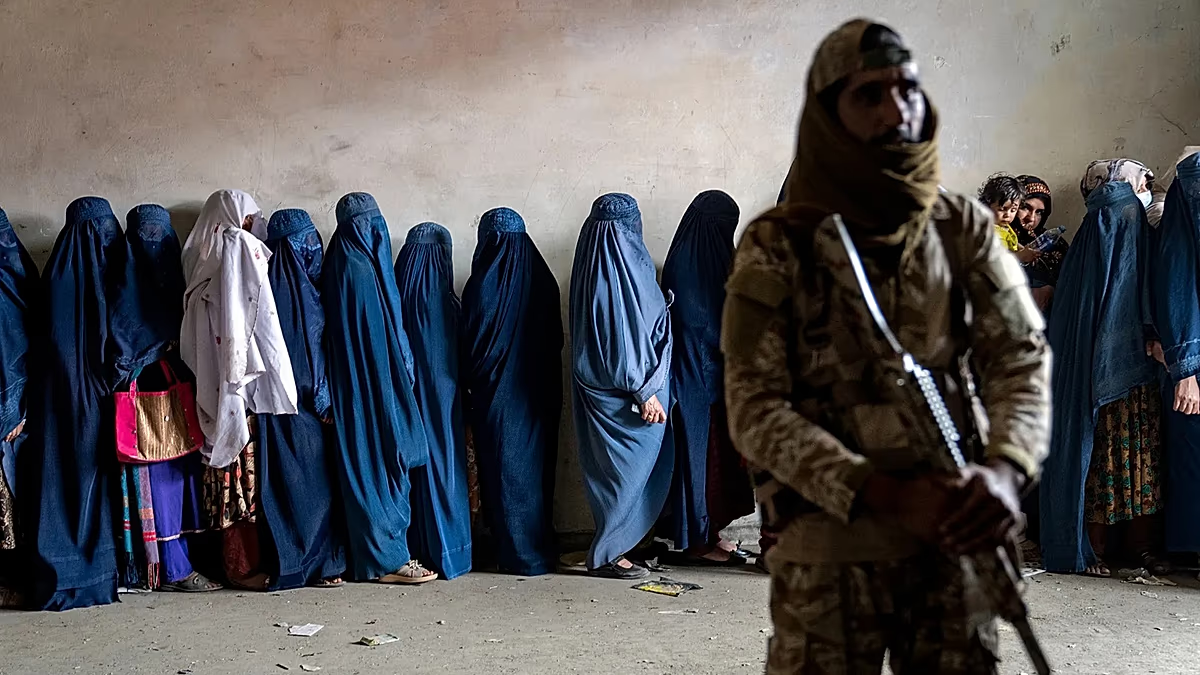
In the western Afghan city of Herat, a palpable climate of fear has descended upon women following a recent and severe crackdown by Taliban authorities over their attire. According to firsthand accounts from residents speaking to the AFP news agency, morality police officials have been detaining women on the streets for allegedly failing to comply with the regime’s strict dress code. These witnesses, who spoke anonymously for their own safety, described scenes of officials—some armed with whips—stopping vehicles, inspecting passengers, and placing detained women into vans. The crackdown has drawn immediate criticism from the United Nations mission in Afghanistan (UNAMA), which expressed deep concern over the multiple arrests, highlighting the ongoing and systematic erosion of women’s rights under the current government.
The enforcement is being carried out by the Ministry for the Propagation of Virtue and the Prevention of Vice (PVPV), the Taliban’s morality police force. While the ministry, when contacted by AFP, stated there was “nothing unusual” happening in Herat and declined to comment specifically on the detentions, it firmly reiterated that the dress code is “a divine command and an enforced law” which they are obligated to implement. Disturbingly, residents reported that many of the women detained were, in fact, fully covered, wearing the required Muslim headscarf, but were not wearing the specific body-cloaking chador or burqa. This suggests an escalation in enforcement, targeting even those adhering to the general mandate but not its most extreme interpretation.
The immediate and visible consequence of this campaign has been the effective disappearance of women from public spaces in Herat. An AFP journalist and multiple residents observed that the number of women seen outside their homes has dropped sharply since the crackdown began. A 20-year-old taxi driver noted that women are “not seen in the city at all,” adding that drivers have been instructed not to transport any woman not wearing a chador. This has created a cityscape of silent streets and markets, where half the population is now forcibly invisible, confined and isolated, erasing their presence from the social and economic life of the community.
For the women of Herat, this is not merely an inconvenience but a profound suffocation of their basic freedoms and dignity. One 33-year-old woman captured the collective despair, stating that the situation has become “unbearable” and that she is “genuinely saddened that we don’t even have the right to breathe freely.” Her words speak to a fundamental denial of personhood. Another resident, a 23-year-old woman who witnessed an arrest, simply said, “Everyone is frightened.” This fear is now a constant companion, governing every decision to step outside, turning simple errands into potential ordeals with severe consequences.
This incident in Herat is not an isolated event but part of a deliberate and gradual campaign since the Taliban’s return to power in August 2021. The regime rules according to its strict interpretation of Islamic law and has systematically dismantled women’s rights, closing girls’ secondary schools and universities, banning women from most public-sector jobs, and severely restricting their movement. The nationwide mandate already requires women to be completely covered in public, typically with a flowing abaya robe, headscarf, and face covering. The crackdown in Herat represents a tightening of this control, signalling that compliance with the general rule is no longer sufficient and that even stricter conformity will be violently enforced.
The international response, embodied by UNAMA’s statement, stands in stark contrast to the Taliban’s unwavering position. However, for the women living under this reality, diplomatic expressions of concern offer little tangible relief. Their daily lives have been meticulously narrowed, their autonomy stripped away under the threat of public humiliation, violence, and detention. The streets of Herat now tell a story of enforced silence and absence, a powerful and chilling symbol of a regime that seeks to control not just the actions, but the very visibility of an entire gender, making life, as one woman starkly put it, “very difficult for us” in every conceivable way.