


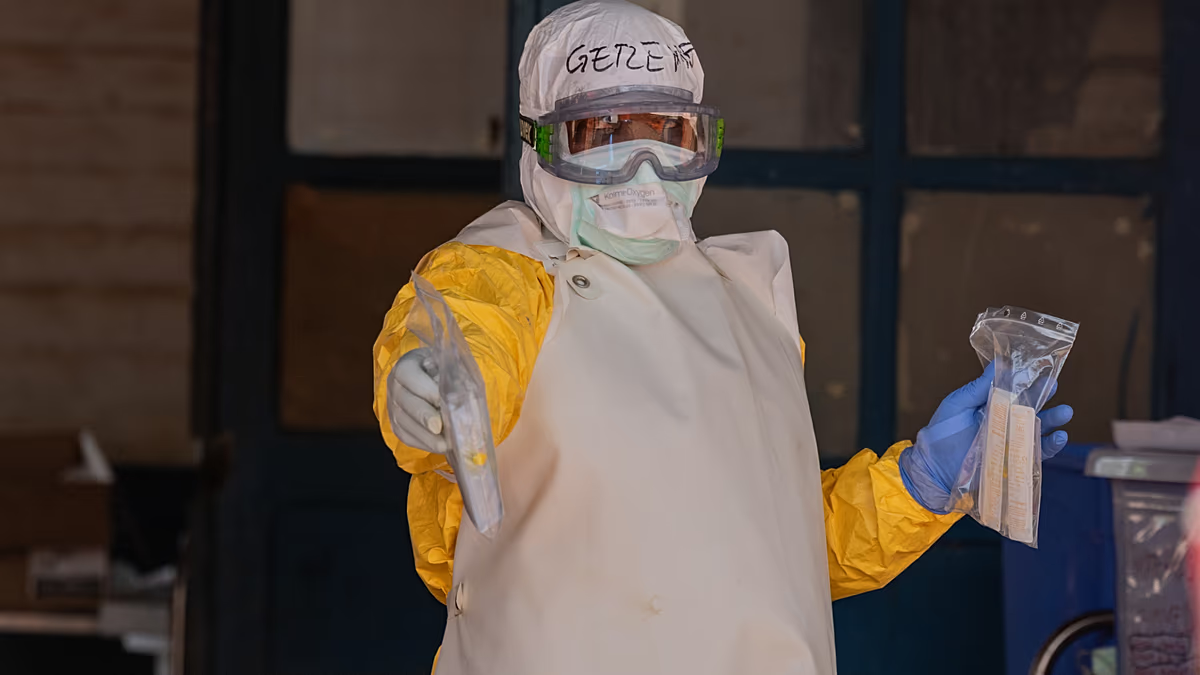
In the dense and troubled landscapes of eastern Democratic Republic of the Congo, a familiar and deadly threat has re-emerged, prompting urgent international action. The European Union, through its Commissioner for Crisis Management Hadja Lahbib, has announced an additional €5 million in funding to combat the accelerating Ebola outbreak. During a visit to Bunia airport in Ituri province—a vital logistics hub—Lahbib emphasized that this new support would establish regional diagnostic centres in the hardest-hit areas. This move aims to drastically improve the speed and reliability of testing, which is crucial for rapidly identifying and isolating new cases to break chains of transmission. The EU’s commitment, as Lahbib stated, is immediate and serious: “As soon as the outbreak began, we sprang into action and were on the ground very quickly to step up our support, and that commitment continues today.”
This latest crisis represents the 17th Ebola epidemic to afflict the region, a tragic testament to the persistent vulnerability of communities in eastern Congo. According to the World Health Organization’s latest figures, there have been 452 confirmed infections and 82 deaths since the outbreak was officially declared just three weeks ago. Health experts warn that without a swift and robust containment effort, this epidemic risks becoming one of the largest ever recorded. The situation is not unforeseen; during a visit four months prior, Commissioner Lahbib had already sensed the impending danger. She recounted seeing “a healthcare system on its knees, an exhausted population, and a population constantly displaced by the fighting,” conditions she described as perfect for another devastating outbreak.
The challenge of containing Ebola here is magnified exponentially by a context of protracted conflict and instability. Eastern Congo is a region scarred by violence from numerous armed groups, which has forced massive displacement, disrupted fragile healthcare systems, and hindered humanitarian access. Lahbib issued a poignant plea during her visit, urging all parties to respect international humanitarian law and allow aid workers safe passage to affected communities. “Respecting humanitarian law means respecting life,” she asserted, reminding that “even in times of war, there are rules that must be observed.” She underscored a grim reality of public health in conflict zones: “The virus pays no heed to borders or human disputes, and kills even faster than bullets.”
The EU’s latest financial pledge adds to a substantial existing effort, bringing the bloc’s total allocation for this crisis to €89 million. This funding supports a multi-faceted humanitarian response alongside organizations like the WHO and UNICEF. Recently, a UNICEF airlift delivered nearly 100 tonnes of critical supplies—including medicines, protective equipment, and tents—to the region, with five additional EU-coordinated humanitarian flights scheduled for Bunia in the coming weeks. This logistical support is vital for keeping frontline health workers equipped and operational in an environment where even basic infrastructure is often lacking or compromised by insecurity.
Alarmingly, the virus has already demonstrated its capacity to cross national boundaries, with confirmed cases now reported in neighbouring Uganda. WHO Director-General Tedros Adhanom Ghebreyesus visited Uganda, where 19 infections and two deaths have been linked to the outbreak. He praised the country’s surveillance and border screening measures, which have successfully identified infected travelers from Congo, helping to initiate rapid containment protocols. This cross-border spread validates the EU’s and WHO’s focus on regional diagnostic centers and reinforces the declaration of this outbreak as a “Public Health Emergency of International Concern,” a status meant to galvanize a coordinated global response.
Ultimately, the fight against Ebola in eastern Congo is a race against time, fought on two fronts: against a lethal virus and against the man-made obstacles of conflict and displacement. The European Union’s renewed funding and Commissioner Lahbib’s visit highlight the critical need for sustained international engagement that addresses both the immediate medical crisis and the underlying instability that fuels it. As the response continues, the world is reminded that global health security is inextricably linked to peace and humanitarian access. In this complex emergency, providing faster testing and more supplies is essential, but ensuring safe passage for health workers to deliver that care remains the fundamental challenge.