



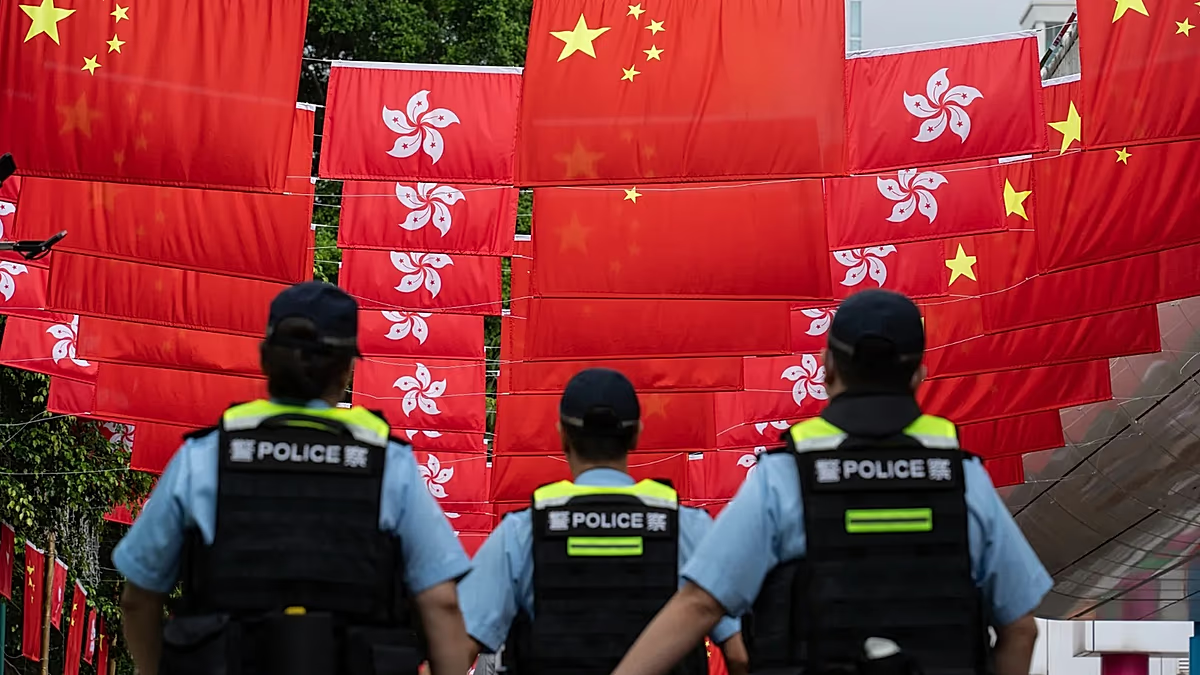
Hong Kong’s government has introduced new legislative measures that grant its Chief Executive the authority to designate specific criminal acts as national security offences. This move, proposed on Monday, signifies a further consolidation of legal tools aimed at eliminating perceived threats to the city’s governance. Critics argue that this continues a pattern of eroding the freedoms that were guaranteed when Hong Kong transitioned from British to Chinese rule in 1997. The proposal comes against a backdrop of already stringent security laws: the sweeping national security law imposed by Beijing in 2020 following mass pro-democracy protests, and a subsequent local security law enacted earlier this year targeting espionage and state secrets. Authorities insist these laws are vital for stability, but many observers see them as part of a systematic narrowing of Hong Kong’s once-protected civil liberties.
The proposed subsidiary legislation aims to formalize the process by which the Chief Executive, John Lee, can determine that an act involved in a criminal case endangers national security. Once such a determination is made, the entire case falls under that category. Notably, if a suspect faces both a national security charge and an alternative charge for the same act, the alternative charge will also be treated as a national security offence. The government contends that this does not create any new criminal offences or enforcement powers, but rather clarifies procedural mechanisms. Officials state that in today’s “complicated geopolitical landscape,” this clarity will improve Hong Kong’s legal system for safeguarding national security. They emphasize that the legislation is meant to refine details and bring greater certainty, urging a swift legislative process to enact the change.
However, legal experts and rights advocates have raised significant concerns about the implications for judicial independence and the rule of law. Professor Simon Young of the University of Hong Kong notes that the proposal confirms two existing realities: the definition of national security offences depends on circumstances beyond mere legal categories, and the Chief Executive’s determination—often issued via a certificate—is binding on the courts. Young warns of a particular danger: the Chief Executive could rely on secret, undisclosed information to judge a case as a national security matter, leaving the defendant with no opportunity to contest that foundational decision. He describes this as an “unreviewable executive power” that poses a threat to fair trial principles, a concern he has voiced since the original national security law was introduced.
Eric Lai, a fellow at the Georgetown Centre for Asian Law, expands on these concerns, arguing that the proposed change allows the leader’s will to “arbitrarily” transform ordinary criminal cases into national security matters. He points out that this exercise of power lacks institutional safeguards to prevent abuse, potentially further eroding Hong Kong’s rule of law. Lai suggests that under this framework, the Chief Executive could intervene in a wide array of cases, including commercial fraud or money laundering, by invoking national security pretexts. He observes that such offences are often weaponized against dissidents in authoritarian states, raising fears that Hong Kong’s legal system could increasingly mirror those practices.
In response to these criticisms, Hong Kong’s Secretary for Justice, Paul Lam, has defended the proposal. He explains that the executive branch holds the power to issue such certificates because the determination process often involves “very sensitive and highly confidential information,” which judicial institutions are not typically equipped to assess. This argument positions national security as a domain requiring executive discretion beyond judicial scrutiny. The government’s stance is that this legal refinement is a necessary and technical step, not an expansion of punitive reach. Yet, this very separation of power—where an executive decision based on potentially secret evidence becomes legally binding—lies at the heart of the debate.
The ongoing legislative developments in Hong Kong reflect a deepening integration of national security governance into the city’s legal fabric. While authorities frame each step as a necessary refinement for stability and security, a growing chorus of legal scholars and international observers see a continued shift away from the city’s former common law traditions and protections. The proposed mechanism, by centralizing the definition of national security offences in the hands of the Chief Executive, underscores a model where executive authority increasingly delineates the boundaries of permissible conduct and judicial process. The outcome of this legislative effort will likely have profound implications for Hong Kong’s future as a global financial hub and its unique, though diminishing, legal identity.