



The mullet, that famously audacious hairstyle succinctly described as “business in the front, party in the back,” has ridden a rollercoaster of cultural acceptance. Once the iconic symbol of 1980s rebellion and rock-and-roll flair, it suffered a dramatic fall from grace, derided by fashion elites and relegated to the annals of questionable style choices. For decades, it was the punchline of a joke, a look many were eager to forget. Yet, in a stunning twist of fashion fate, this most divisive of hairstyles has staged a triumphant and global comeback, proving that no trend is ever truly dead. What was once a relic is now a vibrant symbol of individuality and playful nonconformity, embraced by a new generation eager to rewrite its history.
This renaissance has been brewing for years, but it arguably found its moment in the sun during the global COVID-19 pandemic. As lockdowns confined people to their homes, traditional grooming routines were abandoned, and hair was left to grow wild and free. This period of collective isolation became an unexpected incubator for the mullet’s return, with British magazine i-D famously dubbing 2020 “the year of the mullet.” The style represented a form of sartorial rebellion against the mundane, a way to have fun when there was little to be found. Six years on, the revival has not only persisted but has flourished, evolving from a quarantine experiment into a full-blown cultural movement with its own dedicated community and events.
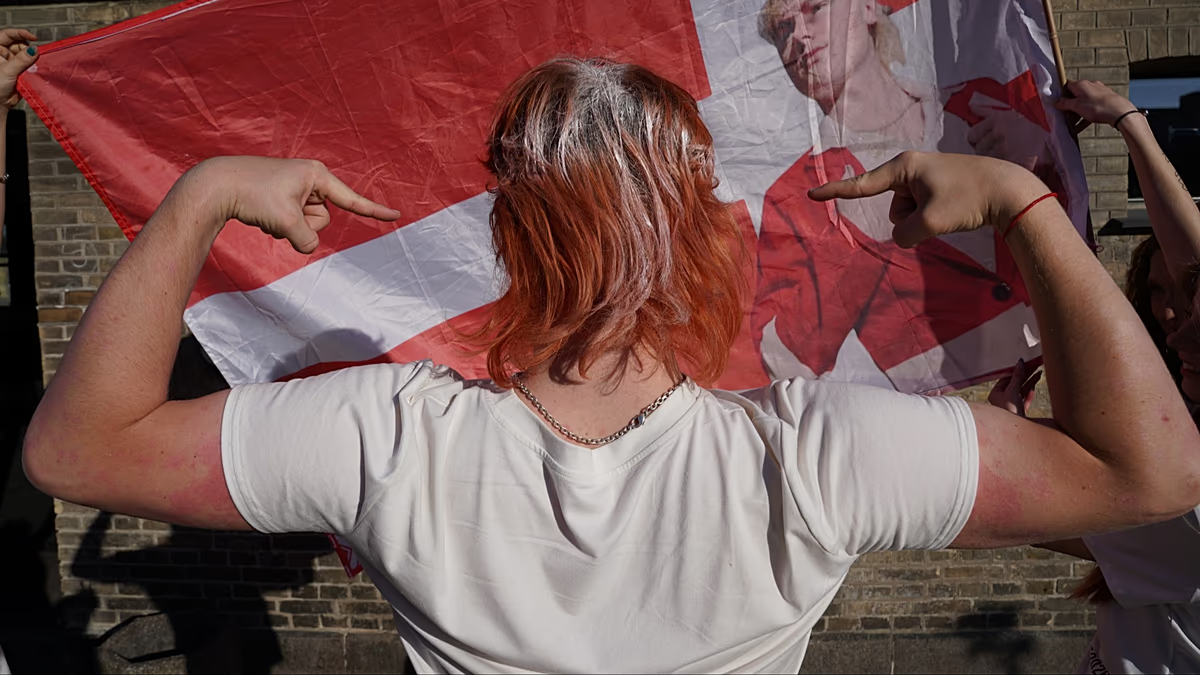
The pinnacle of this modern mullet mania was on full display recently in Copenhagen, Denmark, where a crowd of over a thousand spectators gathered under the open sky for the 2026 Mullet Championship. The event, now in its fourth year, transformed a public stage into a temple of tonsorial artistry, where twelve proud competitors showcased their flowing locks. The championship’s origin story is as unique as the hairstyle it celebrates. It was founded by Steffen Stiw Weber, a 37-year-old electrician, who was inspired to grow his own mullet after a hair transplant. His dream of competing in an American mullet contest dashed by citizenship rules, he decided to bring the party to his own backyard, creating a now-beloved Danish tradition.
At this lively competition, the mullet was judged as both an art form and a performance. Contestants were not merely evaluated on the cut itself—its style, uniqueness, and “finesse”—but on how they brought it to life. Judge Bobby Agren captured the essence of the search, looking for that special “twist” and nostalgia, appreciating when a mullet managed to look “ridiculous or maybe ugly in a beautiful way.” Each competitor had just sixty seconds on stage to strut, dance, and perform their “mullet moves,” with judges holding up scorecards after each exuberant display. It was a celebration of personality, where the hair was the star, but the confidence behind it was the true engine.
The 2026 champion, Thomas Berg, a 43-year-old construction worker, embodied this spirit perfectly. He captured the title and the crowd’s heart with a memorably energetic performance that involved frantic jumping on a trampoline while dressed in neon green gym wear, his mullet and orange headband flying freely. His victory speech was less about vanity and more about the joy of participation. “I think it’s just funny. It’s just a big party,” Berg said, adding that it was “nice to be a bit outside the box.” His words underscore the event’s core: it’s a communal, lighthearted rebellion against taking oneself too seriously, a space where standing out is the whole point.
From a single Danish competition, the phenomenon has grown into a worldwide circuit, with events like the European Mullet Cup in Belgium drawing their own crowds. Steffen Stiw Weber offers a compelling theory for the mullet’s powerful resurgence in our digital age. In a world dominated by curated perfection on social media, where everyone strives for a polished, acceptable image, the mullet is a deliberate act of defiance. It is an imperfect, bold, and inherently playful statement. By choosing the mullet, individuals are pushing back against homogenized beauty standards, opting instead for a look that is authentically, unapologetically themselves. It’s not just a haircut; it’s a declaration of independence, proving that sometimes, the best way to stand out from the crowd is to let your hair down—especially at the back.