


Navigating the Inner Maze: The Resonant Horror of “Backrooms”
We have all known those transitional spaces that feel unsettling in their emptiness—a deserted hotel corridor late at night, a silent airport gate before dawn, or an office hallway after everyone has gone home. These are liminal spaces, thresholds between one place and another, and they possess a unique, quiet eeriness. They are not overtly menacing, yet their unfamiliar familiarity can make our skin crawl, as if time itself is holding its breath. It is this universal, almost primal sensation that forms the foundation of Kane Parsons’ stunning debut film, Backrooms, a horror story that translates this ambient unease into a tangible, terrifying, and deeply human nightmare.
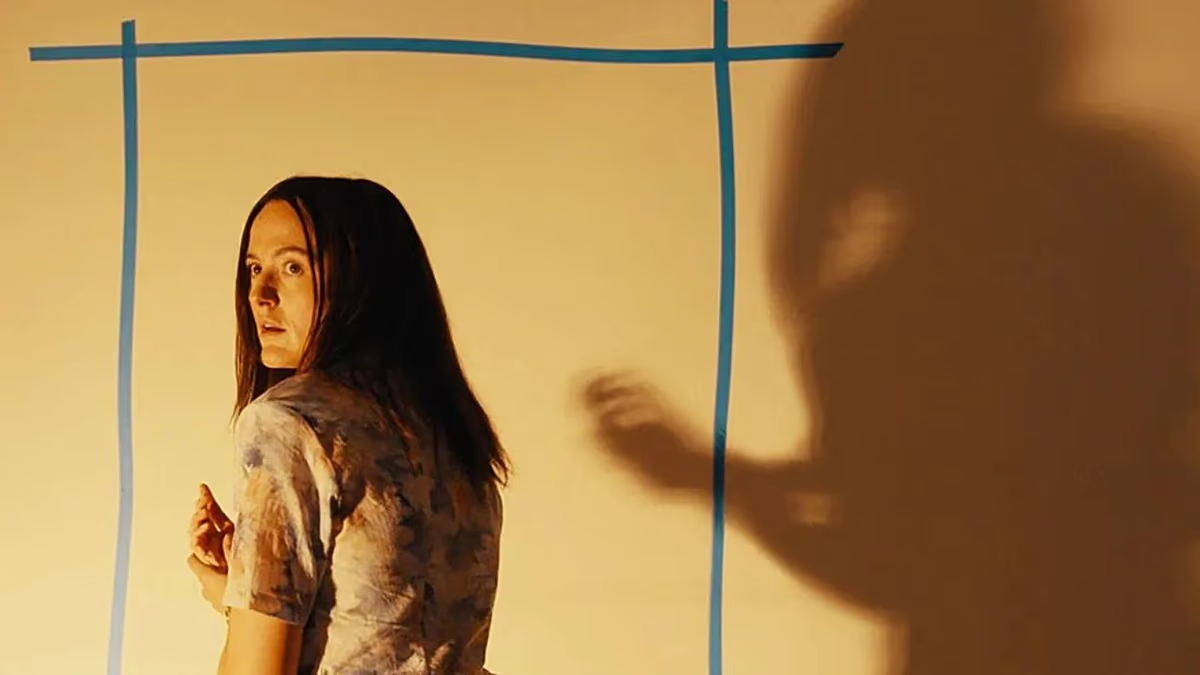
The film follows Clark, a failed architect and profoundly depressed furniture store owner played with devastating weariness by Chiwetel Ejiofor. Within his own store, Cap’n Clark’s Ottoman Empire, he stumbles upon a hidden portal. It does not lead to a fantasy realm, but into the Backrooms: an endless, extradimensional maze of monotonous yellow wallpaper, stained carpets, and the relentless fluorescent hum of faulty lights. It is a prison of mundane aesthetics, a place of pure existential boredom tinged with a lurking, unseen evil. When Clark vanishes into this labyrinth, his therapist, Mary, portrayed by the brilliant Renate Reinsve, embarks on a search for him. She too passes through the looking glass, only to discover that this is no Wonderland, but a reflection of the interior mazes we all carry within us.
The success of Backrooms is a cultural event in itself. Crafted by a 20-year-old YouTuber expanding his own viral web series, the film achieved a staggering box office opening, becoming A24’s biggest debut ever. While its roots in popular internet lore—a creepy image from 4chan that Parsons himself helped evolve—guaranteed an audience, its triumph is powered by exceptional word-of-mouth. This is because Parsons has crafted a film that is both a masterclass in atmospheric horror and a substantial, emotionally resonant drama. The palpable unease is built through surreal nightmare logic, unnerving set design, and a score that gets under your skin. It evokes classics like The Shining in its exploration of oppressive architecture and Cube in its claustrophobic, bureaucratic terror, all while feeling entirely fresh. It is a slow-burn that respects its source material yet requires no prior knowledge, plunging viewers directly into a world where the greatest terror often stems from a single, bizarrely out-of-place object in an otherwise monotonous landscape.
Yet, for all its chilling aesthetics, the true genius of Backrooms lies in its psychological depth. Parsons shrewdly centers the story on two profoundly lonely, broken individuals. Clark is a divorcé drowning in frustration and unresolved anger, while Mary is a therapist grappling with her own childhood trauma even as she tries to heal others. The endless, repeating corridors of the Backrooms become a perfect physical manifestation of their—and our own—psychological traps: the behavioral loops we cannot escape, the flawed solutions we repeatedly attempt, the memories that haunt us. This transforms the film from a simple survival story into a poignant quest for self-understanding and breaking cyclical pain. The most potent monster, Parsons argues, is not waiting around the corner in the yellow halls, but is the one we harbor inside.
Of course, no film is without its flaws, and Backrooms has drawn some critique. Some seasoned horror aficionados may find its terrors more atmospheric than shocking, and the final act ventures into more explicit lore—involving a mysterious research institute—that some feel complicates the elegant, terrifying simplicity of the core concept. Certain dialogues can feel clunky amidst otherwise stellar performances. However, these are minor quibbles in a remarkably confident debut. Parsons wisely chooses to suggest and tease rather than over-explain, culminating in a final shot that is deeply ambiguous and ripe for theorizing. Is the Backrooms a sentient universe, a psychological projection, or something else entirely? The ambiguity is its strength, leaving the horror to linger in the mind long after the credits roll.
In the end, Backrooms is a testament to a potent new voice in cinema. Kane Parsons looked at a single eerie image online and saw not just a setting for scares, but a mirror for the human condition. He has confidently leapt from YouTube to Hollywood, delivering a film that is as thought-provoking as it is terrifying. It succeeds not merely because it makes us jump, but because it makes us recognize those empty, echoing spaces within ourselves—and asks what might be lurking there, waiting in the quiet hum of the fluorescent lights. As the film continues its global rollout, it challenges viewers not just to be afraid of the monster in the maze, but to confront the mazes we build in our own minds.