



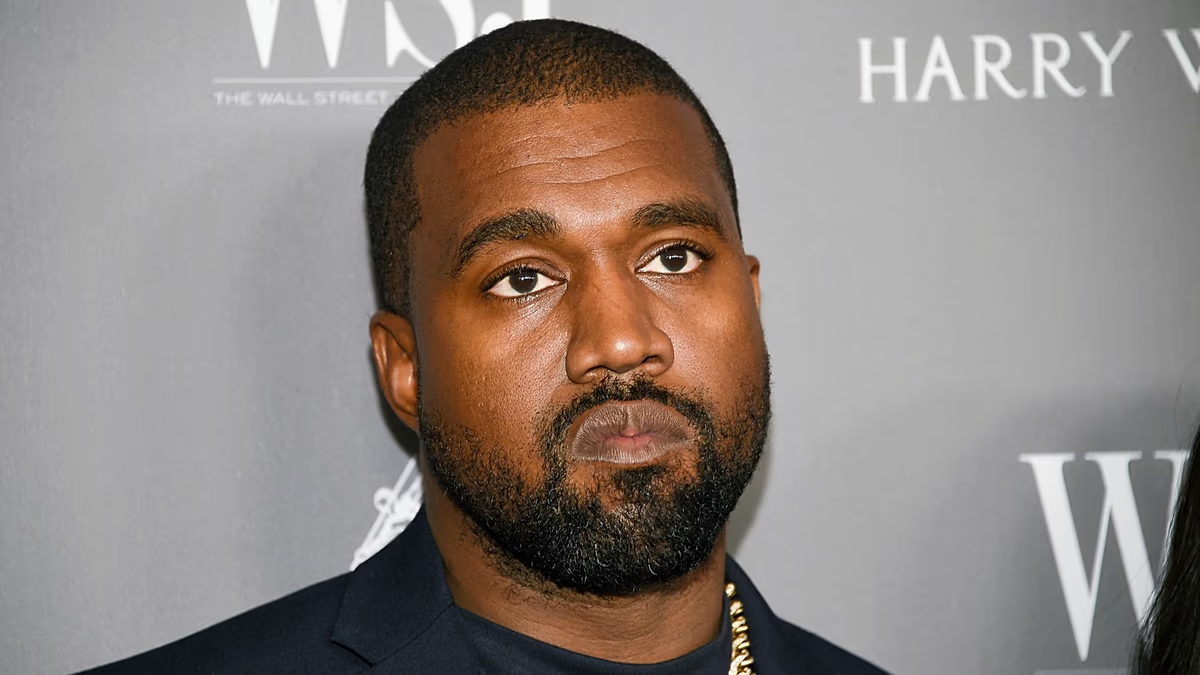
In a decision that has sparked significant debate, a Dutch court has ruled that the controversial American rapper Kanye “Ye” West will be permitted to perform two scheduled concerts in the Netherlands this June. The Amsterdam District Court rejected an emergency lawsuit filed by the Netherlands’ Central Jewish Council, which sought to block the events at the Gelredome in Arnhem due to West’s extensive history of antisemitic remarks. The judge concluded that there were no concrete indications his presence would endanger public order, allowing the sold-out shows, with 70,000 tickets reportedly purchased, to proceed. This ruling underscores a legal principle emphasized by Dutch Deputy Prime Minister Bart van den Brink: that past statements alone, however reprehensible, are insufficient grounds to deny entry or bar a performance without evidence of an imminent threat. For the Jewish community, however, the message felt profoundly different. Chanan Hertzberger, chair of the Central Jewish Council, expressed a sense of deep injury, stating the ruling conveyed that “it is okay if you are antisemitic.”
This legal victory in the Netherlands stands in stark contrast to the fate of West’s planned tour across much of Europe. Numerous countries, including France, the United Kingdom, Poland, and Switzerland, have cancelled his performances. Most recently, Italian authorities called off two major shows set for Reggio Emilia, explicitly citing public order and security concerns. This pattern highlights a broader European struggle to balance principles of free expression and artistic freedom against the imperatives of public safety and the condemnation of hate speech. The Netherlands’ position, therefore, places it in a distinct minority, permitting an artist whom many other nations have deemed too inflammatory to host. West’s only recent European performance prior to this ruling was in Turkey, where he played to a massive crowd in Istanbul, claiming a historic turnout. This successful event outside the EU may have factored into the Dutch court’s assessment of risk.
The controversy fueling these cancellations stems from a deeply troubling pattern of behavior initiated by West in late 2022. Beginning with a series of virulently antisemitic posts on social media—which led to his suspension from major platforms—West’s rhetoric rapidly escalated. He was subsequently dropped by his talent agency and saw lucrative partnerships with global brands like Adidas and Balenciaga severed. Undeterred, his actions grew even more overtly hostile: he posted imagery of Ku Klux Klan robes, publicly declared himself “a Nazi,” and asserted he had “dominion” over his then-wife. The offensive campaign reached new depths in 2025 with the sale of merchandise featuring swastikas and the release of a song titled “Heil Hitler,” which praised the Nazi leader. These actions had direct consequences, leading Australia to revoke his visa and Brazilian authorities to issue a warrant for his arrest, demonstrating that his words and actions carried tangible legal and professional repercussions beyond public condemnation.
Earlier this year, West offered a public apology, taking out a full-page advertisement in the Wall Street Journal. In it, he attributed his past behavior to a “four-month-long manic episode of psychotic, paranoid and impulsive behaviour,” stating he had “lost touch with reality.” He expressed regret for his antisemitic comments and the pain they caused. However, the sincerity and timing of this apology have been met with widespread skepticism. Many observers, including critics and members of the Jewish community, noted its proximity to the planned rollout of his new album, ‘Bully,’ slated for 2026. This led to questions about whether the statement was a genuine attempt at accountability or a strategic maneuver to rehabilitate his image and salvage his European tour. The court’s decision in the Netherlands suggests that, on a legal level, the apology may have contributed to a scenario where authorities could not justify a pre-emptive ban, even as the wound from his remarks remains fresh for many.
Consequently, the upcoming concerts in Arnhem present a profound societal dilemma. On one hand, they represent a judicial commitment to a high threshold for restricting artistic expression and movement. The system has ruled that without proof of immediate danger, even speech widely deemed abhorrent cannot be preemptively silenced by the state. On the other hand, for the Jewish community and allies, the events symbolize the painful normalization of hate speech and the perceived prioritization of a celebrity’s commercial interests over the security and dignity of a minority group. The sold-out stadium also indicates that for a significant segment of the public, West’s artistic output continues to eclipse his personal controversies, a reality that is itself a point of contention. The nation now watches to see if the court’s prediction of no public order disturbances will hold true, or if the deeply charged atmosphere surrounding the performer will manifest in protests or unrest.
As matters stand, West’s European itinerary now hinges on the Dutch dates. Following Arnhem, his tour is currently set to continue in Georgia, Albania, Spain, and Portugal. The Netherlands’ ruling may influence authorities in these remaining host nations, though each retains the sovereign right to make its own assessment based on local context and law. The broader narrative extends beyond concert logistics, touching on enduring questions about redemption, accountability, and the limits of tolerance in a democratic society. It asks whether there is a path back from the propagation of hateful ideology, and what genuine amends would require. For now, the show in Arnhem will go on, serving not merely as a musical performance but as a live case study in the complex and often painful intersection of law, morality, art, and social cohesion.