



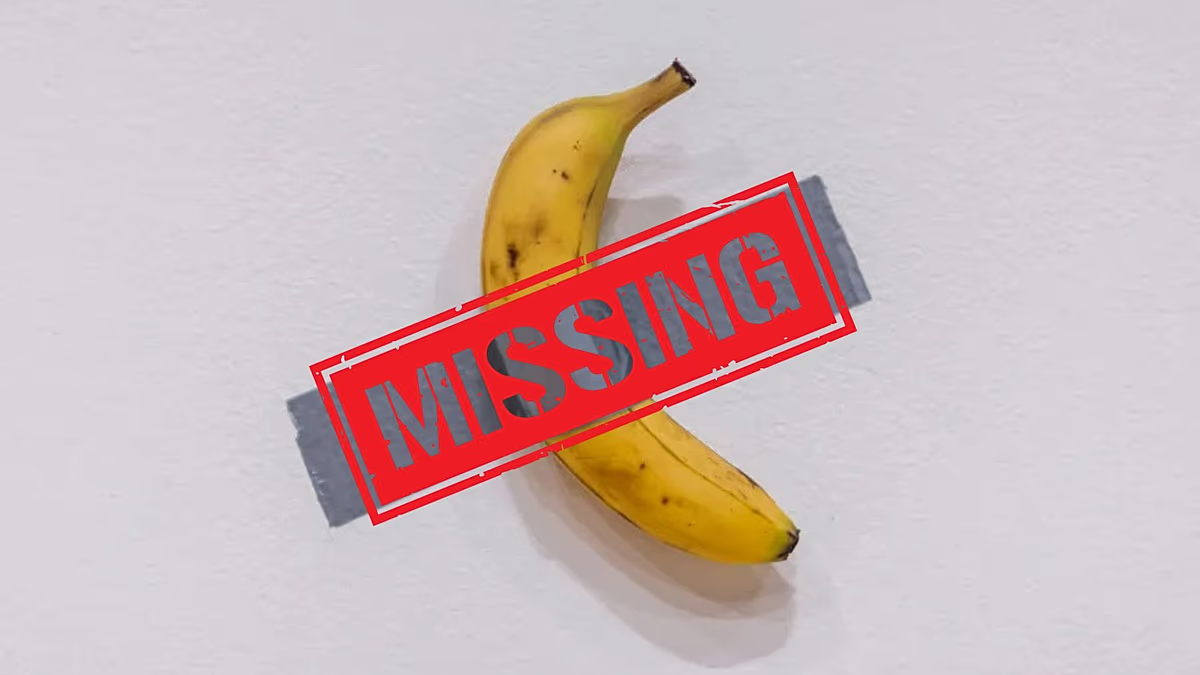
Of all the artworks that could vanish from a museum, few would be as absurdly fitting as Maurizio Cattelan’s “Comedian” – the now-infamous banana duct-taped to a wall. In a twist that seems almost predestined for this provocative piece, the Pompidou-Metz museum in eastern France recently reported that, once again, the artwork has been stolen. Valued at a staggering €5.8 million, the conceptual work was noticed missing by a security guard this past weekend. Unlike previous incidents where the fruit was merely consumed, this act was a full removal, prompting the museum to take the unusual step of filing a criminal complaint against persons unknown. Their reasoning was simple yet pointed: with the perpetrator unidentified, there was “no possibility of dialogue.” This marks the second such incident at this venue, following an event last July when a visitor simply ate the banana, an act which elicited a wry response from Cattelan himself, who expressed disappointment that the visitor hadn’t eaten the tape as well. That time, no legal action was pursued. This escalation to theft, however, signaled to the museum a deeper issue of respect – or perhaps a fundamental misunderstanding – for the artwork they are tasked with protecting.
The journey of “Comedian” from art fair curiosity to multi-million-euro icon is a story of our times. It first sparked global controversy upon its debut at Art Basel Miami Beach in 2019, with an initial asking price of $120,000. Almost immediately, it became a target for performance and protest. Artist David Datuna ate the banana on the fair floor, declaring he was “hungry.” This act set a precedent, establishing consumption as a recurring, almost ritualistic, response to the work. The piece continued to be a magnet for hungry visitors, with another eaten in Seoul in 2023. Yet, paradoxically, each act of destruction seemed only to inflate the artwork’s market value and cultural notoriety. The core of its worth lies not in the perishable fruit, but in its certificate of authenticity and a precise hanging protocol: the banana must be fixed 1.72 meters above the floor and tilted at a 37-degree angle. This transforms “Comedian” into what is known as a “protocol artwork,” where the idea and its official execution instructions are the true, enduring assets.
The zenith of this paradox was perhaps reached in 2024, when Chinese-born crypto founder Justin Sun purchased an iteration of “Comedian” for the full €5.8 million. In a move that blurred the lines between performance art, critique, and sheer spectacle, Sun then ate the banana in front of cameras in Hong Kong mere days after acquiring it. His act highlighted the absurdity of the artwork’s valuation while simultaneously participating in and amplifying its legend. It underscored a central question Cattelan’s work persistently raises: what are we actually valuing? Is it the concept, the celebrity of the artist, the certificate, or the sheer audacity of the gesture? In a world where value is increasingly abstract and digital, a taped banana that commands millions becomes a perfect, if baffling, symbol.
Cattelan is no stranger to creating works that probe the intersections of value, satire, and contemporary society. His 18-carat solid gold, fully functional toilet, titled “America,” was famously offered to the Trump White House. That piece itself fell victim to crime, stolen in 2020 from where it was exhibited in the UK. The thieves brutally sawed it from its fittings and dismantled it; the gold was never recovered, turning the toilet from a functioning object of critique into a ghostly, scattered legend. More recently, for Easter 2026, Cattelan launched a project inviting confessions via a special hotline, playing with themes of absolution and public spectacle. His practice consistently holds a mirror to the absurdities of power, faith, and the art market itself, with “Comedian” standing as his most accessible and debated emblem.
The recurring fate of the banana—being eaten, stolen, or purchased for destruction—raises profound questions about the social contract of the museum. When an artwork is designed to be ephemeral and replaced every few days to prevent rot, where does the “real” artwork reside? Is the theft of the banana a crime against property, or a misguided performance piece in itself? The museum’s decision to prosecute this time suggests a defensive stance on the integrity of the artistic idea as they are charged with stewarding it. It is an admission that the public’s interaction with conceptual art has crossed a line from participatory interpretation into what they view as vandalism and theft, forcing institutions to defend the sanctity of a concept manifested in a piece of fruit.
As of now, the whereabouts of the latest banana from Pompidou-Metz remain unknown. Is it decaying in a thief’s pocket, pressed in a book, or perhaps displayed privately as a trophy? Its disappearance is the latest chapter in an ongoing, real-world performance that Cattelan perhaps inadvertently authored. Each consumption, each theft, each multi-million-euro transaction continues the conversation he started. “Comedian” is more than a static object; it is a social experiment, a mirror reflecting our hunger for notoriety, our confusion over value, and our desire to touch, test, and sometimes destroy the icons of our culture. The missing banana is not an end, but a continuation. The museum has already replaced it with a fresh one, following the precise protocol, ready for the next visitor, critic, or hungry soul to encounter it, and for the endless, absurd, and deeply human comedy to play on.