

A Dialogue Across Time: The Unseen Bond Between Alaïa and Dior
The world of fashion is often viewed as a relentless march forward, a linear progression of trends and talents. Yet, sometimes, its most profound stories are not about succession, but about resonance—a silent conversation between artists separated by decades. This is the exquisite premise behind both the exhibition and the accompanying book, Azzedine Alaïa and Christian Dior, Two Masters of Haute Couture. Spearheaded by Carla Sozzani, the co-founder of the Fondation Azzedine Alaïa and a dear friend of the Tunisian couturier, this project seeks to construct a bridge between two titans who never met, yet whose creative spirits speak the same fundamental language. It answers a poignant question: how can we honor a relationship that existed not in person, but purely in the realm of influence, philosophy, and shared devotion to the craft of haute couture?
Sozzani’s personal connection to Alaïa provides the emotional heart of this endeavor. Meeting him in the 1980s, their bond, forged through a mutual passion for fashion and art, was deep and enduring. She witnessed firsthand his relentless dedication and the very particular dream that shaped his destiny. As she recounts, Alaïa’s journey began not in Paris, but in Tunis, where he assisted local couturiers while harboring a singular aspiration: to reach Paris and learn at the source. This dream was realized through a client’s connection to the house of Christian Dior, securing Alaïa an internship on the famed Avenue Montaigne in the 1950s. For a young man arriving directly from Tunis, this was a monumental cultural leap, yet Alaïa did not feel intimidated. Instead, he felt instantly at home, utterly captivated by the atmosphere of the atelier—the sanctified space where garments were painstakingly constructed by hand. This experience crystallized his lifelong identity. As Sozzani emphasizes, Alaïa forever declared, “I’m not a designer, I’m a couturier.” For him, this distinction was paramount; it was the highest achievement, representing a commitment to the artisanal, sculptural, and intimate process of creating clothing directly for the body.
This early exposure to Dior’s world left an indelible imprint on Alaïa’s philosophy, creating an unseen thread linking their careers. Both men were, in their respective eras, revolutionaries who defied prevailing norms to redefine femininity. In 1947, Christian Dior’s “New Look” erupted onto the post-war scene, a dramatic rejection of the utilitarian, boxy silhouettes of the wartime years. His designs celebrated a return to luxury, opulence, and a distinctly hourglass shape—broad shoulders, a cinched waist, and a full, sweeping skirt—restoring a sense of romance and grandeur to women’s fashion. More than three decades later, Azzedine Alaïa accomplished a similarly seismic shift. As Sozzani explains, in the 1980s, Alaïa gave the human body a new, confident shape. His designs were intensely body-conscious, yet paradoxically celebrated comfort. He masterfully used techniques like knitting and meticulous seaming to create garments that clung to and celebrated the form without constricting it. This was a response to a new social reality: women were now powerfully present in the workforce and demanded clothing that conveyed strength, beauty, and ease simultaneously. Alaïa’s mission, as Sozzani notes, was always to make women “beautiful, feminine and powerful,” with comfort being a non-negotiable cornerstone of his design ethos.
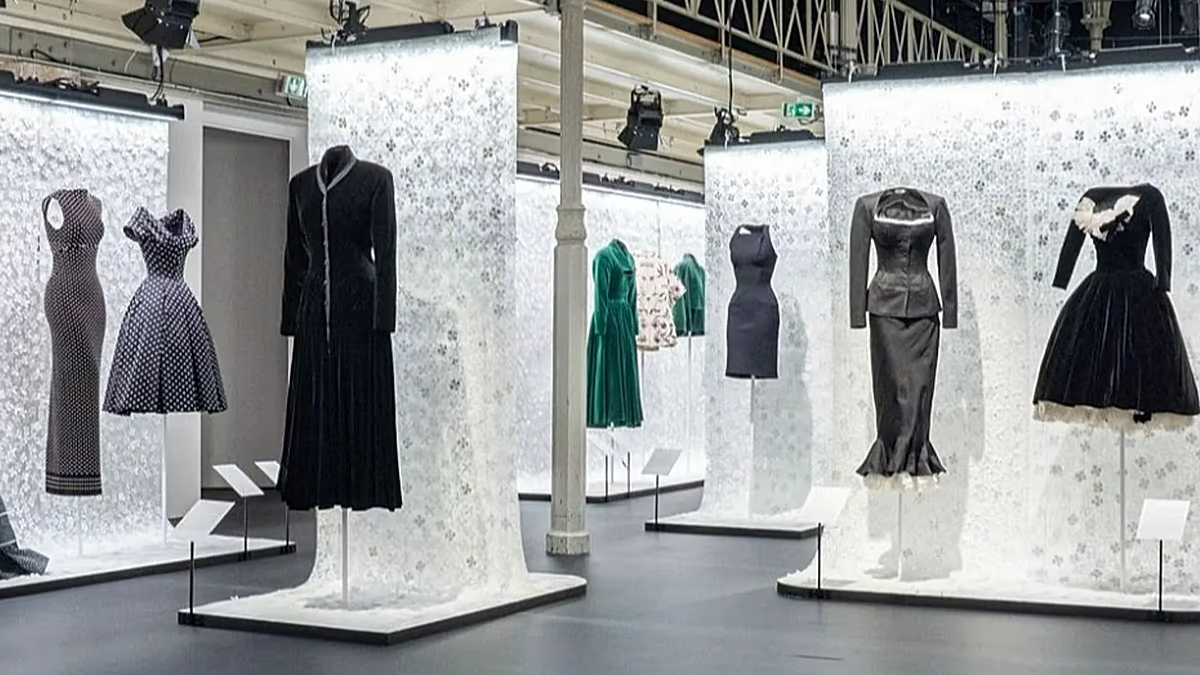
The exhibition and book physically manifest this philosophical dialogue by placing the garments of both masters in direct conversation. Visitors and readers are invited to see beyond the surface differences of period, color, or specific technique—the 1950s taffeta versus the 1980s stretch knit—and to perceive the deeper kinship. A Dior gown with intricate pleats might stand beside an Alaïa dress with precise laser-cut lace; a structured Dior jacket next to a molded Alaïa leather bodice. In this curated space, they begin to “talk to each other,” as Sozzani poetically describes. The dialogue is about shared values: a reverence for the female form, an obsession with technical perfection, and a belief that clothing should empower and elevate the wearer. It transports the observer into a realm of pure creativity, where the clothes themselves seem to stand autonomously as artistic statements, whispering stories of their creation and their purpose across the divide of time.
Ultimately, this project is a tribute to the enduring spirit of haute couture itself—not as a commercial enterprise, but as a sacred, artistic discipline. Both Dior and Alaïa operated as true couturiers, masters of their ateliers, deeply involved in every stitch and seam. They respected fabric as a sculptor respects marble, shaping it directly onto the body of the client or model. The exhibition at the Fondation Azzedine Alaïa in Paris, running until 21 June 2026, and the Damiani-published book are more than historical comparisons; they are a celebration of this rare, unwavering dedication to craft. They propose that true innovation in fashion is not merely about novelty, but about a deep, humanistic understanding of beauty, change, and dignity.
In weaving together the legacies of Christian Dior and Azzedine Alaïa, Carla Sozzani has crafted a narrative that transcends chronological biography. It reveals how a brief, formative experience in a Parisian atelier can seed a lifetime of inspiration, and how two distinct voices, singing in different eras, can harmonize in their core beliefs. This dialogue across time reminds us that influence is not always a loud, declared inheritance, but can be a quiet, absorbed lesson that grows into its own unique, powerful expression. It is a story of how dreams born in Tunis can find their validation on Avenue Montaigne, and how, decades later, those dreams can return to Paris to finally greet their source, completing a circle of creativity and respect that was always meant to be whole.