


Of course. Here is a summary and humanization of the provided content, expanded into six paragraphs.
The much-hyped Great American State Fair, a centerpiece event planned for the National Mall in Washington, D.C., to celebrate America’s 250th birthday this summer, is facing a public relations crisis that threatens to derail it before it even begins. Intended as a unifying national celebration under the banner “Freedom 250,” the event has instead become mired in controversy, artist defections, and political scrutiny. The initial excitement over the musical lineup quickly curdled into widespread ridicule online, with critics lambasting it as a dated and incohesive roster. More damning than the aesthetic complaints, however, was the rapidly emerging perception that the fair was less a patriotic tribute and more a politically-aligned rally, causing the very artists hired to provide the soundtrack for unity to head for the exits.
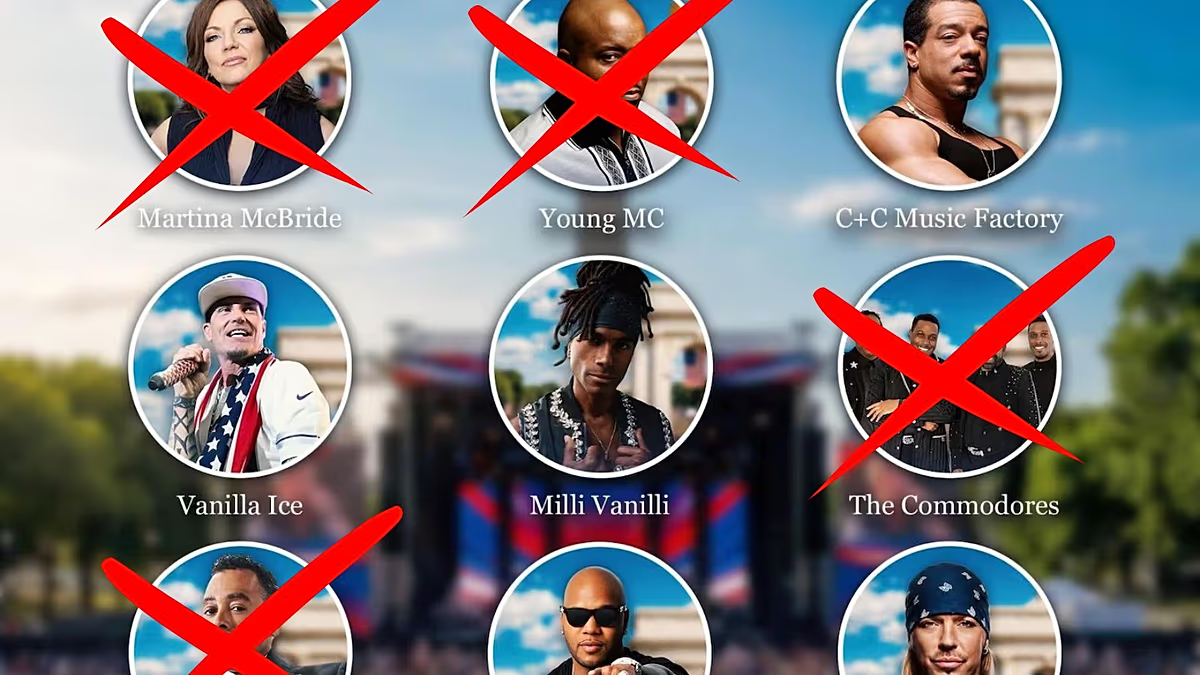
The unraveling began almost immediately after the lineup was announced, featuring a mix of legacy acts like The Commodores and Martina McBride alongside 80s and 90s icons like Vanilla Ice, C+C Music Factory, and Fab Morvan of Milli Vanilli. The negative public reaction was swift, but the real exodus started as performers discovered the event’s contentious backing. Reports revealed the fair is funded through a public-private partnership with significant financial support from major tech firms and federal contractors aligned with former President Donald Trump’s orbit. This connection sparked immediate backlash and intense scrutiny from watchdog groups and members of Congress, who questioned the use of federal resources for an event with perceived partisan ties.
Confronted with this backlash, artists began withdrawing their participation with pointed statements. Morris Day and Young MC were among the first to clarify they were never properly informed of the event’s political dimensions and would not perform. The situation escalated when cornerstone acts like The Commodores and country star Martina McBride made formal, principled exits. The Commodores stated their music was their voice and they chose not to affiliate with any single political party, emphasizing a desire to support “the betterment of all Americans.” McBride offered a more detailed account, expressing that she was misled, having asked numerous questions and believing she was participating in a nonpartisan celebration. She lamented that the assurances she received were not reflective of the event’s reality, feeling her intention to bring people together through music had been co-opted.
Amid this high-profile retreat, a stark divide has emerged among the remaining performers, highlighting the deep cultural and political fissiles the event has accidentally exposed. On one side are artists like Fab Morvan and Vanilla Ice, who are proceeding with a determined focus on entertainment and nostalgia. Morvan speaks of uniting people and celebrating life through music, while Vanilla Ice’s camp enthusiastically promotes a birthday party for America where “everyone is welcome.” Their approach frames the fair as a simple, apolitical celebration. In stark contrast, Freedom Williams of C+C Music Factory offered a chaotic and profanity-laced defense from an unlikely setting—his bathroom—declaring his personal disdain for Trump but an even fiercer resentment at being told what to do by critics. His defiant stance frames his performance as an act of personal rebellion, further muddying the event’s intended message.
At its core, the debacle is a case study in modern cultural collision, where the lines between celebration, commerce, and politics are irrevocably blurred. The organizers’ attempt to craft a unifying, nationalistic event has backfired, revealing the immense difficulty of staging a supposedly “nonpartisan” gathering in today’s polarized climate. The involvement of Trump-aligned corporations, coupled with the former president’s own association with some of the participating artists, made neutrality an impossible sell. What was marketed as “Freedom 250” is now widely perceived as “MAGA-adjacent,” a label that has proven toxic for a significant portion of its intended audience and talent pool. The fair has become a proxy battleground, with artists forced to make public, career-defining calculations about the associations they are willing to endure.
As the fair’s late June start date approaches, its fate seems uncertain. With nearly half of its announced headline acts having publicly withdrawn and the event under a cloud of political and financial scrutiny, the celebration risks becoming a symbol of division rather than unity. The remaining performers will take the stage before a audience whose composition is now unpredictable, likely drawing enthusiastic supporters of the event’s perceived politics while repelling a broader swath of the public. The Great American State Fair, conceived as a patriotic capstone for the nation’s sestercentennial, now stands as a cautionary tale. It demonstrates how easily a call for communal celebration can be fractured by the very political tensions it seeks to transcend, leaving in its wake a cancelled artists, confused intentions, and a celebration that may only appeal to a fragment of the America it aims to honor.