


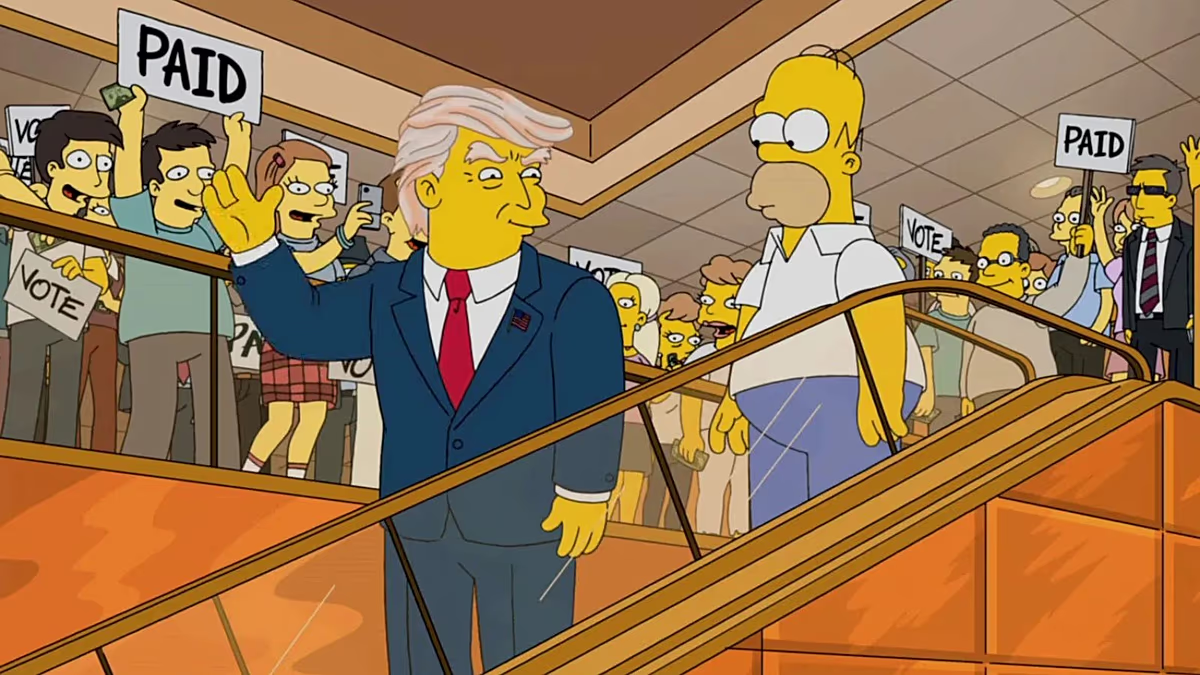
In the ever-unpredictable landscape of American politics, a new and unconventional candidate has emerged for the 2028 Presidential race: Dan Greaney, a veteran writer for the iconic television series The Simpsons. His announcement, made in late May 2026, instantly captured public attention, not merely for its whimsical presentation but for the unique cultural backdrop he carries. Greaney is famously linked to an episode of the show that, years later, became a staple of pop culture folklore. In the 2000 episode “Bart to the Future,” a line uttered by President Lisa Simpson noted, “As you know, we’ve inherited quite the budget crunch from President Trump.” This fictional quip, aired a full sixteen years before Donald Trump’s actual election, cemented The Simpsons in the public mind as a curious, and sometimes eerily accurate, cultural oracle. Greaney’s entry into the political arena now adds a surreal layer to this narrative, positioning a man associated with a prophetic cartoon into the very real world of presidential campaigning.
Greaney’s campaign launch was a performance blending satire with a serious underlying message. In a video posted to Instagram, he initially appeared dressed as a wizard, introducing himself as a “self-proclaimed prophet” who diagnoses America’s political ailments. With theatrical flair, he lamented that “Trump, Vance, the billionaires, careerists, and cowards in both parties have turned their backs on [the US].” He then performed a comedic reveal, discarding the robe to show a suited politician underneath, exclaiming, “Screw it, I can be a politician… I’m running for president. My platform: America for all.” This staged transformation from mystic to candidate cleverly underscored his central critique: that contemporary politics is shrouded in illusion and disconnected from the people, and that perhaps a fresh, unconventional perspective is needed to cut through the performance.
Beyond the theatrics, Greaney’s campaign platform outlines substantive, progressive policy goals. According to his campaign materials, he advocates for restoring democratic norms and institutions alongside major initiatives like universal healthcare and a revived Green New Deal. His slogan, “America for all,” seeks to unify these ideas under a principle of broad inclusivity and accountability. While his professional background is in comedy writing—he is a four-time Emmy winner—his message deliberately contrasts with the current political climate, positioning him as an outsider aiming to challenge what he describes as a system dominated by money, power, and security for a select few, rather than prosperity for the general populace.
This announcement arrives in a political moment already fixated on the future. Although the 2028 election is years away, the shadow of Donald Trump looms large over the conversation. Current law prohibits any president from serving more than two terms, meaning Trump himself cannot be a candidate in 2028. Nonetheless, his continued influence on the political landscape is undeniable, with entities like the Trump Organization already merchandising “Trump 2028” caps, a symbolic gesture that keeps his movement in the public consciousness. Greaney’s entry, therefore, can be seen as an early, contrasting response to this enduring influence—a bid to channel the populist energy of the moment toward a different, progressive vision rather than a continuation of the same.
Of course, the immediate reaction to a television comedy writer running for president leans toward skepticism and amusement. The phrase “Stranger things have happened…” echoes in the mind. Yet, there is a poignant symbolism in his candidacy. Greaney represents a bridge between the cultural imagination and concrete political action. In a nation where entertainment and politics are increasingly intertwined, his campaign asks a legitimate question: why should the skills of storytelling, understanding public sentiment, and framing complex ideas—honed in a writer’s room—be considered less relevant than traditional political credentials? His bid, whether ultimately serious or satirical, challenges the very norms of who is deemed qualified to seek the highest office.
The next United States Presidential election is scheduled for November 7, 2028. While Dan Greaney’s journey from The Simpsons scribe to presidential candidate may be long and undoubtedly arduous, his early announcement has successfully injected a note of creative rebellion into the political discourse. It reminds us that politics is, in part, a narrative—a story a nation tells about itself. Whether his campaign gains traction or remains a cultural footnote, it has already served to highlight public yearning for change and accountability. In the spirit of his most famous written line, it suggests that the future, while uncertain, is always open to new scripts, even those penned by a prophet in a wizard’s cloak who decided, ultimately, to just suit up and try.