


The Texas primaries were never just about Texas. They became a high-stakes preview of the political forces that will define the remainder of President Donald Trump’s second term, casting a stark light on the Republican Party’s soul. More than a routine election, these races served as a national test of Trump’s enduring command over his party, the hardening ideology of the MAGA movement, and a fundamental GOP dilemma: what matters more, loyalty to the president or electability in a general election? The results delivered a clear, resonant answer that will echo through the halls of Congress for the next five months and beyond, reshaping the political landscape for the critical midterm elections.
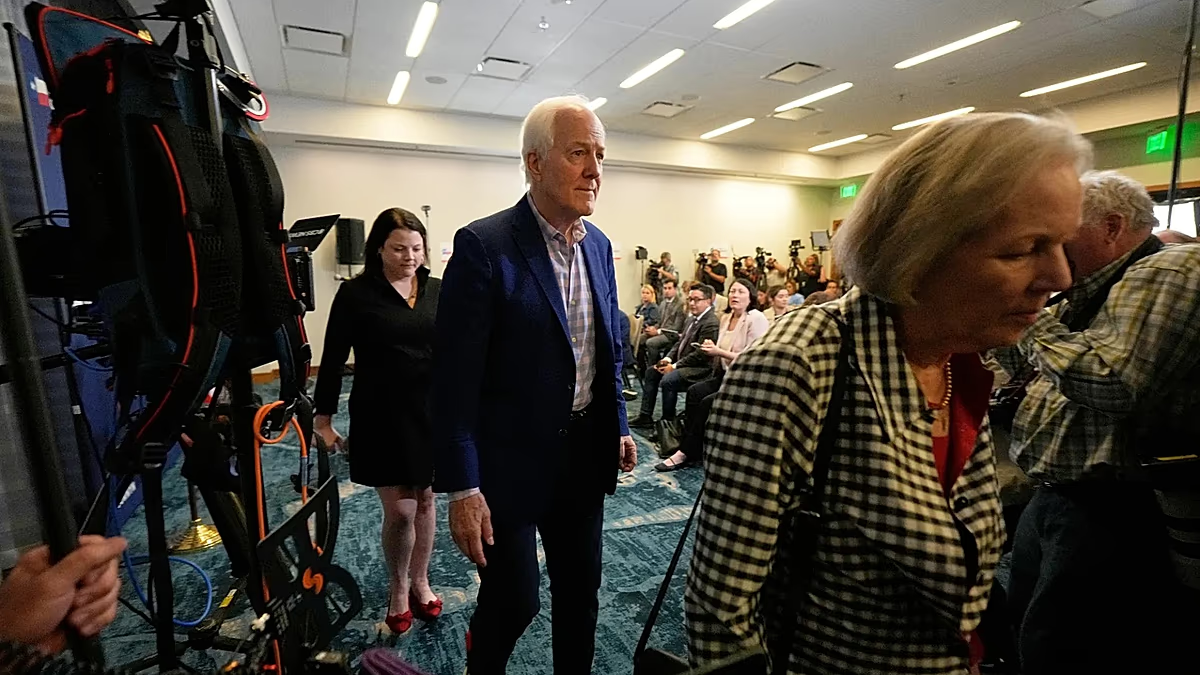
The most thunderous result came from the Republican Senate primary, where Texas Attorney General Ken Paxton, buoyed by a last-minute Trump endorsement, defeated the powerful four-term incumbent Senator John Cornyn. This was no ordinary upset. Cornyn is a pillar of the Washington GOP—a reliable conservative who voted with Trump’s position over 99% of the time and helped shepherd the president’s Supreme Court nominees to confirmation. Yet, he was branded by Trump as disloyal, an institutionalist lacking sufficient combativeness. Paxton, by contrast, carries a long trail of serious legal and ethical allegations, including securities fraud and bribery, and survived a Republican-led impeachment just last year. The GOP establishment, including Senate Republican leaders, poured millions into defending Cornyn, desperate to avoid the exact scenario that unfolded. Their failure was total. Paxton’s victory speech tellingly hailed Trump’s endorsement as “the most powerful force in politics,” a lesson every Republican lawmaker in Washington instantly understood.
Paxton now advances to a November face-off against Democratic nominee James Talarico, a 37-year-old former educator and rising star in his party, who has the backing of former President Barack Obama. Talarico immediately framed the race as a choice between “service and selfishness,” vowing to highlight Paxton’s scandals. While Texas has not sent a Democrat to the U.S. Senate in nearly four decades, polls suggest Talarico has a serious chance. This possibility sends a chill through the GOP. A Democratic win in Texas would not only be a political earthquake but could doom Republican hopes of keeping the Senate majority. It reveals the profound risk in Trump’s strategy: by prioritizing personal loyalty and ideological purity over a candidate’s broader electability, he may be jeopardizing the very congressional control he needs to govern effectively.
The implications of Cornyn’s defeat stretch far beyond a single Senate seat. It serves as a dire warning to every Republican incumbent across the country: aligning with Trump’s agenda is no longer enough. Survival now requires perceived personal fealty, a rejection of the “old guard,” and a demonstrated willingness to engage in perpetual political combat. The defeats of other established figures like Congressman Dan Crenshaw, who lost to a challenger running to his right, reinforce that the GOP base increasingly rewards ideological purity over pragmatism. For Trump, this translates into immense short-term power. As he enters the second half of his term, potential dissenters in Congress are now on notice, likely making his party more compliant on issues from immigration to executive authority, fearing they could be the next Cornyn.
However, this consolidation of power comes with significant perils and complications. The Texas primaries exposed a growing tension at the heart of Trumpism. By pushing the party toward more polarizing, MAGA-loyalist candidates, Trump may be strengthening his personal grip while weakening the party’s appeal in competitive general elections. Some Republican strategists fear nominating figures like Paxton in key states could energize Democratic turnout and alienate crucial suburban moderates, turning safe seats into battlegrounds. Should this lead to Republicans losing Congress in the midterms, Trump would face a torrent of investigations and legislative paralysis for his final years in office. Furthermore, the results suggest Trumpism is evolving from a personality cult into a rigid ideological litmus test within the GOP, a shift that may intensify internal factional wars long after Trump leaves the political stage.
Ultimately, the message from Texas is one of supreme, yet fragile, authority. The primaries confirmed that Donald Trump remains the gravitational center of the Republican universe, with the party moving decisively in his direction. For the remainder of his presidency, this guarantees him unparalleled influence over both policy and personnel. But the victory also magnifies his burden. The Republican Party’s fate in the midterms—and perhaps in the 2028 presidential election—will now be seen as a direct referendum on Trump’s political instincts and the durability of his movement. In making the GOP unmistakably his own, he has inextricably tied its success or failure to his personal brand, betting that the power of loyalty will outweigh the perils of polarization.