


In a significant and contentious development, European Union lawmakers are raising the alarm over what they describe as the excessive and covert influence of corporate lobbying on forthcoming environmental regulations. At the heart of the dispute is a draft EU law concerning data centres, the massive, energy-hungry facilities that power the digital world and, increasingly, the artificial intelligence boom. A deep-dive investigation by watchdog groups Corporate Europe Observatory and AlgorithmWatch revealed that the European Commission’s draft text included provisions “almost word-for-word identical” to wording suggested by the tech giant Microsoft and the lobby group DigitalEurope. This discovery has sparked accusations that the EU executive is quietly sidelining public and environmental interests in favor of corporate secrecy, setting the stage for a major clash over transparency, democracy, and the bloc’s green ambitions.
The specific point of conflict is a provision in the draft rules that mandates the Commission and member states to keep all information on individual data centres confidential. In a letter to Environment Commissioner Jessika Roswal, 35 Members of the European Parliament (MEPs) from the Green and Socialist groups decried this clause, arguing it was directly copied from Microsoft’s suggestions. They demand the amendment be deleted and “full transparency” restored. The lawmakers contend that this move would place almost all data on operational emissions and energy use behind closed doors, effectively shielding the industry from public scrutiny. As Greens/EFA lawmaker David Cormand starkly put it, while it is normal for a company like Microsoft to defend its interests, it is “quite another for the Commission to incorporate its demands almost word for word into European law.” This, the MEPs argue, reflects a profound democratic deficit in Brussels, where complex laws with far-reaching consequences are shaped with limited public visibility.
This controversy erupts at a critically sensitive moment for the EU’s policy agenda. The Commission is poised to unveil a strategy detailing how the bloc will power the explosive growth of AI and data centres, while also using digital tools to optimize its energy system. The EU’s goal is audacious: to triple its data centre capacity within five to seven years. This push is driven by fears of falling behind in the global technological race, particularly against China and the United States, which are aggressively integrating AI into their economies and energy systems. The EU executive warns that without such rapid expansion, the bloc’s future industrial competitiveness is at stake. However, this growth trajectory directly collides with another, equally binding EU priority: its legally mandated climate and energy efficiency targets. Lawmakers find it “extremely worrying” that vital environmental information would be hidden just as this unprecedented build-out is set to begin.
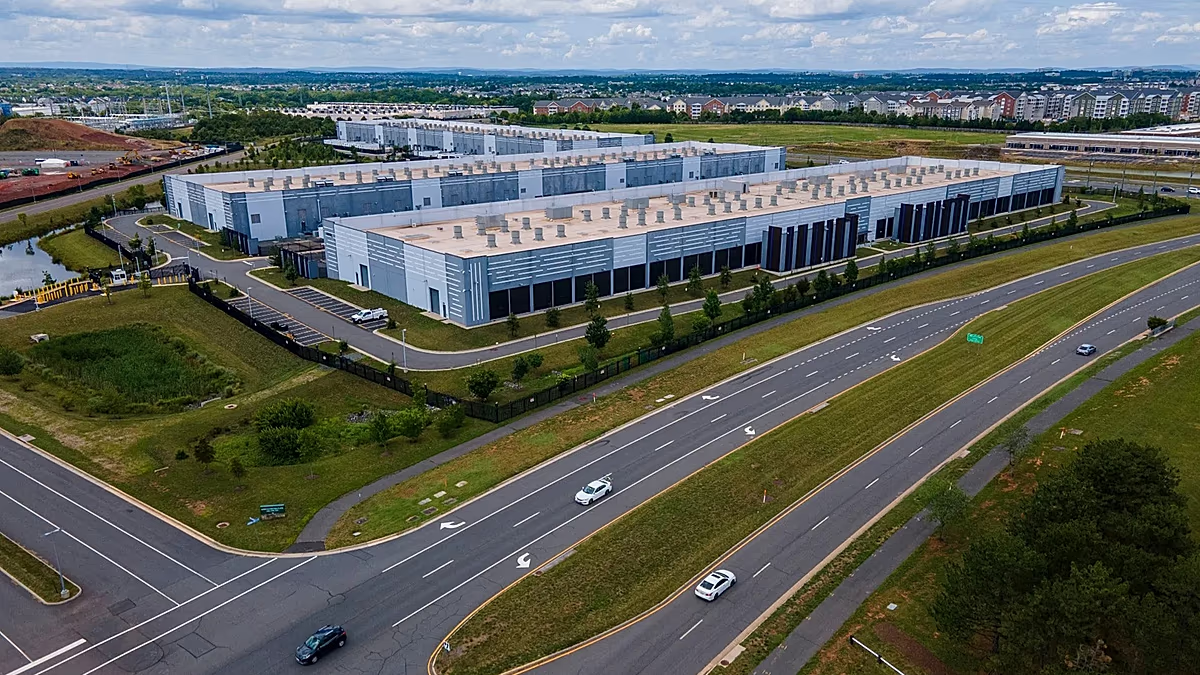
The environmental stakes are prohibitively high. Europe already hosts roughly 3,000 data centres, including about 300 “hyperscale” facilities designed for massive AI workloads, concentrated in countries like Ireland, Germany, the Netherlands, and the Nordic nations. These are not passive digital warehouses; they are major industrial consumers of resources. Their constant operation demands vast amounts of electricity, contributing significantly to carbon emissions based on the local power grid’s fuel mix. Furthermore, they require enormous cooling systems, which can lead to substantial water use, raising concerns about water stress during droughts and competition with local communities and agriculture. Additionally, they often rely on diesel backup generators and have a carbon footprint from construction. The MEPs’ letter highlights that the rapid proliferation of these centres is already straining electricity grids and contributing to rising energy prices, a problem that will only intensify as AI demands soar.
By advocating for secrecy, the Commission’s current draft risks utterly undermining the intent of existing EU energy efficiency legislation, which was explicitly designed to use transparency as a tool for accountability. The law in question aims to improve public oversight of high-energy industries, allowing watchdogs, researchers, and citizens to assess environmental performance. The provision, as criticized by the Corporate Europe Observatory, grants “Big Tech an early win” by keeping crucial data secret “despite the underlying directive explicitly calling for their publication.” The watchdogs and MEPs insist the clause goes far beyond the reasonable protection of genuine trade secrets, creating a blanket of opacity that would make it impossible to gauge the true environmental cost of the EU’s digital ambitions or to hold specific operators accountable for their footprint.
In conclusion, this dispute encapsulates a fundamental tension at the heart of modern governance: the race for technological supremacy versus the imperative of democratic and environmental responsibility. The European Commission faces a clear call to reassess its alignment with corporate lobbying interests. As the watchdog report concludes, “the Commission has to redo its homework and delete the copy-pasted Microsoft amendment.” The upcoming decision will serve as a powerful indicator of whether the EU can effectively regulate the powerful industries it seeks to foster, ensuring that its green commitments and democratic principles are not sacrificed on the altar of digital growth. The integrity of the bloc’s climate legislation and the public’s trust in its lawmaking process now hinge on a commitment to genuine transparency, allowing for an informed public debate on how to sustainably power our digital future.