


A Call for Tough Choices: Tony Blair’s Warning on Britain’s Fiscal Future
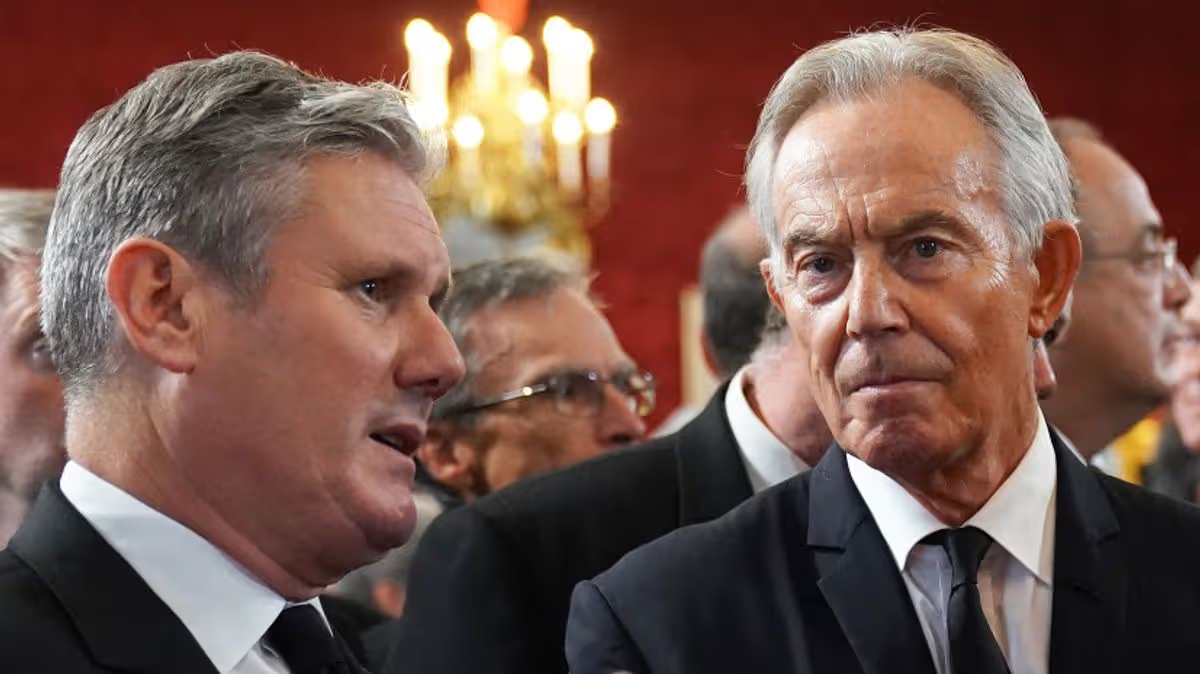
In a stark intervention, former Prime Minister Tony Blair has issued a direct challenge to the current political consensus, warning that the combination of soaring welfare costs and entrenched spending commitments is creating a “weight affecting growth” that could paralyze the British economy. Speaking on BBC Radio 4’s Today programme, Blair framed his critique not as a partisan attack but as a necessary and urgent dose of economic realism. He pinpointed the spiralling cost of incapacity benefits and the inflexibility of the state pension “triple lock” as particularly problematic, arguing that their continued large increases, while perhaps well-intentioned, are becoming unsustainable. His core message was blunt: if the nation’s course is not corrected, “we’re going to create a situation where economically we’re not able to grow.” This is more than a fiscal observation; it is a warning that the very engine of future prosperity—economic expansion—is being stifled by the weight of present-day obligations.
Blair’s analysis of the political landscape was equally forthright. He suggested that the current Labour government’s victory was not a ringing endorsement of a specific, transformative agenda, but rather a verdict on the perceived failures of the previous Conservative administration. “I think people thought that Conservatives have behaved completely unacceptably, and to Keir Starmer’s great credit, the Labour Party was an acceptable alternative,” he stated. This reading implies a mandate based more on competence and integrity than on a public clamour for a new set of sweeping, expensive promises. In Blair’s view, this context presented—and still presents—an opportunity for the new government to reset the national conversation, to move beyond the inheritance of crisis management and towards a clear-eyed strategy focused on a single, overriding priority: reigniting sustainable economic growth.
The former premier argued that upon entering office and surveying the “state of the inheritance,” the government faced a critical juncture. While acknowledging the difficulty of the moment—a sentiment he underscored by noting “everything in politics is difficult”—he outlined the path he believes should have been taken. It would have involved a courageous reappraisal of all spending commitments, however “worthwhile” they might be in principle. “I’d say, look, all of these commitments, they may be very worthwhile. There may be proper commitments in easy times, but in these hard times, we’ve got to prioritise growth,” Blair explained. This philosophy demands a hierarchy of objectives, where long-term economic vitality takes precedence over short-term political comfort, requiring the deferral or reshaping of policies that, in more prosperous times, might be easily affordable.
Central to this growth-centric strategy, in Blair’s view, is a dual focus on supporting the business sector and aggressively harnessing the potential of artificial intelligence. He emphasised that the government must “grasp it, both its opportunities and its risks, with both hands.” This is a call for a modern industrial policy that goes beyond mere regulation, actively partnering with enterprise to drive innovation, productivity, and competitiveness. The subtext is clear: the funds needed to invest in this technological future and to create a genuinely supportive environment for business are being increasingly swallowed by automatic, inflation-linked increases in major areas of social security. For Blair, the choice is between funding the past and investing in the future.
Ultimately, Blair’s critique culminates in a plea for political honesty and a more mature dialogue with the public. He contends that leadership, especially in “hard times,” requires the courage to confront uncomfortable truths head-on. “At some point you’ve got to be able to stand up and have an honest debate with the public,” he asserted, framing the national challenge in straightforward terms: “ultimately we’re probably taxing people too much, spending too much, borrowing too much at the moment.” This triad—high taxes, high spending, and high borrowing—is presented not just as a fiscal headache, but as a collective drag on national dynamism. His warning over the triple lock, a policy beloved by pensioners and politically hazardous to touch, is the most potent symbol of this dilemma. It represents how politically sacrosanct commitments can become economically constraining, locking governments into expenditure paths that may crowd out vital investment elsewhere.
In essence, Tony Blair’s intervention is a manifesto for a different kind of politics—one of explicit trade-offs and strategic prioritisation. He acknowledges that explaining such tough choices “would have been tough,” but maintains it was both necessary and possible. The underlying argument is that true political credit is won not by avoiding difficult debates, but by steering the country towards a more secure and prosperous future, even if that means reconsidering cherished policies in the present. His words serve as a reminder that economic growth is not an abstract statistic, but the fundamental prerequisite for funding public services, supporting vulnerable citizens, and improving living standards for all. Without a deliberate shift to prioritise it, he cautions, the nation risks a stagnant future where promises become impossible to keep.