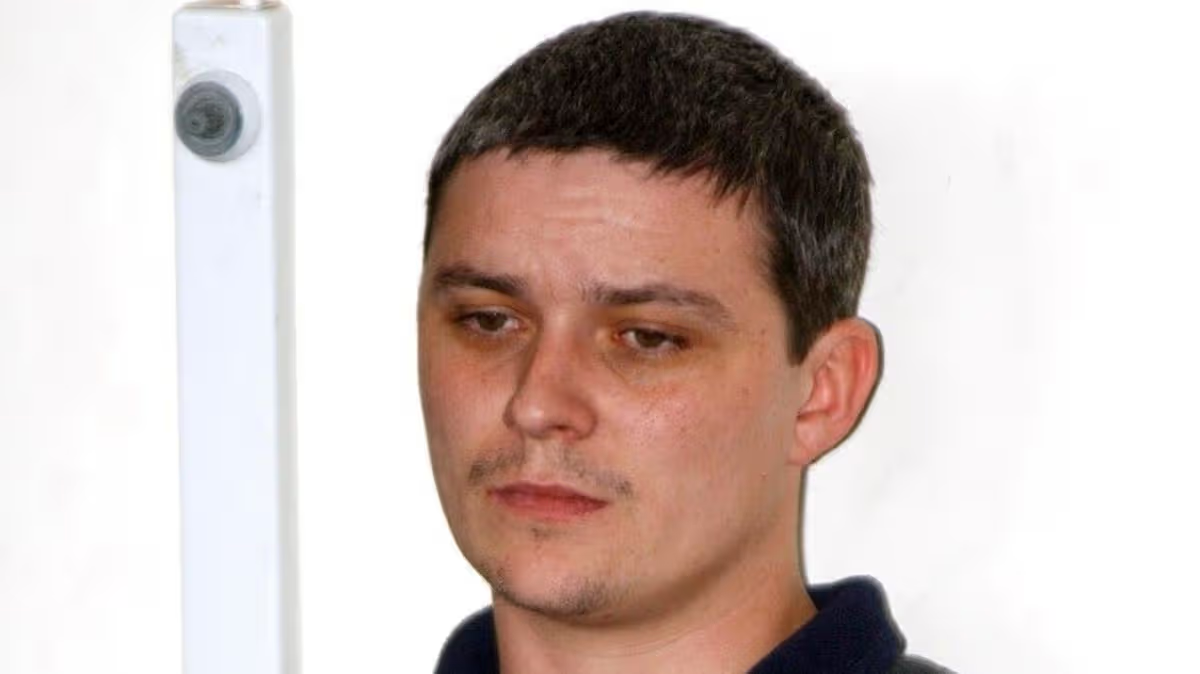




The death of Ian Huntley, one of Britain’s most reviled criminals, marked a violent and secretive end to a life defined by an unspeakable act of evil. On March 7, 2026, Huntley died in the Royal Victoria Infirmary in Newcastle, nine days after being brutally attacked within the walls of HMP Frankland, the high-security prison where he was serving a life sentence. The 52-year-old, convicted for the 2002 murders of ten-year-olds Holly Wells and Jessica Chapman in Soham, succumbed to severe head injuries inflicted by another inmate, allegedly wielding a metal bar. His death, occurring over two decades after his crimes shattered a community, reignited public memory of that traumatic summer while casting a stark light on the dangerous, closed world of the prison system where he met his fate.
The legal proceedings surrounding his death immediately entered a state of suspension, as confirmed during a brief coroner’s hearing at Crook Coroners’ Court. Coroner’s officer Bradley King outlined the facts: Huntley was struck “multiple times” in a prison workshop, an assault so severe it required him to be placed on life support before his eventual death. Senior Coroner Jeremy Chipperfield formally adjourned the inquest, stating the law requires such an investigation to be suspended when a person has been charged with an indictable offence. That person is Anthony Russell, a 43-year-old fellow inmate at Frankland, who now faces a murder trial for Huntley’s killing. This legal pause places the quest for official answers about the prison’s security and the circumstances of the attack on hold, pending the outcome of the criminal case.
Huntley’s final days were a grim echo of the notoriety he garnered in life, yet his passing was met with a deliberate, stark silence. Reports emerged that his remains were handled with an almost administrative coldness, cremated in secret without a funeral service or mourners. His body was released directly to the Prison Service, bypassing any public ceremony. Notably, it was reported that his family, offered a state-funded funeral, chose to decline the provision. This decision was described as an act of respect for the families of Holly and Jessica, a tacit acknowledgment that any gathering, however small, could retraumatize those who had suffered most from his actions. In death, as in the latter years of his life, Huntley existed in a form of isolated purgatory.
To understand the weight of this moment, one must recall the profound horror of Huntley’s crimes. In August 2002, he exploited his position as a school caretaker in Soham, Cambridgeshire, to lure Holly and Jessica into his home. Their disappearance triggered a massive, heart-wrenching two-week national search, during which Huntley cynically played the role of a concerned Good Samaritan, giving televised interviews. The subsequent discovery of their bodies and the truth of his guilt revealed a depth of betrayal that scarred the national consciousness. His six-week trial at the Old Bailey forced the grieving families to endure harrowing details, culminating in a sentence of life imprisonment with a minimum term of 40 years. His then-girlfriend, Maxine Carr, was convicted of perverting the course of justice for providing a false alibi.
Huntley’s incarceration was itself marked by volatility and self-destruction. Initially held at HMP Wakefield, he was transferred to Frankland in 2008. His time behind bars included a serious suicide attempt in 2006, underscoring a life that was both dangerous to others and to himself. The prison environment at Frankland, which houses some of the country’s most dangerous offenders, is a pressure cooker where violence is an ever-present risk. The alleged use of a metal bar as a weapon in a workshop raises inevitable questions about supervision, the management of inmate interactions, and the safety protocols within such a facility, questions that will eventually demand answers once the criminal trial concludes.
Ultimately, the story of Ian Huntley’s death is a bleak postscript to a narrative that forever altered the lives of two families and a nation’s sense of security. It provides no catharsis, offers no solace to the families of Holly and Jessica, and resolves nothing of the past. Instead, it serves as a dark footnote about justice, punishment, and the chaotic end that can await even the most closely monitored individuals within the penal system. The suspended inquest and pending murder trial mean the final chapter of Huntley’s story remains technically open, yet the essential facts are clear: a man who stole the innocence of two young girls met a violent, lonely, and unmourned end within the very system designed to contain the worst of human nature.