



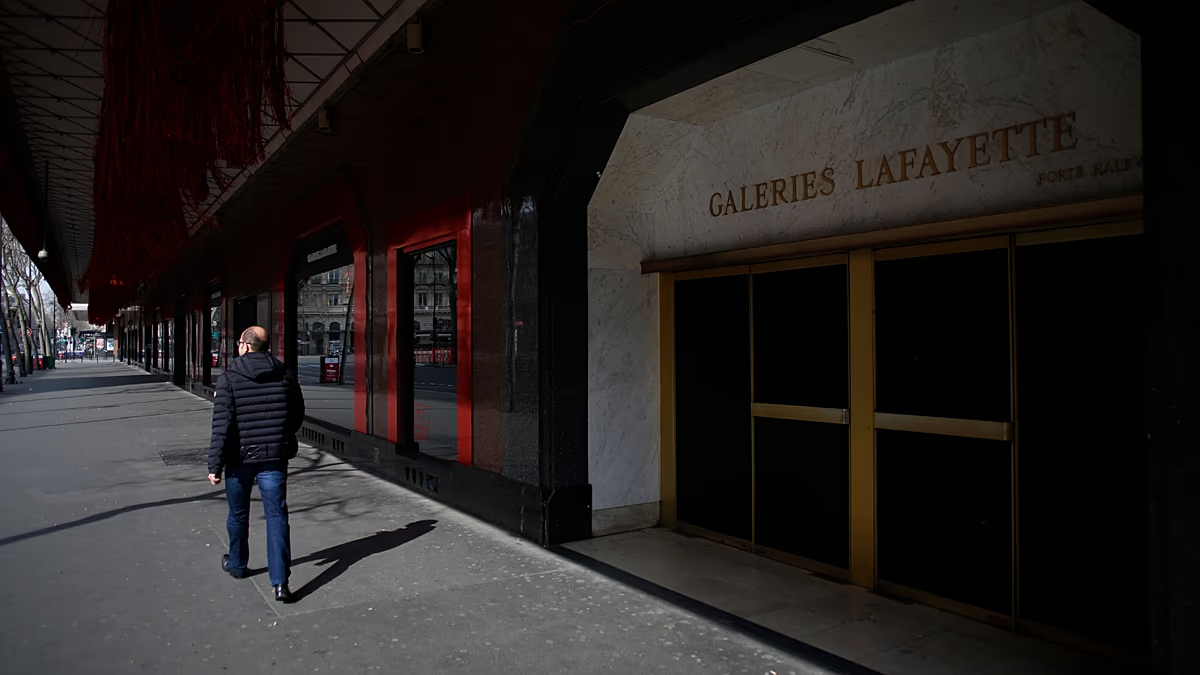
The recent closure of Galeries Lafayette’s inaugural flagship store in Beijing marks the end of a significant chapter, not just for the French retail icon, but for the luxury landscape in China itself. After thirteen years of operation, the sprawling six-storey emporium near the Forbidden City fell silent on May 27, 2026. The company cited declining sales as the direct cause, a quiet finale for a location that once stood as an iconic symbol of Western luxury for a generation of younger Chinese shoppers. This event, however, is far more than a simple business closure; it serves as a potent symbol of a profound and rapid evolution in Chinese consumer behavior and market dynamics, forcing global brands to adapt or recede.
To understand this moment, one must look back at the trajectory that preceded it. The mid-2010s witnessed explosive growth in China’s luxury market, fueled by the rapid expansion of an affluent middle class eager to acquire prestigious international brands. For many, destinations like the Beijing Galeries Lafayette were not just stores but destinations—temples of aspiration where one could experience the allure of Parisian chic firsthand. As Lisa Nan, an editor at Jing Daily, notes, this period represented a crucial decade of growth and maturation. Chinese consumers became deeply familiar with luxury, moving from novice buyers to sophisticated connoisseurs. Their tastes refined, and their expectations grew beyond mere logo recognition, setting the stage for the more discerning market we see today.
The shift from that boom period to the present day was accelerated by a confluence of major economic challenges. The COVID-19 pandemic and the subsequent severe property crisis acted as decisive turning points, abruptly curtailing domestic consumption and injecting a new sense of caution into spending habits. The economic uncertainty reshaped priorities, making consumers more deliberate and value-conscious. Simultaneously, as Lisa Nan points out, the very nature of what attracts shoppers has transformed. Younger consumers, in particular, are often no longer captivated solely by a brand’s legacy. They are drawn to immersive pop-up experiences, innovative digital marketing, and unique storytelling—elements that a traditional, large-format department store can struggle to provide consistently. This perfect storm of economic pressure and changing desires has created what Nan describes as a “major challenge” for the broader brick-and-mortar retail sector in China.
The final days of the Beijing store were tinged with a sense of nostalgia, highlighting the personal connections forged within its walls. In the hours before closure, a steady stream of visitors wandered through, capturing last memories and final bargains as staff packed away unsold goods and silent mannequins. For shoppers like Qian Linlin, a finance worker whose office was nearby, the closure was a surprising and sentimental blow. She recalled the store’s former status as a landmark where young people would flock to shop, a tangible piece of recent history now reduced to memory. Her sentiment underscores that while business strategies may pivot, these retail spaces become woven into the social fabric of a city, and their departure leaves a palpable void for the community that grew up around them.
Crucially, Galeries Lafayette has been careful to frame this not as a retreat from China, but as a strategic recalibration. In a statement bidding “not goodbye” but “see you soon” to Beijing, the group clarified its commitment to the market, with stores in Shanghai, Shenzhen, and Macao continuing operations. The company explicitly acknowledged that consumer expectations have “changed considerably.” Modern shoppers, they note, now prioritize greater convenience, high-quality service, meaningful experiences, and a heightened sense of well-being over the sheer scale of a retail offering. Therefore, the plan is to evolve towards more functional, curated store formats with a stronger focus on select brands and products, aiming to meet these new demands for quality and engagement over sheer quantity.
In conclusion, the shuttering of Galeries Lafayette’s Beijing flagship is a microcosm of a much larger narrative. It signifies the closing of an initial, enthusiastic chapter of Western luxury retail in China and the opening of a far more complex and demanding new one. The era where a prestigious foreign name and a massive footprint guaranteed success is over. The future belongs to retailers who can demonstrate agility, deep cultural resonance, and an unwavering focus on the sophisticated, experience-driven desires of the Chinese consumer. This is not a story of failure, but of necessary evolution—a poignant reminder that in the world’s most competitive markets, even the most storied institutions must listen, learn, and transform to remain relevant.