



Paragraph 1: The Core Dispute
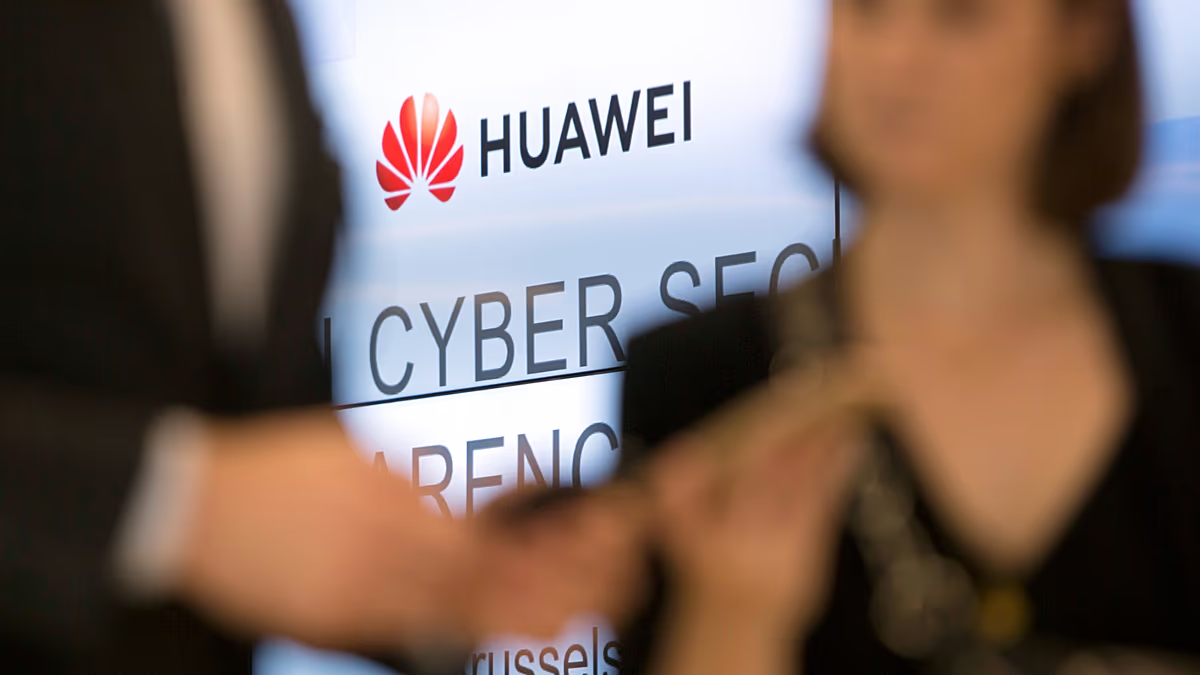
In a significant legal and commercial clash, the Portuguese telecommunications operator Meo has initiated a lawsuit against its own government, seeking €81.7 million in compensation. This substantial claim, filed in late April 2024 at the Lisbon Administrative Court, stems from state-mandated changes to Portugal’s 5G infrastructure. At the heart of the dispute is a 2023 resolution by Portugal’s Security Assessment Commission, which effectively excluded equipment from certain foreign vendors—most notably the Chinese tech giant Huawei—from the nation’s next-generation mobile networks on national security grounds.
Paragraph 2: The Rationale and Impact of the Ban
The government’s decision targeted suppliers from countries outside the EU, NATO, or OECD whose domestic laws could permit governmental “control, interference or pressure” over their operations abroad. While not explicitly naming Huawei, the resolution was universally understood to be aimed at the company, reflecting broader geopolitical tensions and security concerns prevalent across Western nations. For Meo, however, the ruling was not a theoretical policy shift but a costly operational directive. Having already integrated Huawei technology extensively into its evolving 5G network, the company was forced into a sudden and expensive overhaul, replacing the banned equipment.
Paragraph 3: The Human and Commercial Cost
Meo’s legal action argues that it has suffered “special and abnormal damage” due to these “administrative decisions.” The €81.7 million figure represents the tangible financial burden of this forced technological pivot—the costs of ripping out and replacing hardware, redesigning network architecture, and potential delays in service rollout. This lawsuit transforms an abstract security policy into a concrete balance sheet issue, highlighting the often-overlooked financial repercussions such geopolitical decisions have on private sector companies caught in the crossfire.
Paragraph 4: Industry-Wide Unease and Legal Challenges
Meo is not alone in its discontent. The ban has drawn criticism from across Portugal’s telecoms sector, suggesting the government’s approach may be seen as overly stringent. Executives from rivals Vodafone Portugal and NOS have publicly stated that Portugal’s measures are more “aggressive” and broader in scope than similar restrictions elsewhere in Europe, calling the resolution “not particularly well judged.” Furthermore, Huawei itself is not a passive observer; the company launched its own legal challenge against the resolution in September 2023, setting the stage for a complex multi-party legal battle that questions the boundaries of national security and fair market practice.
Paragraph 5: The Broader Context: A Global Trend Hits Home
This conflict in Portugal is a localized chapter in a global narrative. For years, the United States has pressured allies to exclude Huawei from critical infrastructure, citing espionage risks—claims Huawei consistently denies. Several European nations have adopted varying levels of restriction. Portugal’s case is striking because of the direct financial fallout for a major domestic operator and the resulting legal rebellion. It illustrates how international diplomatic and security pressures eventually land on the desks of corporate executives and, ultimately, can impact national infrastructure development and consumer access to technology.
Paragraph 6: The Stakes and Unanswered Questions
The outcome of Meo’s lawsuit carries significant implications. It will test the limits of state power to mandate security changes in private infrastructure and determine whether companies must bear the full cost of such sovereign decisions. A ruling in Meo’s favor could force the state to compensate for what the company views as an unfair financial burden, potentially influencing future policy-making. Conversely, a state victory would reinforce governmental authority in defining national security imperatives, regardless of corporate cost. As the case follows its “judicial course,” it leaves a critical question hanging: in the delicate balance between national security and economic fairness, who should pay the price when the rules change mid-game?