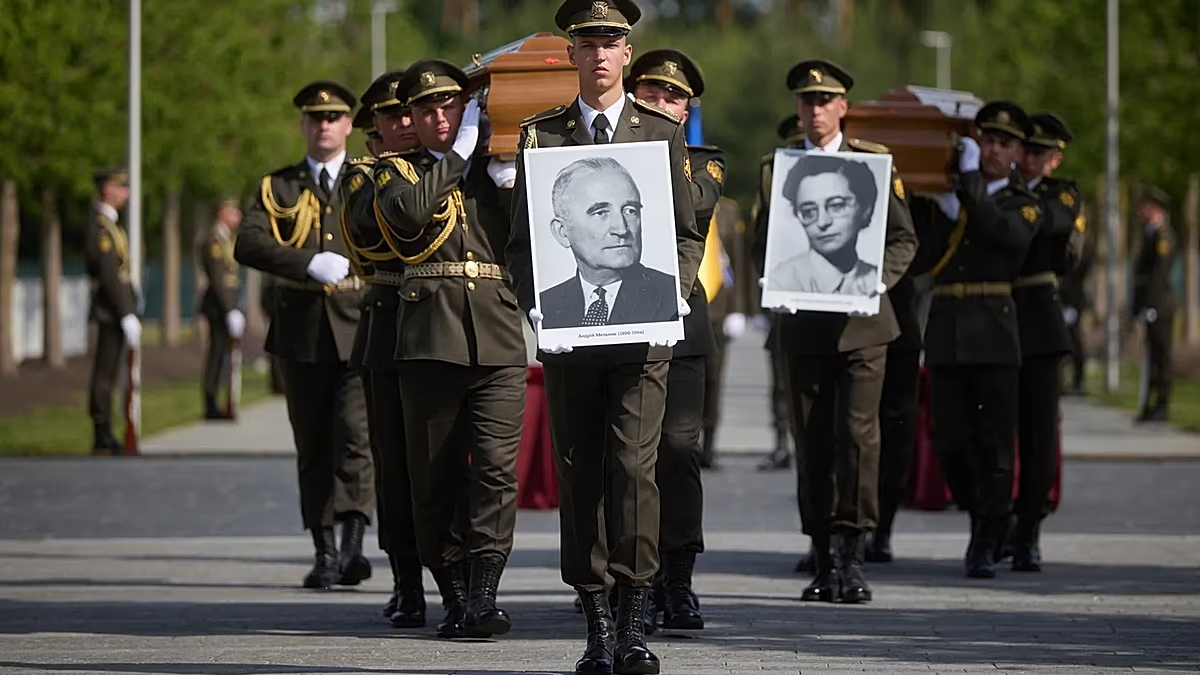



In a solemn ceremony attended by President Volodymyr Zelenskyy and other state officials, the repatriated ashes of 20th-century Ukrainian military leader Colonel Andrii Melnyk and his wife, Sofiia Fedak-Melnyk, were laid to rest at the National Military Memorial Cemetery near Kyiv on Monday. The couple’s remains, exhumed last week from Luxembourg where Melnyk died in 1964, were transported home in a procession that crossed half of Ukraine, symbolically returning a complex historical figure to the soil of the nation he fought to establish. President Zelenskyy, addressing the gathering, framed the event as a moment of national unity and historical closure. “Today we all see that the Ukrainian idea can overcome what once seemed absolutely insurmountable,” he stated, emphasizing that the return was conducted under the Ukrainian flag and anthem, allowing the nation to collectively feel “everything that Ukrainians were forced to go through.”
Andrii Melnyk, born in 1890, was a colonel in the Army of the Ukrainian People’s Republic and a key figure in the Organisation of Ukrainian Nationalists (OUN). His life was intertwined with the tumultuous struggle for Ukrainian independence amidst the dominating powers of the Soviet Union and Nazi Germany. He was a close comrade of Yevhen Konovalets, the OUN’s founding leader, until Konovalets was assassinated by the Soviet NKVD in 1938. This event precipitated a split within the OUN, resulting in two factions: the OUN-M, led by Melnyk, which advocated for a more traditional, hierarchical approach, and the more radical, populist OUN-B, led by Stepan Bandera. Both factions, driven by a fierce opposition to Soviet rule, remain subjects of intense historical controversy due to their wartime activities.
The controversy stems primarily from the factions’ tactical collaboration with Nazi Germany during World War II, a partnership born from the hope that Germany might facilitate an independent Ukrainian state against the Soviets. However, this hope was brutally dashed. Nazi Germany, having no intention of allowing Ukrainian sovereignty, soon turned against its temporary allies. Melnyk and other Ukrainian nationalist leaders were arrested; Melnyk was initially placed under house arrest before being deported to the Sachsenhausen concentration camp. His subsequent death in exile in Germany and burial in Luxembourg underscored the tragic trajectory of many Ukrainian independence efforts—opposed and crushed by both totalitarian regimes of the era.
President Zelenskyy’s remarks sought to navigate this difficult history by focusing on the present moment of unity and clear purpose. In a post on X about the repatriation journey, he noted, “There were no doubts about who Ukraine’s true enemy is, and who its friends, partners, and brothers are.” This statement implicitly draws a direct line from the historical enemies of Ukrainian statehood—the Soviet Union and Nazi Germany—to the current aggressor, Russia, while positioning the ceremony as a step toward healing internal historical divisions. The reburial, therefore, was not merely a historical tribute but a contemporary political act, aiming to consolidate a national narrative that transcends past factionalism.
The chosen final resting place reinforces this modern symbolism. The National Military Memorial Cemetery, an Arlington-style burial ground opened last year, is dedicated to soldiers killed in Russia’s ongoing invasions of Ukraine. By interring Melnyk there, his legacy is consciously linked to the present-day defenders of the nation. The ceremony thus becomes a bridge between generations of struggle, folding a contested past into the unambiguous, unifying narrative of current resistance. It acknowledges a historical figure whose legacy is shadowed by collaboration, yet reclaims him as a Ukrainian patriot whose ultimate fate—persecution and imprisonment by Nazis—aligns with the broader story of Ukrainian suffering and resilience under foreign oppression.
In conclusion, the repatriation and reburial of Andrii Melnyk is a multifaceted event. It is an act of historical recovery, bringing a exiled leader home. It is a gesture of national reconciliation, attempting to integrate a divisive chapter of history into a unified patriotic memory. Most powerfully, it is a contemporary political symbol, leveraging the past to underscore the clarity of Ukraine’s current fight for sovereignty. As Zelenskyy framed it, the journey of Melnyk’s ashes across a free Ukraine marked a path “not marked by the discord that had so often knocked us, and Ukraine, off our feet in the past.” In the context of a brutal war, the state has chosen to honor a complex figure not to glorify all his actions, but to claim his story as part of the long, painful, and enduring struggle for Ukrainian independence—a struggle that continues today on the very grounds where he now rests.