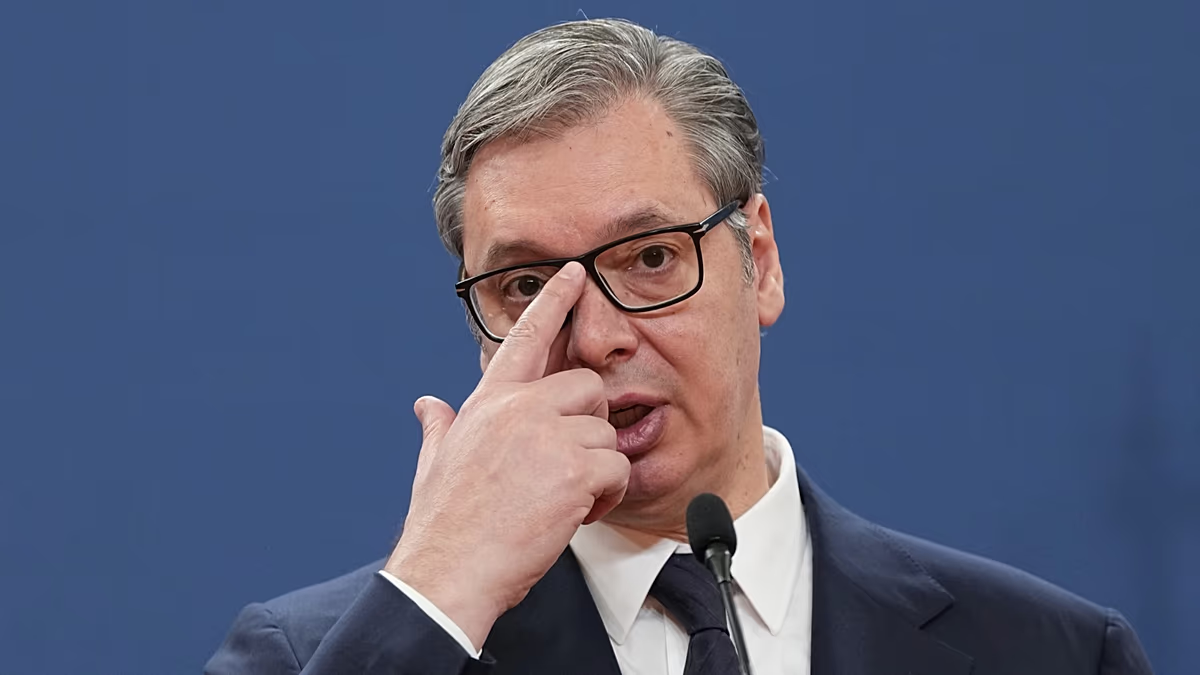


In a world where geopolitical alliances are increasingly scrutinized, Serbian President Aleksandar Vučić’s recent visit to Beijing underscores a defiant foreign policy path. During meetings with Chinese President Xi Jinping, Vučić openly criticized what he portrayed as European Union efforts to constrain Serbia’s diplomatic sovereignty. His pointed remarks at a press conference—suggesting the EU might as well provide a “wish list” of approved contacts—highlight the tension between Serbia’s pursuit of EU membership and its desire for an independent foreign policy. This stance frames Serbia not as a passive candidate awaiting accession, but as an “autonomous, sovereign, independent state” determined to engage with partners it deems vital to its national interests, chief among them being China.
The cornerstone of this strategic partnership is a significant free trade agreement solidified during President Xi’s own visit to Serbia in 2024. As Serbia’s largest foreign investor, China committed to drastically reducing tariffs on nearly all Serbian imports over the coming decade. This deal represents a substantial economic lifeline and a vote of confidence in the Serbian economy. However, from the EU’s perspective, this deepening entanglement presents a profound dilemma. Brussels is faced with the prospect of integrating a member state whose economic and political ties with Beijing could be more extensive than those of any current EU nation, potentially complicating the bloc’s own efforts to craft a unified stance towards China.
This friction is thrown into sharp relief by the timing of the Sino-Serbian agreement. It coincided with the EU’s own moves to increase pressure on Chinese imports, particularly electric vehicles, aiming to shield its domestic industries. Serbia’s enthusiastic embrace of a free trade pact amidst this backdrop is seen by many analysts as a symbolic challenge to EU economic policy. For Vučić, it is a pragmatic pursuit of investment and growth, but for EU accession negotiators, it is a major point of contention, raising questions about regulatory alignment and long-term strategic loyalty within the union.
President Vučić’s visit is part of a broader diplomatic offensive by China, which has recently hosted a series of high-profile world leaders. Just prior to the Serbian president’s arrival, Chinese President Xi Jinping held crucial talks with US President Donald Trump, aimed at de-escalating intense trade tensions that have defined the economic relationship during Trump’s second term. The outcome was a proposed framework for reciprocal tariff reductions, a significant, if tentative, step towards stabilizing trade on billions of dollars worth of goods. These discussions illustrate China’s active role in managing its most complex and economically critical bilateral relationship, even as it cultivates ties elsewhere.
Perhaps more consequential for European security dynamics was the immediately preceding visit by Russian President Vladimir Putin. The meeting between Xi and Putin, whom Xi addressed as a “dear friend,” resulted in a joint statement celebrating their “unyielding” bond and pledging enhanced military cooperation. This agreement deals a direct blow to European hopes that China might leverage its influence to moderate Russian actions in Ukraine. Instead, it signals a deepening of the strategic partnership between Moscow and Beijing, reinforcing a geopolitical axis that stands in contrast to the transatlantic alliance.
In conclusion, President Vučić’s defiant journey to Beijing is more than a bilateral meeting; it is a microcosm of a fragmented global order. Serbia, navigating between its EU candidacy and its tangible benefits from Chinese partnership, exemplifies the difficult choices facing nations in a multipolar world. Meanwhile, China, through its consecutive summits with Trump, Putin, and Vučić, demonstrates a multi-front diplomatic strategy: managing competition with the United States, consolidating an anti-Western partnership with Russia, and expanding its influence in strategic regions like the Balkans through economic statecraft. Together, these movements paint a picture of a world where traditional alliances are being tested and new power centers are actively being forged, with nations like Serbia carefully calculating their position amidst the shifting tectonic plates of international relations.