

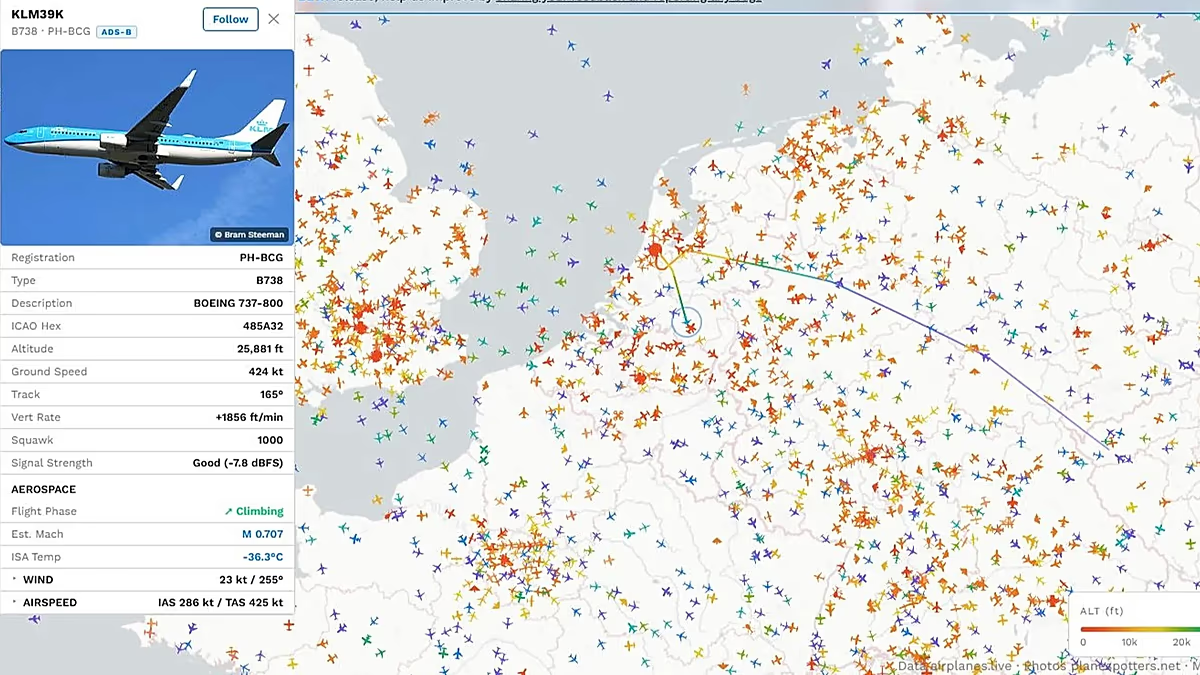


From the solemn, globally watched procession of Queen Elizabeth II’s final journey to the tense skies during the early days of the Iran conflict, when every departing flight from the UAE symbolized hope and escape, the public’s fascination with live aviation has never been more pronounced. In moments of historical significance or personal curiosity, people increasingly turn to flight tracking websites to “monitor the situation,” transforming abstract news into a tangible, moving map of the world. This digital window into the skies satisfies a deep human urge to witness events as they unfold, to feel connected to stories both monumental and mundane. It is within this context that a new flight tracker has been launched, promising not just to show the skies, but to intelligently interpret them for a growing audience of aviation enthusiasts and concerned observers alike.
Created by the well-regarded aviation news outlet Simple Flying, this new platform distinguishes itself with a sophisticated alert system designed to flag unusual activity. It goes beyond simply plotting an aircraft’s position; it analyzes data for potential anomalies like sudden altitude oscillations, erratic flight paths, unusual turn rates, and critical squawk codes—most notably the code 7700, the universal digital distress signal for an in-flight emergency. This feature transforms the tracker from a passive viewing tool into an active monitoring system, offering users a chance to be among the first to know when a plane might be in trouble. Furthermore, users can follow flights in breathtaking real-time or replay completed journeys, examining details like the specific aircraft model, operating airline, current altitude, and rate of climb or descent. The interface also integrates NOTAMs (Notices to Airmen), providing crucial context about airspace restrictions and hazards.
The tracker’s utility is enhanced by its powerful filtering options, allowing users to tailor the global map to show only commercial airliners, military aircraft, private jets, or even surface vehicles equipped with transponders. For those following specific stories or assets, the ability to create a personalized watchlist of particular aircraft tail numbers or callsigns is invaluable. An especially engaging feature for data lovers is the statistics panel, which offers insights like altitude distributions across the current traffic, lists of the top operators in view, and the most frequently spotted aircraft types at any given moment. This combination of depth, customization, and analytical tools makes it, as the article aptly notes, “an AV geek’s dream,” catering perfectly to the community that finds wonder in the technical rhythms of global flight.
But how does this digital magic actually work? The data powering Simple Flying’s tracker is sourced from providers like Airplanes.Live and OurAirports.com, which themselves rely on a vast, decentralized network of technology and volunteers. The primary technology is Automatic Dependent Surveillance–Broadcast (ADS-B), where aircraft automatically and continuously broadcast their identity, position, altitude, and speed. This signal is then captured by a global web of ground-based receivers. Supplementing this is MLAT (multilateration), a method used to calculate the position of aircraft that aren’t broadcasting full ADS-B data by triangulating their signals from multiple receivers. The remarkable aspect is that many of these receivers are operated by independent enthusiasts around the world, who contribute their data to the collective pool.
This collaborative, crowdsourced model means that the very act of flight tracking is a participatory endeavor. The article points out that interested individuals can even sign up to share their own data with networks like Airplanes.Live, becoming a tiny but vital node in this global sensing network. This democratization of aviation data underscores a significant shift: the skies are no longer the sole domain of official air traffic control systems for observation. Now, anyone with the right hardware and an internet connection can contribute to painting a real-time picture of worldwide aviation, fostering a unique blend of community, hobbyist passion, and public information.
Ultimately, this new tracker from Simple Flying represents the evolution of a simple tool into a rich, interactive platform. It meets our modern desire for instant, contextual, and detailed information, whether we are nervously tracking a loved one’s flight, watching history unfold in the form of a state funeral procession, or simply marveling at the complex ballet of aircraft crisscrossing the globe. By humanizing the data with alerts, filters, and statistics, it turns raw telemetry into a narrative. It serves as a testament to how technology, when combined with human curiosity and community effort, can bring the vast and often impersonal scale of global aviation down to a personal, understandable, and endlessly fascinating level.