



Summary and Analysis of the Iran Strait of Hormuz Fee Announcement
In a statement delivered on May 25, 2026, Iran’s foreign ministry clarified a controversial new maritime policy. Spokesman Esmaeil Baqaei explained that Iran is instituting fees for “navigational services” within a specific zone of the Strait of Hormuz, a vital global shipping corridor. He explicitly stated that these are not “tolls,” framing them instead as charges for essential services like environmental protection and safe passage management provided by Iran’s Persian Gulf Strait Authority (PGSA). This distinction appears to be a diplomatic effort to legitimize the action under international maritime frameworks, which allow for fee-based services, rather than presenting it as an arbitrary toll on sovereign waters.
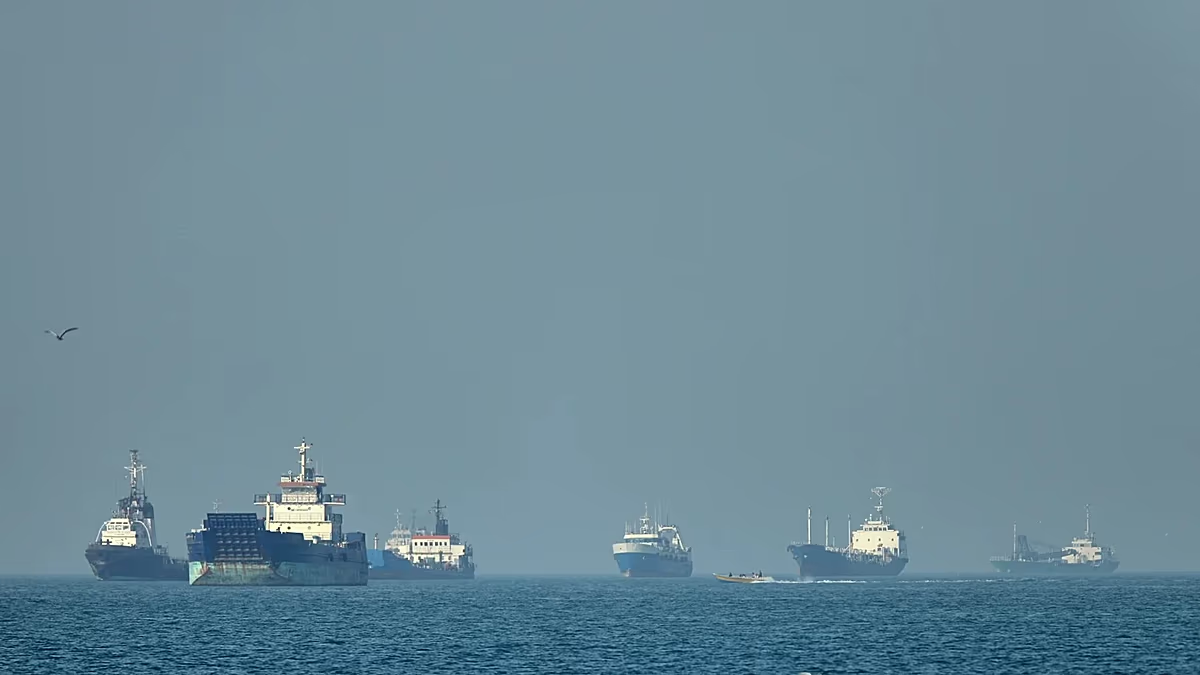
The move has immediately sparked significant regional controversy because of the geographic scope of Iran’s claimed regulatory zone. Iran published a map asserting control over a vast stretch of the strait that extends deep into waters internationally recognized as belonging to the United Arab Emirates and Oman. This unilateral declaration effectively redraws maritime boundaries and demands that all vessels within this zone obtain prior authorization from the Iranian PGSA. By establishing this requirement, Iran is positioning itself as the mandatory administrative authority for a critical portion of one of the world’s most important waterways.
The reaction from other Gulf states was swift and coordinated. Bahrain, Kuwait, Qatar, Saudi Arabia, and the UAE jointly submitted a formal letter to the International Maritime Organisation (IMO). Their message was a clear warning to international shipping companies: do not comply with Iran’s PGSA or use its newly designated routes. This collective action underscores the depth of regional opposition and aims to mobilize global institutional support to counter Iran’s claims. The conflict is rooted in a fundamental clash over sovereignty and control, with Iran’s neighbors viewing the action as an aggressive infringement on their territorial rights.
The tensions are not confined to regional actors; they have direct and severe global implications. The Strait of Hormuz is a linchpin of global energy security, with approximately one-fifth of the world’s oil and gas trade passing through it. Historical context is crucial here: the article references that Iran had previously “effectively shuttered” the waterway during earlier conflict, and the US had responded with a blockade. The current reintroduction of fees and control measures threatens a renewed disruption. Such instability directly impacts global oil and gasoline prices, creating political and economic pressure, notably mentioned on the US administration during an election period.
The economic repercussions are already being felt worldwide, with Europe serving as a prime example. The European Commission has revised its 2026 growth forecast downward, citing the ongoing Middle East conflict and the resultant spike in energy prices as primary causes. The EU’s expected economic growth was cut from 1.4% to 1.1%, and the eurozone outlook fell to 0.9%. This official assessment directly links the escalating tensions around the Strait of Hormuz to a worsening global economic outlook, demonstrating how localized geopolitical maneuvers can trigger broad financial consequences.
In essence, Iran’s announcement is more than a simple policy change; it is a strategic gambit with layered consequences. By framing fees as “services,” Iran seeks a veneer of legality, while its expansive territorial claim asserts practical control. The unified rejection by Gulf states highlights the risk of regional fragmentation, and the global economic forecasts confirm the real-world impact on energy markets and growth. This situation encapsulates a modern geopolitical standoff, where control of a narrow maritime passage becomes a lever influencing international trade, regional alliances, and the economic stability of nations far beyond the immediate conflict zone.