


Paragraph 1: A Gathering of Hope and Anguish
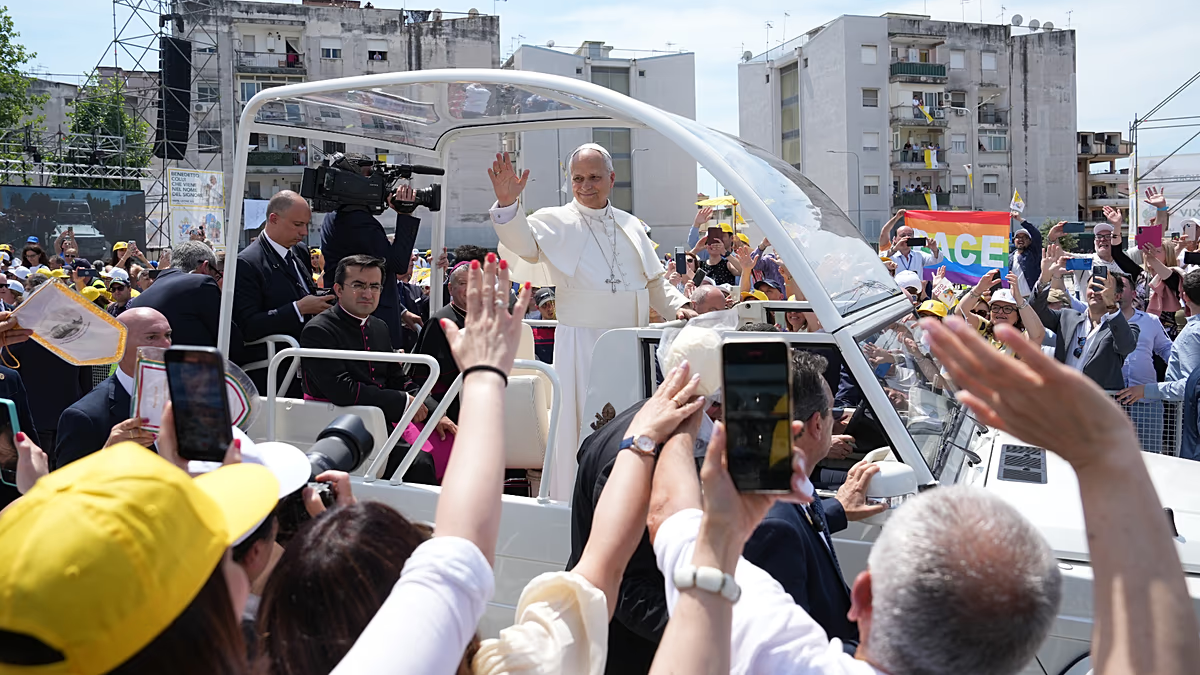
On a Saturday in Campania, a crowd of some 15,000 people filled Acerra’s Piazza Calipari, their presence a powerful blend of hope and anguish as they awaited Pope Leo XIV. The Pope’s visit was not to a celebrated shrine, but to the heart of the infamous “Terra dei Fuochi” – the “Land of Fires.” This is a region whose very nickname speaks to decades of environmental devastation, where illegal dumping and the nocturnal burning of toxic waste have poisoned the earth, polluted groundwater, and cast a long shadow over public health. The gathered multitude, standing in a piazza named for a national hero, came to seek solace and bear witness to their prolonged suffering, hoping for a voice powerful enough to echo their plight beyond the borders of their scarred homeland.
Paragraph 2: First, a Private Acknowledgment of Loss
Upon his arrival, Pope Leo’s first act set a tone of profound pastoral care. Before the formal ceremonies, he turned his attention to those who had been left outside the overflowing cathedral. He then entered to meet privately with families who had lost loved ones—victims of the elevated cancer rates and diseases linked to the pollution. This intimate encounter grounded his entire visit in raw human loss. Later, addressing the public, he acknowledged the grim renown of the “Terra dei Fuochi,” noting that the label, while failing to capture the enduring goodness of its people, had at least served to awaken broader consciousness to the “criminal activity and the indifference” that had allowed such crimes to flourish.
Paragraph 3: A Call for a Moral and Economic Reckoning
From within the cathedral, the Pope issued a challenge that extended far beyond the immediate environmental crisis. He called for a fundamental rethinking of our economic and social models, urging a move away from systems that prioritize profit over people and planet. “Let us learn, then, to be rich in a different way,” he implored, advocating for wealth measured in strong relationships, the common good, attachment to one’s local area, and the gracious integration of newcomers. He specifically linked the environmental devastation to social injustice, identifying the “fires lit on the edges of cities” as acts often born from desperate, marginalized communities. His insight was piercing: “Marginalisation always breeds insecurity.” The true path, he argued, is to combat the root causes of marginalization itself, not to punish the marginalized, breaking an entire chain of neglect rather than striking only its final, visible link.
Paragraph 4: A Public Assembly of Resolve
The Pope then moved to the main square, where his audience embodied the collective will of the region. Awaiting him were the mayors of all 90 municipalities within the Terra dei Fuochi, alongside thousands of citizens and representatives from environmental advocacy groups. This was a formal assembly of civil society and local governance, united in their struggle. To these leaders and families, Pope Leo offered a transformative vision: the same “fires” that defined their suffering could be metaphorically converted into a new, positive force. He expressed his hope that they might become “a fire that revives and warms, the fire of the Spirit” – a spiritual and social energy that would ignite hearts and inspire widespread care, consolation, and genuine love for their community and land.
Paragraph 5: The Community Gives Voice to Its Pain and Resolve
The gathering was not merely about hearing from the Pope; it was equally an occasion for the community to articulate its own decades-long ordeal. Bishop Antonio Di Donna of Acerra recounted the bitter history, emphasizing the persistent nature of the crimes by referencing a recent, fresh discovery of toxic waste dumping in nearby Caserta. His words underscored a tragic continuum of violation. Following him, Acerra’s Mayor, Tito d’Errico, speaking for all the assembled mayors, gave a powerful voice to the people’s determination. He acknowledged the “deep wounds inflicted by wrongdoers who have served profit” and the resulting suffering from pollution, fires, and family loss. Yet, he fiercely rejected the narrative of victimhood, declaring, “this is not a land of resignation, but of civic resistance and moral redemption, thirsting for profound change.”
Paragraph 6: A Unified Cry for Justice and Renewal
The visit of Pope Leo XIV to Acerra thus crystallized into a pivotal moment of moral recognition and collective resolve. It wove together the private grief of bereaved families, the public solidarity of thousands, the administrative burden borne by local mayors, and the spiritual call for a civilizational shift. The event transcended a simple papal address; it became a platform where the Church, civil authorities, and citizens stood together to denounce environmental crimes as both an assault on creation and a failure of social justice. The unified cry that emerged was not one of despair, but a demand for accountability, healing, and a redeemed future—a future where the fires that once symbolized destruction might instead symbolize the enduring, warming light of community resilience and renewed hope.