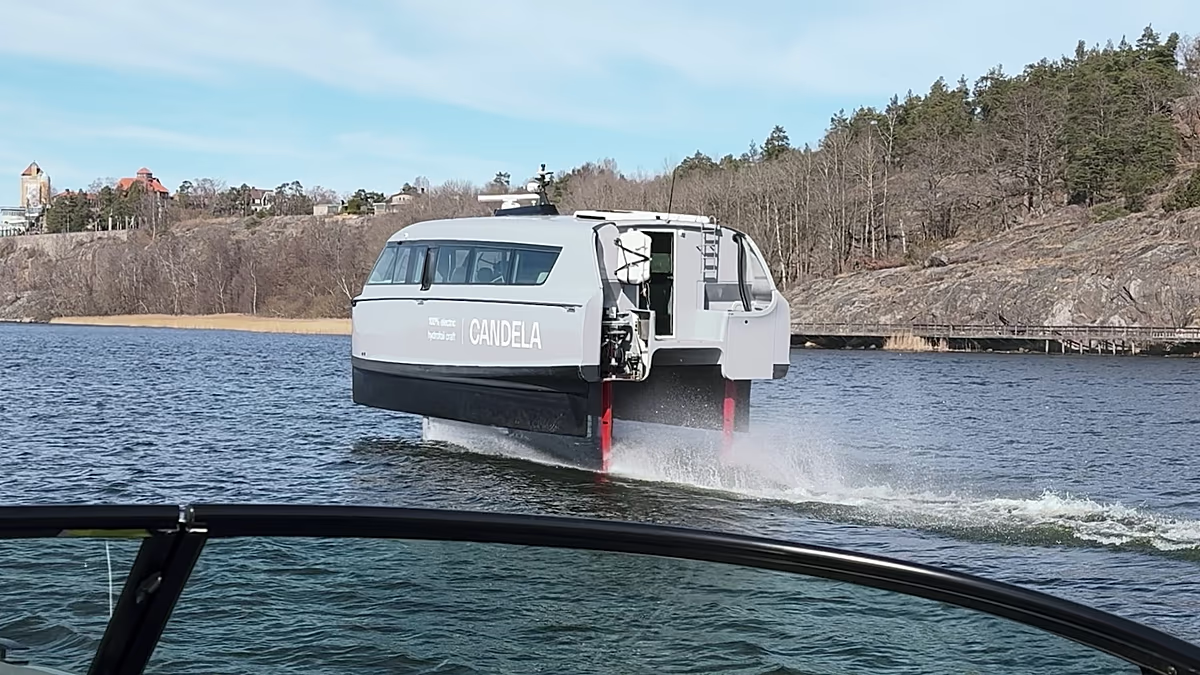



The scene at Stockholm’s Frihamnen harbour is one of quiet revolution. Gustav Hasselskog, founder and CEO of Candela, steps aboard a vessel that seems plucked from a sci-fi narrative—low, sleek, and resembling an aircraft fuselage more than a traditional ferry. As the Candela P12 pulls away from the dock, Captain Lars Billström guides it to a transformative moment: “We will go full power up to 17 and then she lifts above the water and then we fly.” True to his word, the 30-seat commuter ferry rises smoothly on hydrofoils, its hull entirely above the surface. The churning wake and engine roar synonymous with ferry travel vanish, replaced by an almost silent glide as the city’s shoreline slips past. This is not merely a new boat; it is a fundamental reimagining of waterborne transport, where flight replaces plowing, and silence replaces noise.
The physics behind this silent flight is where the true innovation lies. As Captain Billström notes, lifting the boat reduces water drag by an astonishing 80 to 85 percent. This drastic efficiency gain is the key to electrifying vessels at this scale. Hasselskog explains the core challenge: batteries contain far less energy than diesel, making traditional electric boats impractical for long routes. By resurrecting and re-engineering hydrofoil technology—using underwater wings to lift the hull—Candela found its answer. However, a crucial difference from aircraft makes hydrofoiling uniquely difficult: a boat’s center of gravity sits above its lifting point, creating a natural instability. Solving this instability was the pivotal engineering hurdle that had long hindered the technology’s widespread use.
Candela’s elegant solution lies in a digital nervous system. Onboard computers, armed with a suite of sensors, measure the vessel’s position and adjust the angle of its hydrofoils 100 times per second. This constant, micro-second correction transforms an inherently unstable platform into one that is not only stable but offers a ride smoother than any conventional boat. Mikael Mahlberg, Candela’s head of communications, highlights the profound benefits while aboard one of their smaller leisure models: “We take the discomfort out of boating.” The technology eliminates not just emissions and fuel costs, but also the environmental nuisances of oil spills, disruptive noise, and shoreline-eroding wakes. It makes electric vessels not just viable, but superior—cheaper to operate, greener, and more pleasant to ride.
This superior value proposition is catalyzing a global shift. At Candela’s production facility north of Stockholm, the assembly line is humming to meet international demand. Orders are flowing in from Mumbai, Bangkok, Saudi Arabia, the Maldives, and major U.S. cities. A landmark contract for twenty ferries from Norway stands as the world’s largest order for electric hydrofoil vessels to date, signaling strong market confidence. Yet, paradoxically, Europe—the company’s home continent—remains its slowest market. Hasselskog points to lengthy political and public tendering processes that hinder technological adoption. Despite this, his vision for Europe is expansive: he sees its historic, underused waterways as the next frontier for efficient, modern, and clean urban mobility.
To fulfill this vision, Candela is poised for significant growth, planning to expand from 250 employees to 1,000 and open a new factory in Poland. Hasselskog knows that such scaling depends on more than just engineering talent; it requires a deliberate and nurturing company culture. He has coined the principle “revolutionary kindness.” The “revolutionary” aspect embodies the conviction that with deep knowledge and respect for the laws of nature, monumental challenges can be overcome. The “kindness” element is dual-purpose: it is the drive to create a tangible good for society—cleaner cities and quieter waters—and the commitment to foster a supportive, fear-free internal environment. Hasselskog believes that creativity and efficiency flourish in kindness, whereas a culture of fear drives away the very innovators needed to sustain a revolution.
In essence, the Candela P12 gliding silently past Stockholm is more than a prototype; it is a physical manifesto. It declares that the future of transport need not be a trade-off between performance, economics, and ecology. By marrying cutting-edge hydrofoil aerodynamics with sophisticated software control, Candela has broken a longstanding barrier, making electric water transport not only feasible but highly desirable. Coupled with a company culture designed to sustain innovation, this technology offers a blueprint. It points toward a future where our oldest travel routes—the world’s waterways—are revitalized into silent, swift, and sustainable arteries for modern life, all powered by the synergistic principles of revolutionary engineering and profound human kindness.