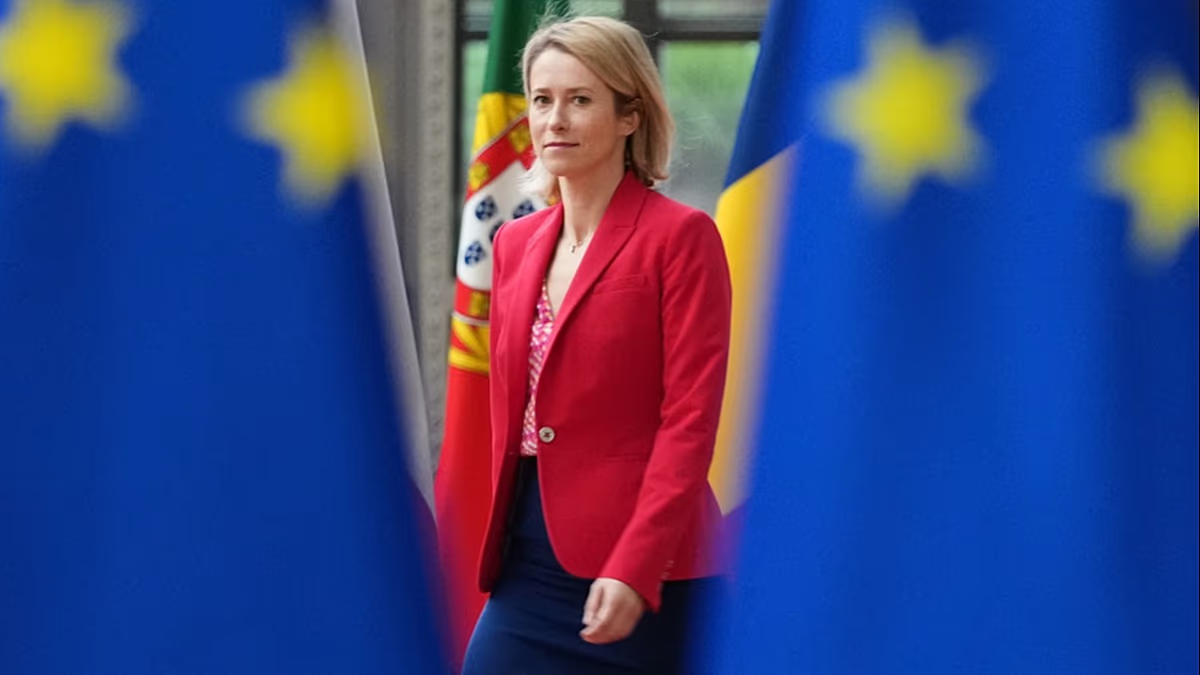


In a global economic climate increasingly marked by the resurgence of protectionist policies and trade tensions, the European Union and Mexico have taken a decisive step in the opposite direction. On Thursday, EU foreign policy chief Kaja Kallas announced the forthcoming modernization of the bloc’s commercial agreement with Mexico, framing it as a vital move to dismantle barriers and foster open commerce. This update, scheduled for formal signing on Friday in Mexico City, represents a strategic commitment to deeper integration at a time when many nations are retreating behind tariffs and quotas. Kallas emphasized that the agreement is designed to eliminate remaining obstacles to trade and investment, specifically targeting key sectors like raw materials, agriculture, and services. This proactive stance underscores a shared belief that economic resilience is built on cooperation, not isolation, positioning both partners to navigate a fragmenting global marketplace with greater confidence and mutual support.
The timing of this enhanced pact is particularly significant, as Mexico concurrently engages in negotiations to revise the USMCA free trade agreement with its largest trade partner, the United States, and Canada. This dual-track diplomacy highlights Mexico’s pivotal role as a bridge between major economic blocs and its strategy to solidify multiple, robust trade pathways. By strengthening its ties with Europe while also updating its North American framework, Mexico is not merely diversifying its economic relationships; it is actively constructing a more stable and diversified trade architecture. The EU, as Mexico’s third-largest trading partner, sees this modernization as an opportunity to lock in and accelerate the impressive growth already achieved—a 75% increase in bilateral trade over the past decade. This agreement, therefore, is more than a bilateral update; it is a calculated element in a broader geopolitical strategy to ensure supply chain security and economic agility.
The substantive benefits of the modernized agreement are focused on practical, sector-specific gains that will translate into tangible economic opportunities. Kallas pointed to the removal of barriers in “strategic sectors” such as raw materials, agriculture, and services. This targeted approach addresses core components of both economies: ensuring access to critical inputs for industry, facilitating the exchange of agricultural goods, and enabling greater cross-border flow in the dynamic services market. Furthermore, Kallas highlighted that the update will “strengthen supply chains and open new opportunities that will help both economies compete globally.” In an era where supply chain disruptions have caused widespread economic headaches, this collaborative effort to create more resilient and efficient networks is a direct response to recent global challenges. It transforms the trade relationship from a simple exchange of goods into a deeper, co-dependent partnership aimed at shared competitive advantage on the world stage.
The formal signing ceremony, to be attended by Mexican President Claudia Sheinbaum and European Commission President Ursula von der Leyen, symbolizes the high-level political commitment behind this economic upgrade. The choice of Mexico City for the event underscores the importance of the partnership from the Mexican perspective, as the nation seeks to elevate its global economic profile. The existing trade figures—with Mexico importing nearly $67 billion from Europe in 2025 and exporting around $28 billion in return—illustrate a relationship that is already substantial but possesses clear potential for more balanced growth. The updated agreement aims not only to increase the volume of trade but also to address disparities, fostering a more symmetrical exchange that benefits industries and workers on both sides of the Atlantic. This ceremonial act, therefore, marks the transition from negotiation to implementation, setting the stage for the next chapter of a long-standing partnership.
Beyond the immediate economic metrics, this agreement carries profound geopolitical and philosophical weight. By choosing to deepen integration amidst a global trend toward protectionism, the EU and Mexico are making a statement about their vision for the future of international commerce. They are advocating for a model where rules-based trade, fair competition, and open markets serve as engines for innovation and development. This stands in contrast to the zero-sum, tariff-driven approaches gaining ground elsewhere. For the European Union, the agreement also reinforces its role as a global economic anchor, committed to building bridges with strategic partners worldwide. For Mexico, it enhances its autonomy by providing a strong counterbalance to its dominant trade relationship with the United States, offering more diversified options for its exports and investments.
In conclusion, the modernization of the EU-Mexico trade agreement is a multifaceted development with immediate economic and long-term strategic implications. It is a direct response to the protectionist currents of the contemporary world, a move to solidify supply chains, and a deliberate effort to generate growth in critical sectors. As Mexico navigates parallel negotiations with its North American neighbors, this strengthened European link provides valuable balance and security. The upcoming signing is not merely a procedural event; it is the launch of a renewed partnership aimed at ensuring that both economies are not merely participants in the global system, but active shapers of a more open, resilient, and cooperative trading environment. The success of this updated framework will ultimately be measured by how effectively it translates high-level principles into concrete benefits for businesses, communities, and citizens across both regions.