
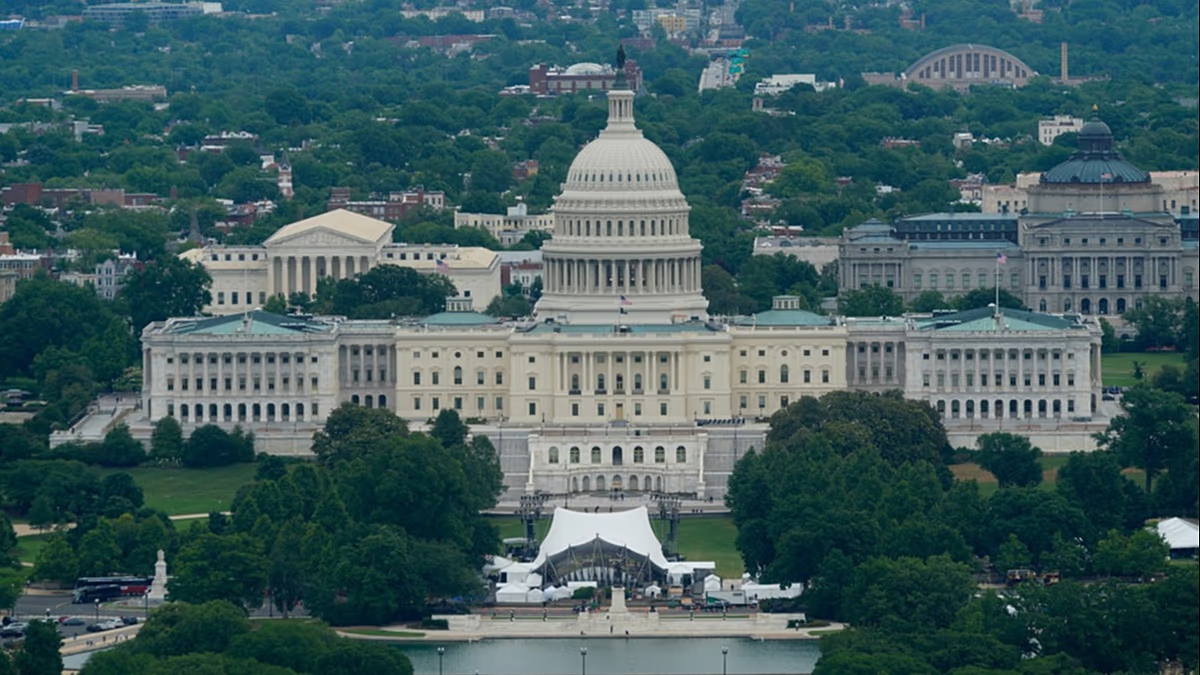


In a significant shift within the halls of the U.S. Congress, a growing bipartisan frustration over the ongoing military engagement with Iran is challenging the once-solid support for President Donald Trump’s foreign policy. On a recent Thursday, Republican leaders in the House of Representatives faced an unexpected political dilemma. They were forced to abruptly delay a scheduled vote on a Democratic-sponsored war powers resolution, a measure designed to compel the President to withdraw American forces from the conflict. This procedural stall was not a sign of strength, but a stark admission that they lacked the votes to defeat the bill. The move reveals a widening crack in the Republican facade, as rank-and-file members grow increasingly uneasy with a war launched without congressional approval over two months prior, in concert with Israel, and with no clear end in sight. As Democratic Congressman Gregory Meeks, the resolution’s sponsor, pointedly noted, the delay was a “political game” necessitated by the fact that the opposition simply had the numbers to win.
This unease is not confined to one chamber of Congress. In the Senate, Republican leaders are similarly scrambling to shore up support, following a preliminary vote earlier in the week where four Republican senators broke ranks to support an identical war powers resolution, with three others absent. The collective actions of congressional leaders signal a profound struggle to maintain political unity behind the President’s handling of a conflict initially presented as a matter of weeks but now approaching the three-month mark. The explanation offered by House Republican Leader Steve Scalise—that the delay was to accommodate absent lawmakers—rang hollow to many, particularly as House Speaker Mike Johnson avoided questions from reporters. The underlying truth is that patience among lawmakers on both sides of the aisle is wearing dangerously thin, eroded by the war’s mounting costs and strategic stagnation.
The source of this mounting frustration is multifaceted, rooted in both principled constitutional concerns and tangible economic consequences. On Capitol Hill, the protracted stalemate in the strategically vital Strait of Hormuz has disrupted global shipping lanes and contributed to rising oil prices, hitting American consumers directly. This economic pinch amplifies the core legal argument driving the war powers resolutions: the War Powers Act of 1973. This law mandates that a president must seek congressional authorization for military actions within 60 days. As Republican Congressman Brian Fitzpatrick of Pennsylvania succinctly stated, “We’re past 60 days so it’s got to be brought to us to vote on. We’re following the law.” His declared intention to support the Democratic resolution underscores that this is no longer a purely partisan issue, but a constitutional one for a growing number of legislators who believe the executive branch has overstepped its legal timeline.
Despite this building congressional pressure, the White House maintains its defiance. Administration officials argue that the requirements of the War Powers Resolution are moot due to a ceasefire that has been in effect since early April. However, this technical argument is undercut by the President’s own volatile rhetoric. On social media, he has continued to issue threats of a “full, large scale assault on Iran” should diplomatic negotiations fail, creating a state of perpetual uncertainty and undermining claims that the conflict is truly paused. This disconnect between a stated ceasefire and ongoing threats of imminent escalation leaves Congress in a bind, watching a conflict that simmers without resolution, while their own constitutional power to declare war is sidelined. The President’s pattern of setting and then backing off from deadlines with Tehran only deepens the skepticism on Capitol Hill about the administration’s long-term strategy.
The political dynamics surrounding the delayed vote illuminate a potential turning point. Last week, a similar war powers resolution failed in the House by a single tie vote, with three Republicans crossing the aisle. The fact that Republican leadership now fears a clear defeat indicates that support may be eroding further. Critically, the lone Democrat who voted against the measure last time, Representative Jared Golden of Maine, has pledged his support for the new resolution, uniting the Democratic caucus. This solidifies the opposition front and increases the pressure on wavering Republicans. In a powerfully worded joint statement, House Democratic leaders condemned the decision to pull the vote as “cowardly,” linking it to the impending Memorial Day holiday and the sacrifice of service members they argue have been “recklessly put in harm’s way.” This framing elevates the debate from procedural squabble to one of accountability and solemn duty.
Ultimately, the delayed vote is more than a temporary parliamentary tactic; it is a symptom of a deep and spreading congressional rebellion against a prolonged military commitment. What began as broad Republican support for action against Iran’s nuclear capabilities is fracturing under the weight of time, legal mandates, and economic fallout. A coalition of Democrats and a small but decisive bloc of Republicans is now asserting Congress’s foundational role in matters of war and peace. While the White House attempts to navigate around the War Powers Act, a critical mass in Congress is determined to enforce it. The coming weeks will test whether this bipartisan coalition can successfully reclaim its constitutional authority, potentially setting a major constraint on presidential war powers and signaling a new chapter in the complex relationship between the executive and legislative branches in the conduct of American foreign policy.