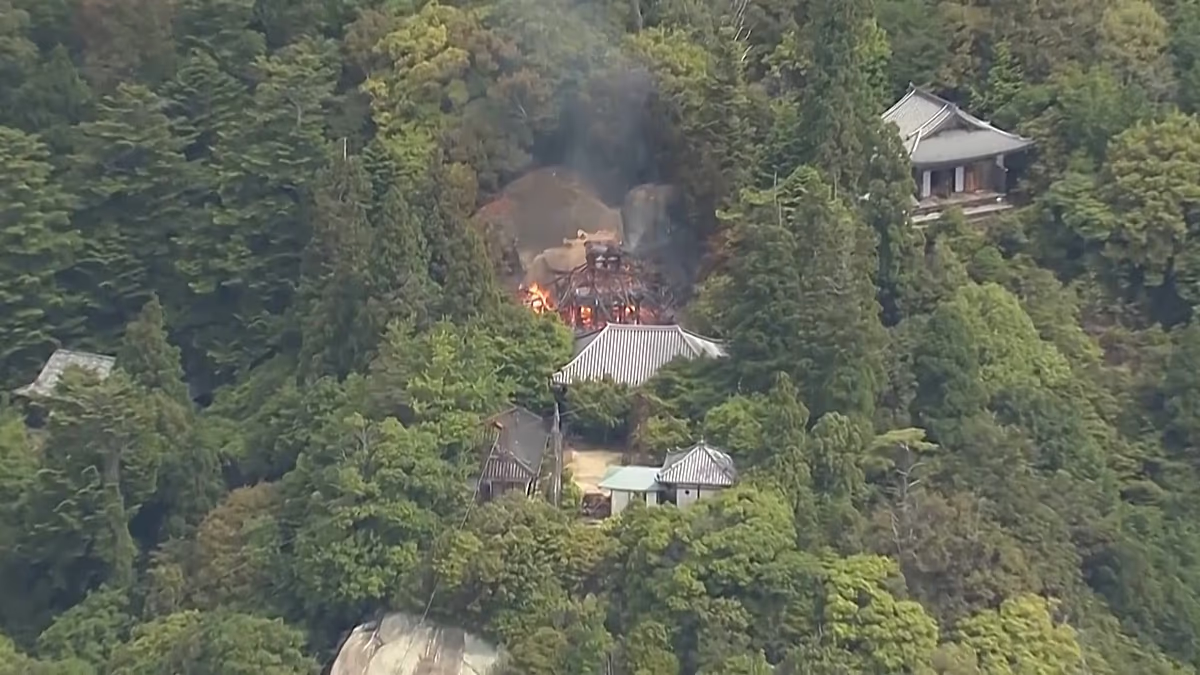


On the sacred island of Miyajima, a place renowned for its serene beauty and its iconic vermilion torii gate floating in the sea, a profound and heartbreaking loss has occurred. A historic Buddhist hall, known as the Reikado Hall, has been utterly consumed by fire. The blaze, which ignited near the base of the island’s revered Mount Misen, rapidly took hold of the wooden structure. From above, aerial footage painted a devastating picture: fierce flames and billowing smoke entirely engulfed the hall, leaving behind only a skeletal, charred ruin where a centuries-old place of contemplation once stood. The intensity of the fire required a significant response, with approximately thirty firefighters battling bravely to contain and eventually extinguish the flames, though they could not save the hall itself.
The loss is immeasurable because the Reikado Hall was no ordinary building. It was an integral part of the Daishoin temple complex, one of the island’s most important and ancient Buddhist sites. Daishoin itself is a tapestry of quiet pathways, stone statues, and prayer halls that feel woven into the very forest of the mountain. But within the Reikado Hall, something truly unique and spiritually significant was housed: an “eternal flame.” This was not a metaphorical concept, but a literal, physical flame believed to have been burning continuously for over twelve hundred years. It was a living thread connecting the present day to the Heian period of Japanese history, a tangible spark from a distant past that had survived wars, natural disasters, and the relentless passage of time—until now.
To understand the depth of this tragedy, one must consider what this eternal flame represented. For over a millennium, it had served as a silent witness and a spiritual beacon. Monks would have tended to it daily, a simple yet profound act of preservation. Pilgrims and visitors would have stood before it, not just seeing a fire, but feeling a direct connection to generations upon generations of the faithful. It symbolized the unbroken transmission of wisdom, the enduring light of enlightenment, and the fragile yet resilient nature of history itself. Its destruction means the severing of a physical link that had persisted since the era of classical Japanese emperors and poets, a flame that would have been burning when the island’s great torii gate was first built.
The immediate questions now turn to cause and consequence. Authorities have launched an investigation to determine the origin of the fire, which thankfully did not spread to the surrounding dense forest or other temple structures on Mount Misen. The focus, however, remains on the incalculable cultural and historical void left behind. While the architectural framework of the hall can perhaps be reconstructed, the eternal flame presents a more profound dilemma. Can such a sacred object, defined by its uninterrupted existence, ever be “restored”? A newly lit flame, however ceremoniously kindled, would be a new symbol, a memorial rather than the original continuum. The loss is of an artifact that was both a religious icon and a historical document written in light and heat.
For the local community on Miyajima and for Buddhists across Japan, the grief is personal and spiritual. The Daishoin temple is a living center of practice and a cornerstone of the island’s identity, which seamlessly blends Shinto and Buddhist traditions. The Reikado Hall and its flame were a quiet but pivotal part of that tapestry. The monks who cared for it have lost a central focus of their ritual stewardship. Residents who have lived their entire lives in the shadow of Mount Misen, knowing that ancient light was flickering within the hall, now grapple with its unsettling absence. The island, often bustling with tourists seeking its scenic beauty, now also holds a space for collective mourning for a piece of its soul.
In the wider world, this event serves as a stark reminder of the vulnerability of our shared heritage. We often think of historical treasures as being lost to the slow erosion of time or the sudden violence of war, but this fire underscores how quickly accident or fate can undo what centuries have preserved. It urges a renewed commitment to protecting the irreplaceable, not just through advanced fire suppression systems, but through continued reverence and awareness. The story of the Reikado Hall’s eternal flame may have reached its final chapter, but its memory now becomes a different kind of legacy—a poignant lesson in fragility and a call to safeguard the living threads of history that still, for now, remain in our care. The charred silence on Mount Misen speaks volumes about what we value and how easily it can vanish.