


Paragraph 1: The Crucible of Campaigning
In the heated atmosphere of Armenia’s election campaign, Prime Minister Nikol Pashinyan finds himself navigating a landscape of profound national grief and fierce political contention. The core of the turbulence revolves around the loss of Nagorno-Karabakh, a region deeply woven into Armenia’s modern identity. During a public event in Yerevan, this tension manifested physically and emotionally when a man from Karabakh, later identified as Arthur Osipyan, confronted the Prime Minister with accusations of betrayal and surrender. This moment, far from a standard political exchange, symbolized the raw, human anguish of a displaced population and the heavy burden of leadership in a nation reassessing its place in a volatile region. Pashinyan’s response was not one of dispassionate political rhetoric but of visceral engagement, setting the stage for a dramatic and telling confrontation.
Paragraph 2: A Megaphone and a Metaphor
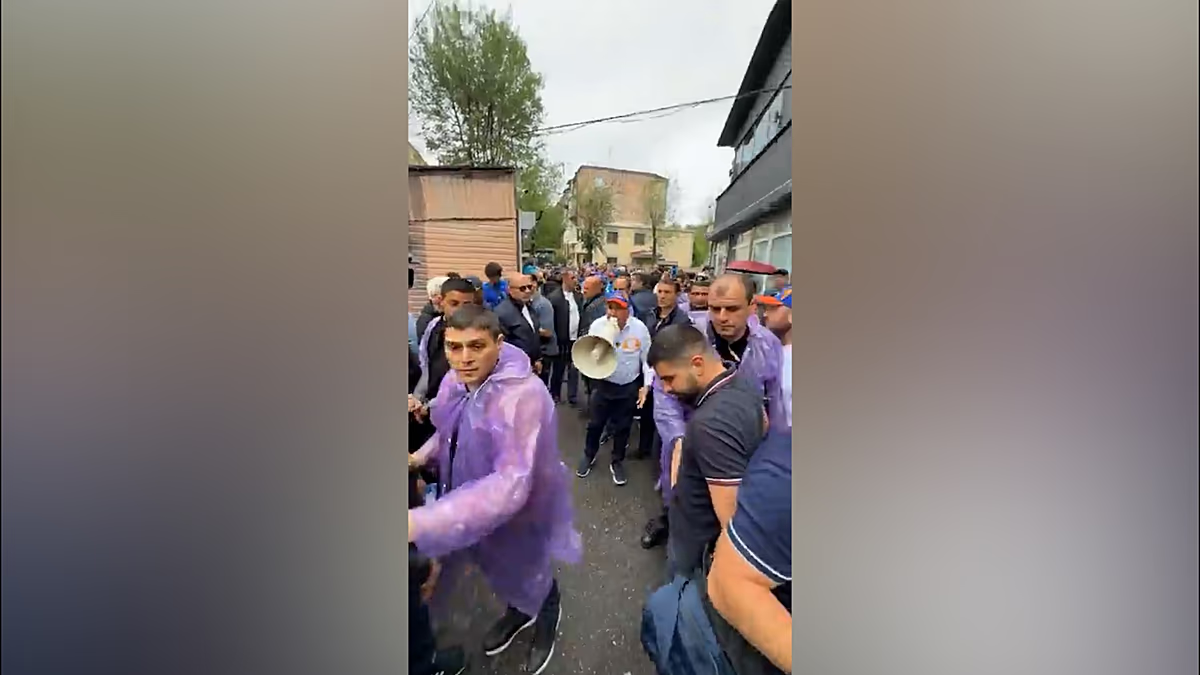
The scene quickly escalated from a personal challenge to a public spectacle. As security personnel intervened to lead the critic away, Pashinyan seized a megaphone—an act that transformed the interaction. This was no longer a private argument; it became a performance for the crowd and, via video, for the nation. Shouting through the device, Pashinyan’s actions underscored a deliberate shift from defensive reception to assertive proclamation. The megaphone served as a potent metaphor: he was amplifying his message, demanding that his voice, and his government’s narrative, be heard above the din of criticism. This calculated move framed the critic not just as an individual protester, but as a representative of a viewpoint Pashinyan seeks to overcome through direct, public rebuttal.
Paragraph 3: The Core of the Conflict: Two Visions for Armenia
The substance of the clash lies in a fundamental debate over Armenia’s future. Pashinyan’s core argument to the public, reiterated forcefully after such confrontations, is that his critics—often framed as remnants of old, militaristic regimes—are obstructing the path to peace and economic revival. He posits that the acknowledgment of a new geopolitical reality, however painful, is the prerequisite for stability, international integration, and prosperity. From his perspective, the confrontation with Osipyan was an opportunity to dramatize this choice: between a past defined by unresolved conflict and a future built on pragmatic statecraft. His critics, however, view this not as pragmatism but as capitulation, arguing that national dignity and security have been irreparably compromised.
Paragraph 4: The Human Cost and the Legal Repercussion
The immediate aftermath of the event highlighted the personal and legal dimensions of political dissent. Arthur Osipyan, the Karabakh Armenian who voiced his despair, was detained and formally charged with hooliganism. This legal action frames his emotional outburst not as political expression but as public disorder, a move critics see as an attempt to criminalize dissent. For many, especially those displaced from Karabakh, Osipyan represents the human cost of the conflict—a person whose life and homeland have been upended, now facing state charges for confronting the leader he believes responsible. This creates a poignant and troubling image: a refugee from a lost territory being dragged away and prosecuted after challenging the Prime Minister in the heart of the capital.
Paragraph 5: The Strategic Theatre of Elections
This incident is not an isolated outburst but a calculated piece of campaign theatre. Pashinyan, a leader known for his direct and often confrontational style, is using such moments to galvanize his base and define the electoral battle lines. By publicly engaging with and overpowering vocal critics from the Karabakh diaspora, he seeks to portray himself as a strong, decisive leader steering the nation through a necessary, albeit unpopular, transition. He aims to convert a narrative of loss into one of resilient forward momentum. Every shouted rebuttal through a megaphone is designed to reinforce his message that he is the architect of a new, peaceful Armenia, battling against forces of chaos and perpetual war.
Paragraph 6: A Nation’s Soul in Question
Ultimately, this microcosm of a megaphone confrontation speaks to a macrocosm of national soul-searching. Armenia is grappling with questions of identity, security, and sovereignty in the wake of a catastrophic territorial loss. Pashinyan’s campaign, punctuated by such dramatic encounters, forces these questions into the public square. Is the path to survival through unwavering defiance or through adaptive realism? Is the Prime Minister a visionary paving the way for a secure future or a leader who has bargained away a sacred part of the nation’s heritage? The detained critic and the shouting Prime Minister embody this agonizing dichotomy. As Armenia approaches its elections, the outcome will reflect not just a choice of administration, but a collective decision on how to carry the weight of history while stepping into an uncertain future.