


Summary and Humanization of Provided Content
Paragraph 1
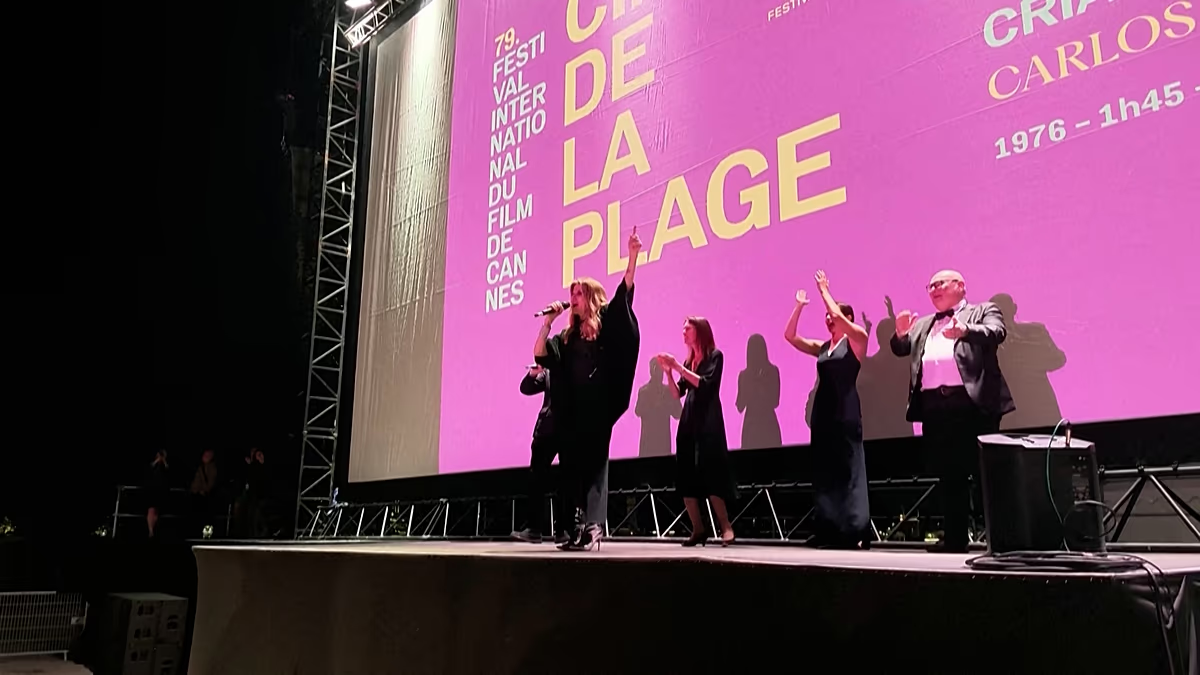
The Cannes Film Festival is renowned for its glamorous premieres and star-studded red carpets, but on a recent Wednesday evening, a different kind of magic unfolded on Macé beach. Under the open sky, the festival’s “Cinéma de la Plage” hosted a special tribute that blended film history with musical nostalgia. The occasion was the 50th anniversary of Spanish director Carlos Saura’s acclaimed film, Cría Cuervos. To mark this milestone, a new 4K restoration of the movie was screened not in a darkened theater, but against the backdrop of the Mediterranean, with deckchairs lining the sand. Before the film began, however, the spotlight turned to a singer whose voice is inextricably linked to its legacy: Jeanette.
Paragraph 2
Jeanette, who has lived semi-retired and away from the public eye in Spain for many years, stepped into this resonant setting to introduce herself to an audience of festival guests, cinephiles, and members of Saura’s own family. In a simple yet profound introduction, she presented herself as “the voice behind the song ‘Porque te vas.’” This was not merely a preface; it was an acknowledgment of a unique cultural symbiosis. The song, originally released by Jeanette in 1974, found its immortal home within Saura’s film. Its melancholic melody and yearning lyrics, repeated throughout the narrative, became the emotional heartbeat of the story, transforming the track from a pop single into an enduring emblem of the film’s themes.
Paragraph 3
Cría Cuervos, presented in competition at Cannes in 1976 and winner of the Grand Prix du Jury, is widely regarded as a defining masterpiece of Spanish cinema. Shot in the final, tense months of Francisco Franco’s dictatorship and released shortly after his death, the film is a profound reflection on childhood, grief, repression, and memory within a transitioning Spain. Its story, seen through the eyes of a young girl, uses subtle allegory and haunting imagery to explore the psychological shadows of a fading authoritarian regime. The inclusion of Jeanette’s “Porque te vas” within this framework was a masterstroke; the song’s plaintive tone perfectly encapsulated the film’s atmosphere of silent longing and unresolved loss, helping to propel both the film and the song to international fame.
Paragraph 4
As Jeanette performed “Porque te vas” live on that Cannes beach, the decades seemed to dissolve. Hundreds of spectators, seated in their deckchairs or standing along the beachfront, listened as her voice echoed across the coast, merging with the sound of the waves. This performance added a deeply personal and nostalgic dimension to the official tribute organized by the festival’s Classics programme. It was a moment of living history—not just a restoration of a film, but a reanimation of its soul. The experience transcended a typical screening; it became an emotional communion, connecting the audience directly to the artistic essence of a work that had touched so many fifty years prior.
Paragraph 5
For Jeanette herself, such appearances are rare but meaningful. Having retreated from the relentless pace of the music industry, she now emerges primarily for tributes, television programmes, and special concerts tied to her iconic song. This selective engagement speaks to a respectful stewardship of her legacy. She understands that “Porque te vas” belongs not just to her, but to a collective memory, to a specific moment in cinematic and national history. Her performance at Cannes was therefore more than a concert; it was an act of cultural preservation, a gentle reminder of the powerful, often unexpected alliances that can form between a filmmaker’s vision and a singer’s voice.
Paragraph 6
The evening on the Croisette served as a beautiful testament to the enduring power of art. The restored film offered visual clarity, but Jeanette’s live rendition provided the emotional clarity. Together, they honored Carlos Saura’s visionary work and celebrated a song that became its unforgettable signature. This event highlighted how certain creations—a film, a melody—can transcend their original context to become timeless touchstones. They remind us of past struggles, of personal and collective mourning, and of the delicate ways art can articulate what words alone cannot. As the notes of “Porque te vas” faded over the Mediterranean, they left behind a renewed appreciation for a film that captured a nation’s silent transition and for the voice that gave that silence its most eloquent song.