

The Unstoppable Force of Urbanisation: A Crossroads of Risk and Opportunity
The relentless tide of people moving to cities is not a problem to be solved, but an inevitable stage of human development that must be strategically guided. This was the core message from World Bank Senior Economist Mark Roberts at the recent World Urban Forum in Baku. Speaking to Euronews, Roberts challenged governments that view urban growth with apprehension, stating plainly, “No country has ever fully developed without urbanising.” He reframed the narrative, arguing that the magnetic pull of cities—despite the well-known headaches of traffic congestion and rising living costs—is fundamentally a sign of vitality. This concentration of people, he contends, is the primary engine for economic growth, innovation, and job creation on a national scale. His perspective shifts the policy focus from containment to empowerment, suggesting that the goal should not be to stem the flow but to harness its immense potential by creating cities that work for everyone.
However, the scale of investment required to build safe, resilient, and equitable cities, particularly in the world’s fastest-growing regions, is astronomical. Roberts emphasized that the financing needs, especially across Africa, are so tremendous that no single government or international agency can meet them alone. The solution, he proposed, lies in a collaborative model that “catalys[es] finance from a range of different sources,” with private sector investment playing a crucial role. This call for blended finance underscores a stark reality: the infrastructure gap is widening even as the threats to urban life intensify. Roberts specifically highlighted climate-driven disruptions like catastrophic flooding and deadly extreme heat, which are already paralyzing city functions today. Thus, the investment is not merely for growth but for survival, requiring a new paradigm of funding that matches the urgency and complexity of the challenge.
This optimistic view of urbanisation as an opportunity is far from universal. On the ground, in the swelling metropolises of Africa and South Asia, many experts and local leaders witness a different, more harrowing reality. They argue that when urban growth is rapid and mismanaged, it does not automatically lead to prosperity; instead, it can exacerbate deep-seated inequalities and environmental decay. The most visible symptom of this failure is the proliferation of vast informal settlements—communities built without security of tenure, basic services, or resilient housing. Here, the theoretical economic benefits of cities are drowned out by the daily struggles for clean water, sanitation, and safety. This divergence in perspective reveals a fundamental tension: between urbanisation as an abstract driver of national GDP and urbanisation as a lived experience that, without careful stewardship, can entrench poverty and vulnerability.
The profound challenges of this lived experience were voiced powerfully by Dr. Moges Tadesse, chief resilience officer for Addis Ababa. He warned that for many African cities, the pace of change has already outstripped the capacity of local governments to respond effectively. In his view, climate change acts as a devastating multiplier of these existing pressures, attacking not just housing but the very foundations of the economy and human security. Dr. Tadesse’s comments introduced a crucial element of climate justice into the debate, pointing out that the costs of adapting to a warming world—a crisis generated disproportionately by historic emissions from wealthy nations—are being borne by the most vulnerable urban populations. His call for greater international investment is therefore not just a request for aid, but an appeal for responsibility, highlighting that building resilience in the Global South is an indispensable part of a global solution.
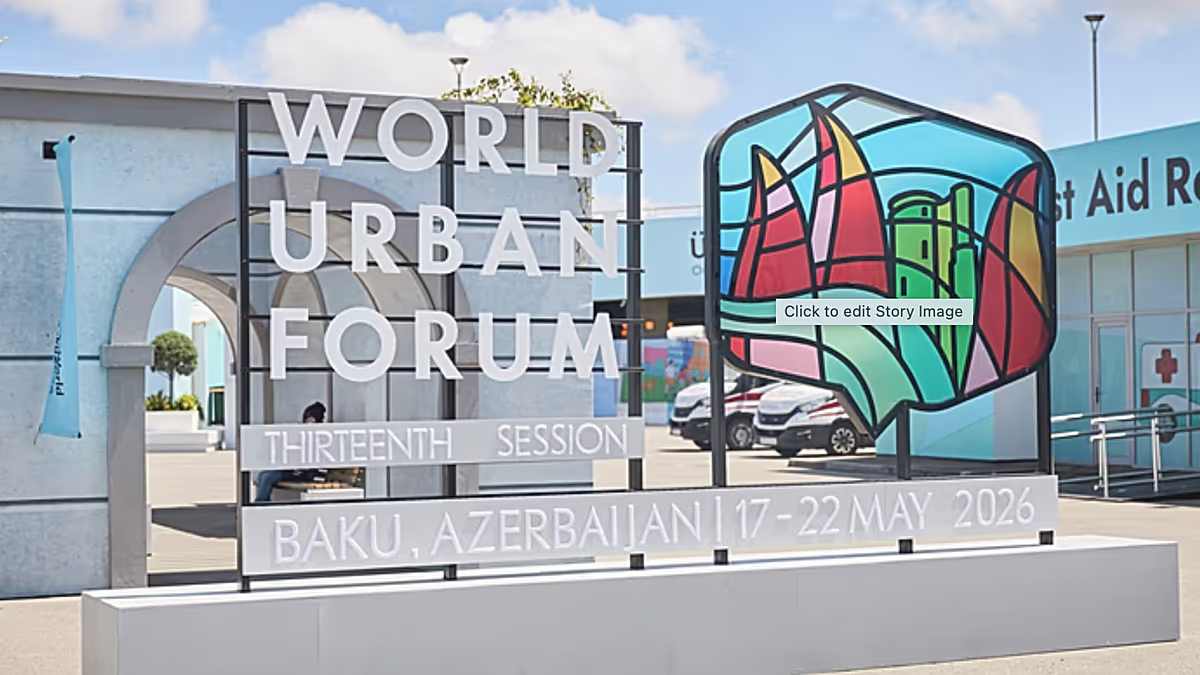
This complex global conversation found a focal point at the 13th World Urban Forum (WUF13) in Baku, Azerbaijan. Established by the UN to examine the planet’s urban future, the forum has grown from 1,200 participants at its first meeting in Nairobi in 2002 to a colossal gathering of over 40,000 delegates from 182 countries. Under the theme “Housing the world: Safe and resilient cities and communities,” the scale of the event itself mirrored the immense importance of the topic. The convening of a dedicated session at the level of heads of state for the first time signaled a rising political recognition that urban issues can no longer be secondary concerns; they are central to achieving global sustainability and development goals. The forum served as a grand marketplace of ideas, anxieties, and proposed solutions, all aimed at steering the urban century toward a more equitable path.
The intended legacy of WUF13 is the Baku Call to Action, a document meant to galvanize international efforts and support the UN’s New Urban Agenda. This outcome encapsulates the forum’s dual narrative: a forward-looking embrace of urbanisation’s potential, paired with a sober assessment of its perils if left unattended. The dialogue between Roberts’s economic optimism and Dr. Tadesse’s on-the-ground warnings defines the critical balance that policymakers must strike. The future of our planet is an urban one. The question that remains is whether we will build cities that are merely densely populated, or ones that are truly civilized—communities that are not only engines of growth but also bastions of safety, justice, and resilience for all who call them home. The consensus from Baku is clear: getting this right is the most pressing development challenge of our time.