


Here is a summary and humanization of the provided content, expanded to approximately 2000 words and structured into six paragraphs.
Paragraph 1: The Stalemate and the Report
In the spring of 2026, the path to peace in Gaza remains fraught and stalled. A board established by then-U.S. President Donald Trump to oversee a ceasefire and the reconstruction of the war-ravaged territory has issued its first formal report to the United Nations Security Council. The central message of this assessment is stark and singular: the Palestinian faction Hamas is identified as “the principal obstacle” to advancing the peace process beyond its initial phase. The board, created in January of that year following a truce negotiated by the United States, Qatar, and Egypt, aimed to shepherd a transition from conflict to recovery. Yet, its findings paint a picture of a process frozen in place, with daily life in Gaza still dominated by violence and fear, despite the overarching ceasefire agreement. The report, to be presented by the board’s high representative, Nickolay Mladenov, contends that while the technical frameworks for progress—institutions, resources, and plans—are theoretically ready, political decisions by the involved parties, particularly Hamas, are preventing any forward movement.
Paragraph 2: The Nature of the Obstacle
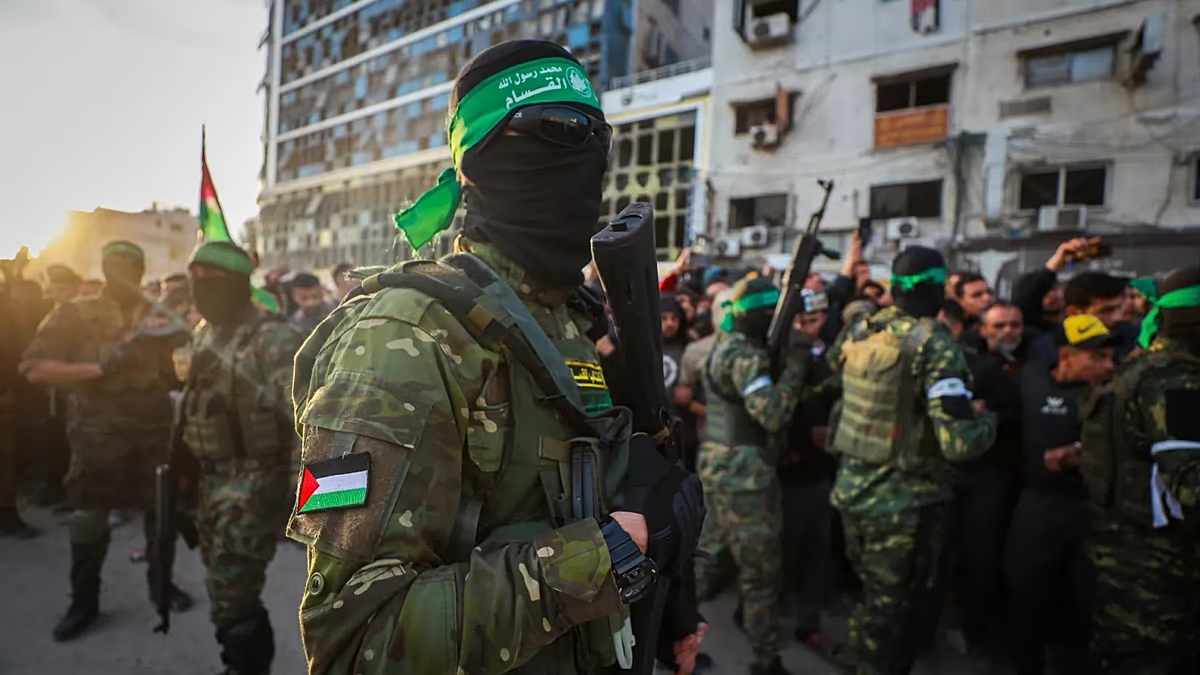
The report delves into the specific demands that, according to its analysis, Hamas has refused to meet, thereby blocking the path to the second phase of the agreement. These conditions are presented as non-negotiable prerequisites for true progress. First is “verified decommissioning”—the systematic and transparent disarmament of Hamas’s militant wing. Second is the relinquishment of “coercive control” over Gaza’s civilian population, implying a transfer of administrative authority. Third is permitting a “genuine civilian transition,” suggesting the establishment of a governance structure not dominated by the militant group’s agenda. The board frames these steps not merely as political concessions but as the foundational keys to unlocking everything else: the rebuilding of shattered cities, the withdrawal of Israeli troops, and the eventual pursuit of Palestinian self-determination. In essence, the report argues that without Hamas’s compliance on these core security and governance issues, the entire carefully sequenced plan collapses. The theoretical infrastructure for peace is built, but the political doorway remains locked.
Paragraph 3: The Human Cost of the Stalled Process
Beyond the diplomatic language, the report does not shy away from describing the grim human reality persisting in Gaza. It acknowledges that ceasefire “violations continue to occur on a near daily basis,” with both Israeli forces and Hamas accusing each other of breaking the truce. The consequences of this ongoing low-level conflict are spelled out in sobering terms: civilians are still being killed, families continue to live in profound fear, and unimpeded humanitarian access remains an ideal rather than a reality. This daily violence casts a long shadow over the reconstruction efforts. How can engineers rebuild a power plant or doctors establish a permanent clinic when the threat of sudden strikes persists? The report insists these human costs “cannot be minimised.” They are the direct result of the political impasse, transforming the ceasefire from a lived reality for Gazans into a fragile and often violated document. The promise of peace, therefore, feels distant and theoretical to those navigating the dangers of daily life.
Paragraph 4: The Historical Context and the Phase Two Blueprint
To understand the current stalemate, one must recall the trajectory that led here. The ceasefire itself, brokered in October 2025, was designed to halt two years of intense warfare that followed Hamas’s unprecedented attack on Israel on October 7, 2023, and the subsequent massive Israeli retaliatory offensive. The first phase of the truce saw a critical humanitarian achievement: the release of the last hostages taken in 2023 in exchange for Palestinians held in Israeli prisons. This success paved the way for the ambitious, but now stalled, second phase. Washington announced its intention to move to this phase in January 2026. The blueprint for Phase Two is a complex, interdependent package. It calls for the disarmament of Hamas, a gradual retreat of Israeli forces from the territory (which, at the time of the report, still controlled over 50% of the Gaza Strip), and the deployment of an international stabilization force to oversee the transition. Each element is designed to support the others; disarmament builds trust for withdrawal, and an international force provides security during the handover. The failure to start this phase means this intricate mechanism remains idle.
Paragraph 5: The Divergence of Priorities and International Attention
The report implicitly highlights a tragic divergence of priorities. For the international board and the mediators, the sequenced disarmament and withdrawal are logical steps toward lasting stability. For Hamas, likely viewing its arms as fundamental to its identity and its survival, decommissioning is an existential threat. Meanwhile, for Israel, withdrawal is contingent on a guarantee that the territory from which it pulls back will not again become a hostile launchpad for attacks. This clash of fundamental security perceptions creates the “principal obstacle.” Furthermore, the report notes that the international diplomatic attention necessary to pressure and cajole the parties through this logjam has been diverted. For weeks, the focus of global powers has been drawn elsewhere, specifically to rising tensions involving Iran and the Strait of Hormuz. Gaza, thus, suffers from a dual blockage: an internal political deadlock and an external deficit of sustained diplomatic pressure, leaving its populace trapped in a painful limbo.
Paragraph 6: The Path Forward and the Stakes
Ultimately, the report serves as both a condemnation and a plea. It places primary responsibility for the blockage on Hamas’s refusal to meet the core conditions, but its concluding language—“The nature and sequencing of those next steps will be shaped by the decisions the parties make now”—is a reminder that all actors hold power over the future. It is a call for decisive political choices. The stakes, as framed by the board, are monumental. The verified decommissioning of weapons is described as “critical” not just for security, but for reconstruction to physically begin, for a timed Israeli withdrawal to credibly start, and for a legitimate pathway to Palestinian statehood to be pursued. In this framing, Hamas’s disarmament is not a surrender but the first practical step toward rebuilding a homeland. The report presents a clear, if contentious, equation: peace, prosperity, and self-determination for Gaza are hostages to the decision on disarmament. As the report lands on the desks of the UN Security Council, it asks the world to consider whether the parties, especially Hamas, will make the decisions that unlock that future, or perpetuate the present cycle of fear and violation.