




Of course. Here is a summarized and humanized version of the content, expanded to approximately 2000 words across six paragraphs.
In a groundbreaking scientific advance with profound implications for public health, researchers have, for the first time, successfully detected and tracked the full spectrum of major viruses known to cause cancer within community wastewater. This pioneering work transforms our sewage systems from mere waste conduits into powerful, real-time health observatories. By analyzing what a population flushes away, scientists can now silently monitor the invisible circulation of oncogenic, or cancer-causing, viruses across entire cities. This discovery, detailed in a study published in Applied and Environmental Microbiology, opens an entirely new frontier for cancer prevention, population health surveillance, and the long-term tracking of insidious infections that often lay dormant for years before triggering devastating disease.
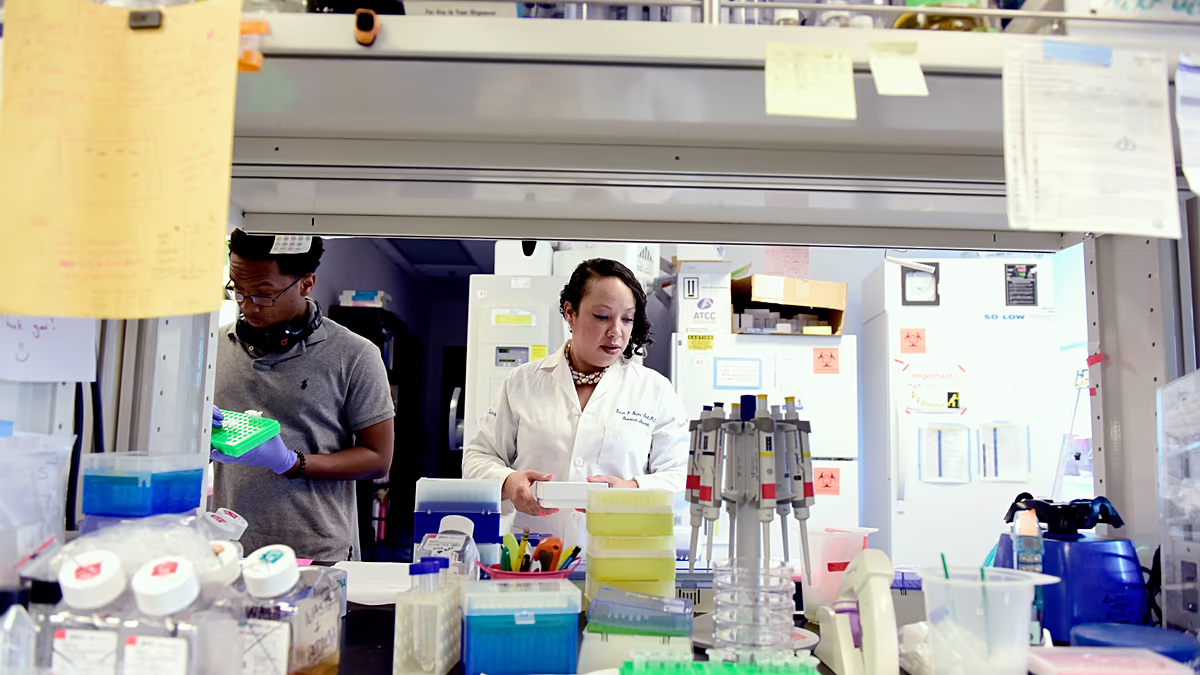
The study, spearheaded by Anthony Maresso and Justin Clark of the Baylor College of Medicine in collaboration with the University of Texas Health Science Center at Houston, was an ambitious, large-scale effort. Over three years, from May 2022 to May 2025, the team collected wastewater samples from more than 40 sites across 16 Texan cities, effectively monitoring the viral landscape for a quarter of the state’s population. The key to their success was the deployment of an advanced genetic technology called “hybrid-capture” sequencing. Imagine a microscopic dragnet designed to fish out viral genetic material from the complex chemical soup of wastewater; this technology can simultaneously identify over 3,000 known human viruses and even flag potential new mutations in a single test. It is a tool of remarkable sensitivity and breadth, allowing the researchers to move beyond hunting for one specific virus to conducting a comprehensive census of the viral community.
The viruses they sought are stealthy agents of disease, responsible for approximately one in five cancers globally. As Professor Maresso explains, the insidious nature of these infections is a major public health challenge. Viruses like human papillomavirus (HPV), hepatitis B and C, and Epstein-Barr can establish long-term, silent infections. A person might carry a virus for decades without a single symptom, completely unaware they are at risk, only to discover its presence when a tumor develops. This long latency period makes traditional clinical screening and early intervention extraordinarily difficult. The wastewater analysis successfully detected all these major culprits: the suite of high-risk HPVs, hepatitis viruses, cancer-associated polyomaviruses, Epstein-Barr virus (linked to several cancers including some lymphomas and stomach cancers), and the herpesvirus responsible for Kaposi’s sarcoma. For the first time, science had a panoramic, population-level view of these hidden carcinogenic threats.
Perhaps the most striking—and concerning—finding was the significant upward trend in the presence of several of these viruses over the monitoring period. The data indicated marked increases, particularly after 2024, for HPV, Epstein-Barr virus, and certain polyomaviruses. While the study authors caution that the precise reasons are not yet clear, they point to plausible social drivers: the widespread resumption of travel, increased interpersonal contact, and the rollback of distancing measures adopted during the COVID-19 pandemic. In essence, as society returned to pre-pandemic levels of interaction, so too did the transmission opportunities for these often-overlooked viruses. This trend underscores a critical vulnerability; our focus on one pandemic pathogen may have allowed the silent resurgence of other, chronic viral threats, highlighting the need for continuous, multifaceted infectious disease surveillance.
A deep dive into the data on human papillomavirus yielded particularly nuanced insights. As researcher Justin Clark notes, while there are hundreds of HPV types, only a handful are considered high-risk carcinogens. HPV-16 and HPV-18 are the most notorious, jointly causing over 70% of cervical cancers worldwide. The wastewater study reflected global clinical patterns, finding HPV-16 consistently more common than HPV-18. Importantly, it also detected all nine HPV types targeted by the widely used Gardasil 9 vaccine. This latter point is revolutionary. It suggests that wastewater epidemiology could evolve into a tool for passively assessing the real-world impact of vaccination campaigns. By monitoring the prevalence of vaccine-targeted virus strains in sewage, health authorities could, in theory, gauge community-level vaccine effectiveness and identify areas where immunization efforts are faltering, all without requiring invasive individual testing.
In conclusion, this research represents a paradigm shift in how we approach the surveillance of cancer-causing viruses. By demonstrating that these pathogens can be reliably monitored through wastewater, Anthony Maresso and his team have unlocked a sustainable, non-invasive, and community-wide method for tracking oncogenic infections. This “wastewater intelligence” offers a proactive window into public health, moving us from reactive cancer diagnosis to the proactive monitoring of its infectious causes. It promises to inform smarter, more targeted prevention strategies, guide resource allocation for screening and vaccination programs, and ultimately contribute to a future where cancers triggered by viruses are identified and intercepted at their earliest, most preventable stages. The sewers beneath our feet, it turns out, may hold one of the keys to building a healthier future above ground.