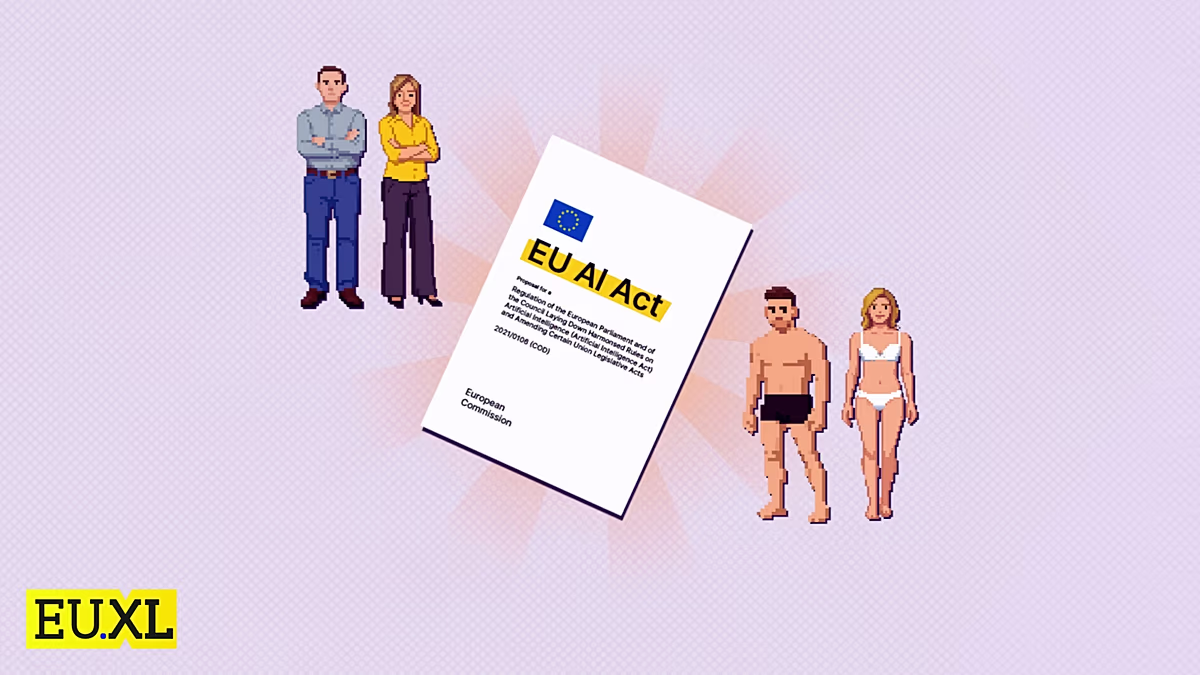
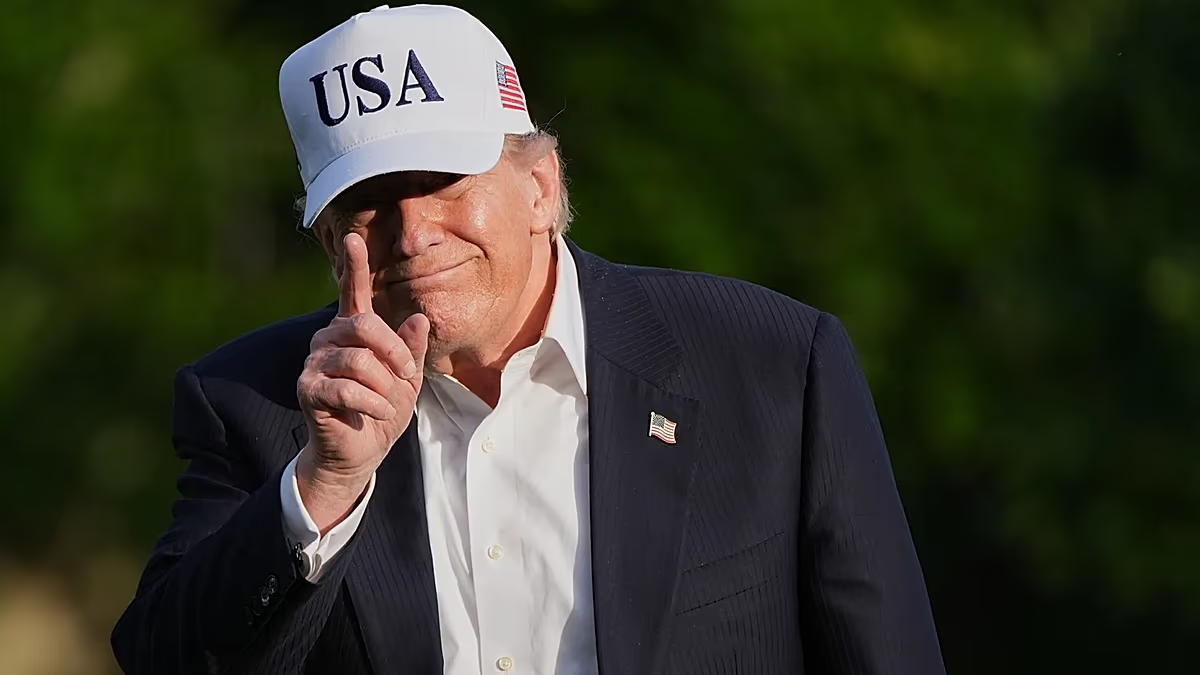



The dawn of Donald Trump’s second term in January 2025 has ushered in a profoundly different chapter in transatlantic relations, one where the traditional pillars of alliance are being tested by an aggressive, transaction-focused American trade policy. The administration’s imposition of tariffs and its sharp public criticisms of European regulations, framed as defenses of U.S. economic interests, represent a deliberate shift from diplomacy to confrontation. This approach is not merely rhetorical; officials have actively courted complaints from American businesses to wield as ammunition in disputes with Brussels. However, this strategy of public pressure has inadvertently catalyzed a complex realignment, not just between governments but within the very corporate communities it aims to defend. The initial shockwaves have revealed that the United States’ largest trading partner is no longer a passive entity but a bloc capable of its own strategic recalculation, turning geopolitical friction into an unexpected crucible for European ambition.
This confrontational stance has exposed a significant and telling rift within the American business community itself, dividing it roughly into two camps. On one side are firms, often newer entrants to the European market or those in consumer-facing sectors, who welcome Washington’s muscular advocacy. They see an opportunity to challenge EU regulations they view as burdensome, directly leveraging U.S. government pressure to improve their operational landscape. On the other side, a substantial portion of companies, typically those with deep, decades-old roots and complex supply chains woven into the European fabric, view the administration’s tactics with profound anxiety. For these entities, stability and predictability are paramount, and they fear that public spats could provoke retaliatory measures, subtly altering their hard-won market access. This corporate divide underscores a fundamental truth: while tactics may differ, a consensus is emerging that deepening distrust is becoming a permanent, structural feature of the relationship, forcing every player to navigate a more volatile environment.
The tension has been dramatically escalated by the administration’s willingness to “weaponise dependencies”—to extend trade disputes into the realm of essential digital and financial services. Incidents like the sanctioning of International Criminal Court officials, which led to their sudden loss of access to U.S. credit cards, software, and logistics platforms, served as a wake-up call across European capitals. These actions laid bare the continent’s deep-seated vulnerability, demonstrating how geopolitical disagreements could abruptly disrupt the invisible infrastructure of daily business and governance. It transformed abstract concerns about “over-reliance” into a tangible security crisis. Consequently, what was once a theoretical debate in Brussels about “strategic autonomy” has been injected with urgent, practical momentum. The question is no longer just about industrial competitiveness but about foundational resilience: how to ensure that critical societal functions cannot be switched off by a political decision made in Washington.
This urgent push for sovereignty is reinvigorating European industrial policy, yet it is also exposing familiar internal fissures. A camp led by France advocates for a more protectionist approach, championing “Made in Europe” mandates and direct state intervention to nurture homegrown champions. Meanwhile, export-powered economies like Germany traditionally caution against protectionism, wary of triggering global fragmentation that could harm their own overseas sales. However, the unpredictable nature of Trump-era policies—exemplified by territorial remarks about Greenland—is shifting the calculus. Even traditionally liberal, free-trading nations like the Netherlands and Denmark are now more receptive to policies that reduce critical dependencies. Early signals of this shift are already visible, such as the European Commission awarding a major cloud contract to a European consortium over a U.S. giant. As one tech representative noted, Washington has unintentionally become “the main business developer for the European tech sector,” creating a political opening for local solutions to prove their mettle.
Nevertheless, forging a unified European response remains an enormous challenge. The concept of “strategic autonomy” is elastic, stretching from hardline economic nationalism to more collaborative frameworks like “Made with Europe,” which would include trusted allies like the UK and Japan. This lack of consensus complicates major legislative efforts, such as the Industrial Accelerator Act and the forthcoming European Tech Sovereignty package, where battles over procurement rules will be fierce. The central dilemma is balancing the urgent need for security and sovereignty with the practical realities of a globalized innovation ecosystem. European businesses are keenly aware of the window of opportunity presented by U.S. friction, but they also operate in a fragmented market that often struggles to scale. The push for a federated, interoperable approach among European vendors attempts to address this, seeking strength in diversity rather than creating a single monolithic alternative to U.S. giants.
As the Trump administration continues its pressure campaign, the transatlantic economic landscape is being irrevocably reshaped. The dynamic is no longer a simple diplomatic tug-of-war but a multi-layered strategic repositioning. American companies are navigating a bifurcated reality, caught between a government urging confrontation and a market demanding continuity. European policymakers and businesses, in turn, are grappling with how to convert a moment of vulnerability into a sustainable long-term advantage. The ultimate legacy of this period may therefore extend far beyond any individual tariff or trade deal. It is cementing the notion of sovereignty—digital, industrial, and economic—as a permanent core objective for the European Union. Whether European alternatives can achieve the scale and sophistication to be truly competitive remains an open question, but the direction of travel is now set. The trust that once allowed the West to operate as a seamless economic bloc has been eroded, replaced by a new, harder-edged paradigm where resilience is prized above all, ensuring that the pursuit of sovereignty will outlast any single political era.