
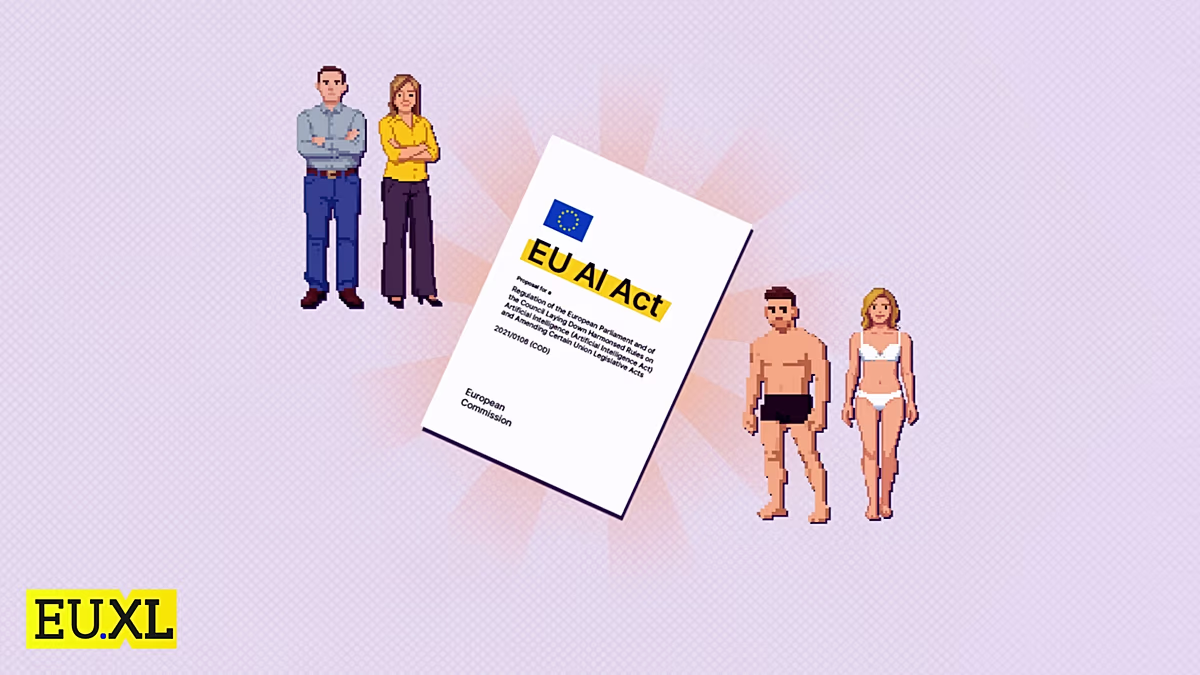



The European Union’s landmark Artificial Intelligence Act, a pioneering and comprehensive framework for governing this transformative technology, has undergone a significant and contentious revision. In early May of 2026, EU governments and the European Parliament reached a provisional agreement to amend the legislation, which had only entered into force in August 2024. This swift move to adjust the rules underscores the incredible velocity of AI development and the intense pressures facing regulators. The core of the amendment represents a substantial concession to industry: a 16-month delay in enforcing the Act’s most stringent requirements for high-risk AI systems. These critical provisions, covering areas like biometric categorization, critical infrastructure, law enforcement, and employment decision-making tools, will now not take effect until December 2027. Proponents of the delay argue it is a necessary dose of pragmatism, providing European businesses and innovators with crucial breathing room to adapt and compete on a global stage against well-funded American and Chinese tech giants, who operate under less restrictive regimes.
However, this delay has ignited a fierce backlash from civil society groups, digital rights advocates, and labor unions. Critics condemn the move as a major victory for Big Tech lobbying efforts, achieved at the potential expense of citizen privacy, worker protections, and fundamental rights. They warn that postponing guardrails for systems used in hiring, policing, and public surveillance leaves individuals vulnerable to algorithmic bias, discrimination, and opaque automated decision-making for years longer. This tension highlights the fundamental dilemma at the heart of modern tech regulation: the balance between fostering innovation and economic competitiveness, and the urgent imperative to establish ethical boundaries and protect human dignity in the digital age. The amended AI Act thus becomes a living document of this struggle, its timeline stretched in response to economic alarms.
In a powerful countermove to the industry-friendly delay, the amended deal introduces a potent new prohibition with strong moral clarity: a total ban on so-called “nudification” apps and other AI tools designed to generate fake explicit images, videos, or audio of real people without their consent. This ban is comprehensive, explicitly extending to the generation of AI-created child sexual abuse material. The provision was championed with particular urgency following a disturbing real-world event in early May 2026, when AI-generated intimate images of Italian Prime Minister Giorgia Meloni were widely circulated on social media. This high-profile violation demonstrated the terrifying personal and political damage these tools can inflict, moving the issue from abstract concern to immediate societal harm. The law now states unequivocally that creating such non-consensual synthetic intimate imagery is illegal.
The penalties for violating this ban are severe, designed to act as a real deterrent even for large corporations. Fines can reach up to €35 million or 7% of a company’s global annual turnover, whichever is higher. This aligns with the EU’s general philosophy of data and digital governance, where financial penalties must be substantial enough to materially impact major technology firms. The ban itself is scheduled to take effect on December 2, 2026, creating a clear line in the sand. This aspect of the amendment reveals a legislative body capable of swift and targeted action when confronted with a clear and egregious misuse of technology, standing in contrast to the more complex phase-in for broader high-risk systems.
The provisional deal still requires formal ratification by both the European Parliament and the Council of the EU, but this is widely expected to be a formality following the intense negotiations. Even with its implementation timeline for core provisions stretched, the amended AI Act retains its character as the world’s most ambitious and strictest regulatory framework for artificial intelligence. Its risk-based tiered approach—which outright prohibits unacceptable AI practices, tightly regulates high-risk applications, and imposes transparency requirements on others like chatbots—remains intact. The framework itself is not being diluted; its enforcement clock is simply being wound more slowly for certain complex, foundational applications.
Ultimately, the 2026 amendments paint a picture of EU regulators navigating an immensely complex field under tremendous cross-pressure. On one hand, they have responded to loud economic warnings about stifling innovation, granting a significant delay to help European entities find their footing. On the other, they have demonstrated a capacity for rapid and forceful action against a specific, deeply harmful application of AI, closing a gruesome loophole before it could widen further. The path forward is a staggered one, where immediate, morally unambiguous harms are outlawed quickly, while the broader architecture for ensuring the safety and rights-compliance of powerful AI systems is given a longer, more deliberate rollout. The EU’s experiment in comprehensive AI governance continues, now operating on a dual-track timeline that reflects both the urgency of ethical threats and the deliberate pace of building a resilient digital society.