

Paragraph 1: A Shadow Over Strasbourg
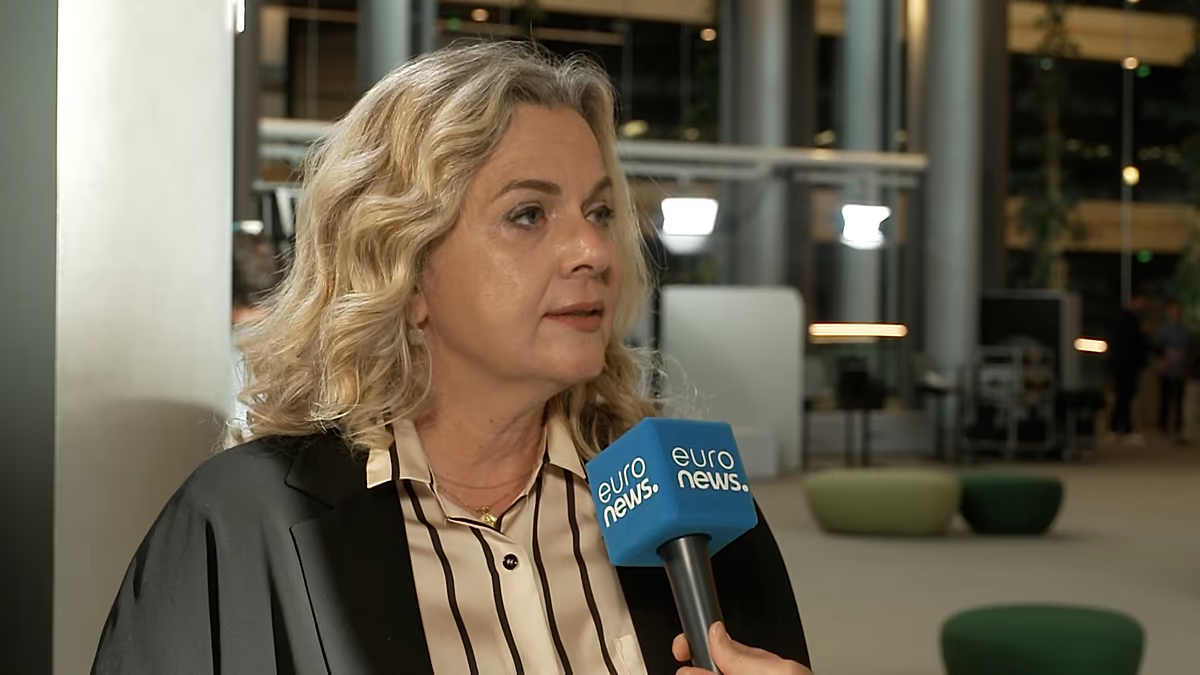
As the historic city of Strasbourg prepared to host a pivotal round of EU-US talks, a note of caution was introduced by a key insider. Željana Zovko, a seasoned Member of the European Parliament from the influential European People’s Party, voiced a sobering perspective that cut through the usual diplomatic optimism. On the morning of the high-stakes negotiations, she admitted to journalists that she was feeling “not so confident.” This candid admission from an experienced political figure immediately cast a shadow over the proceedings, signaling that the path to an agreement would be fraught with more than just typical bureaucratic hurdles. Her words framed the evening’s discussions not as a mere formality, but as a critical juncture where long-standing transatlantic collaboration could either be reaffirmed or dangerously strained.
Paragraph 2: The Warning from Within
Zovko’s concerns were not vague anxieties but pointed diagnoses of the core ailments affecting the negotiation process. She identified two distinct, yet equally formidable, obstacles standing in the way of a deal. From the American side, she pointed to what she termed “ideological fights.” This evocative phrase suggests a political landscape in the United States increasingly polarized by deep-seated partisan divides, where foreign policy decisions can become entangled in domestic political battles. The implication is that American negotiators might arrive at the table not only with a national mandate but also constrained by internal ideological pressures, potentially making compromise more difficult.
Paragraph 3: The Burden of Brussels
Conversely, Zovko characterized the European Union’s primary challenge as its own “complex process procedures.” This is a familiar critique, referencing the intricate, often slow-moving machinery of EU decision-making, which requires consensus-building among 27 member states with diverse interests. In the high-pressure context of urgent international talks, this institutional complexity can be a significant liability. It can lead to a rigid negotiating position, slow responses to new proposals, and a cumbersome process for securing final approval for any deal reached. Zovko’s warning highlighted a fundamental tension: the very mechanisms designed to ensure democratic unity within Europe can sometimes hinder its agility on the world stage.
Paragraph 4: A Clash of Political Cultures
The combined effect of these two obstacles, as framed by Zovko, paints a picture of a potential cultural clash in the negotiating room. On one side, a political system wrestling with intense internal ideological fervor; on the other, a consortium of nations bound by meticulous, multi-layered procedures. This sets the stage for a frustrating dialogue where American impatience with European bureaucracy could meet European wariness of American political volatility. The core challenge for diplomats becomes translating shared strategic goals into an agreement that can survive both the tumultuous currents of US domestic politics and the rigorous scrutiny of EU institutional pathways.
Paragraph 5: The Stakes of Failure
The urgency in Zovko’s tone stems from the unspoken but immense stakes of these Strasbourg talks. While the specific topic of negotiation is not detailed, high-level EU-US summits typically address foundational issues of global security, trade, technological cooperation, and democratic solidarity. A failure to reach an accord would not merely represent a missed deadline. It would be a visible crack in the transatlantic alliance, a signal of disunity that rivals and authoritarian regimes worldwide would be quick to exploit. In an era of strategic competition, the inability of democratic partners to align their policies carries significant consequences for global stability.
Paragraph 6: A Call for Pragmatism Over Politics
Ultimately, Željana Zovko’s pre-negotiation comments serve as a poignant humanization of the diplomatic process. They move the story beyond abstract notions of “statecraft” and remind us that real people, with their own doubts and frustrations, are tasked with steering these vital relationships. Her lack of morning confidence is a very human reaction to a deeply political problem. Her analysis is a plea, from within the system, for both sides to rise above their inherent limitations—for American representatives to temporarily bridge ideological divides in the interest of foreign policy continuity, and for European leaders to find a way to streamline their consensus-driven model to meet a moment of urgency. The success of the Strasbourg talks would hinge on whether the negotiators could embody this pragmatic spirit and prove her cautious forecast wrong.