


A Renaissance on the Rails: Europe’s Passenger Boom and the Push for a Connected Future
In 2024, Europe’s railways witnessed a remarkable resurgence, not merely as a nostalgic mode of travel but as a central pillar of contemporary life. According to the latest Eurostat figures, people across the European Union took a staggering 8.7 billion trips by train. This activity translated into 444.5 billion passenger-kilometres—the total distance traveled by all passengers—marking the highest level recorded in years. This statistic tells a story of collective movement, of millions of daily commutes, weekend adventures, and business journeys, all converging on the continent’s vast network of tracks. It signals a renewed confidence in rail as a reliable, sustainable, and integral part of Europe’s transport ecosystem.
This impressive total, however, is underpinned by a distinct geographical pattern. Germany and France emerged as the undeniable giants of European rail, contributing 109.1 and 107.3 billion passenger-kilometres respectively. Italy followed as a significant third. In contrast, the scale of operation varies dramatically across the bloc, with six countries recording fewer than 1 billion passenger-kilometres; Lithuania and Estonia, for instance, each recorded just 0.4 billion. Furthermore, the journey is overwhelmingly a domestic one. In 25 EU countries, more than 90% of rail travel occurs within national borders, with Luxembourg and Czechia being the only notable exceptions where cross-border journeys hold a larger share. This highlights a current reality: while the EU boasts a single market, its rail passenger experience remains largely fragmented along national lines.
The infrastructure supporting this boom presents a complex picture. The European Council rightly notes that the EU possesses one of the densest railway networks in the world. Yet this network is not static. Eurostat data reveals a curious contraction: between 1990 and 2024, the total length of the railway network in the EU shrunk by 7.9%. This overall decline masks individual success stories, like Spain, which increased its network length by 12.2%, primarily through ambitious investments in dedicated high-speed lines. Network density—the concentration of tracks relative to land area—closely mirrors geography and economic activity. High densities are found in the central-northern European heartland, reflecting both populous urban corridors and heavy freight volumes. Conversely, lower densities are reported on the EU’s periphery: in Greece, with its challenging island geography; in the sprawling Nordic and Baltic nations; and across the Iberian Peninsula and Ireland. This uneven map underscores the varied challenges and priorities facing member states.
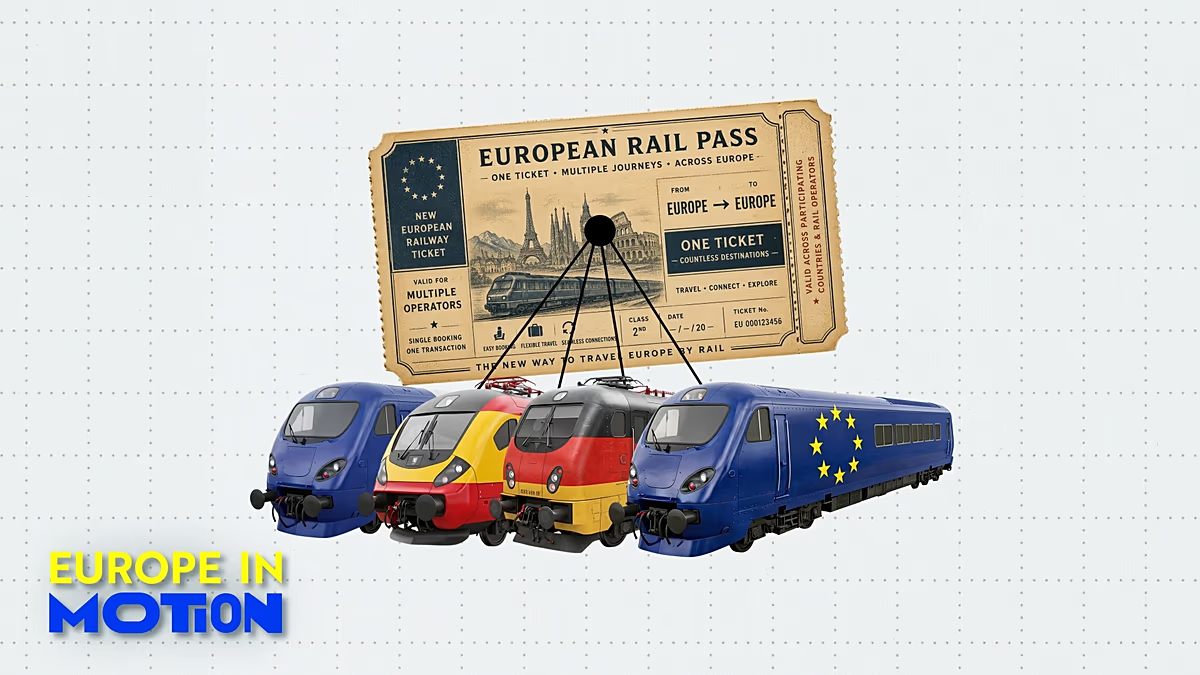
Recognizing both the surge in passenger demand and the existing barriers to seamless travel, the European Commission has launched a timely and transformative initiative. A newly announced “passenger package” aims to fundamentally simplify cross-border rail travel, tackling the fragmentation evident in the current data. The cornerstone of this scheme is the ability for travelers to make single-ticket bookings across multiple rail operators in one seamless transaction. Beyond convenience, the initiative significantly strengthens passenger rights, ensuring protection—such as assistance and rebooking—if a connection is missed, even when different companies operate the legs of the journey. This move addresses a long-standing headache for international travelers.
The vision, as articulated by Commissioner for Sustainable Transport and Tourism Apostolos Tzitzikostas, extends beyond tickets. It envisions a fully integrated digital mobility ecosystem. “With digital tools and integrated mobility services,” he stated, “Europeans will be able at the click of one button to plan, compare and purchase multimodal journeys across borders, while benefiting from stronger rail passenger rights, greater transparency and better protection every step of the way.” This policy shift is not merely administrative; it is a conscious effort to make the philosophical idea of a connected Europe a tangible lived experience for every citizen.
Thus, the 2024 data paints a portrait of a continent at a rail crossroads. On one hand, there is undeniable vitality: record numbers of people are choosing the train, demonstrating its entrenched value. On the other hand, the network’s uneven density and the dominance of domestic travel reveal persistent frontiers to be crossed. The European Commission’s new passenger package represents a direct and ambitious response to this dichotomy. By marrying robust infrastructure where it exists with smarter, more unified digital and regulatory frameworks, the EU is striving to ensure that its railway renaissance is not confined by national borders. The goal is a future where the rail network’s statistical density is matched by its experiential simplicity, allowing the 8.7 billion journeys of today to flow even more freely across the map of Europe tomorrow.