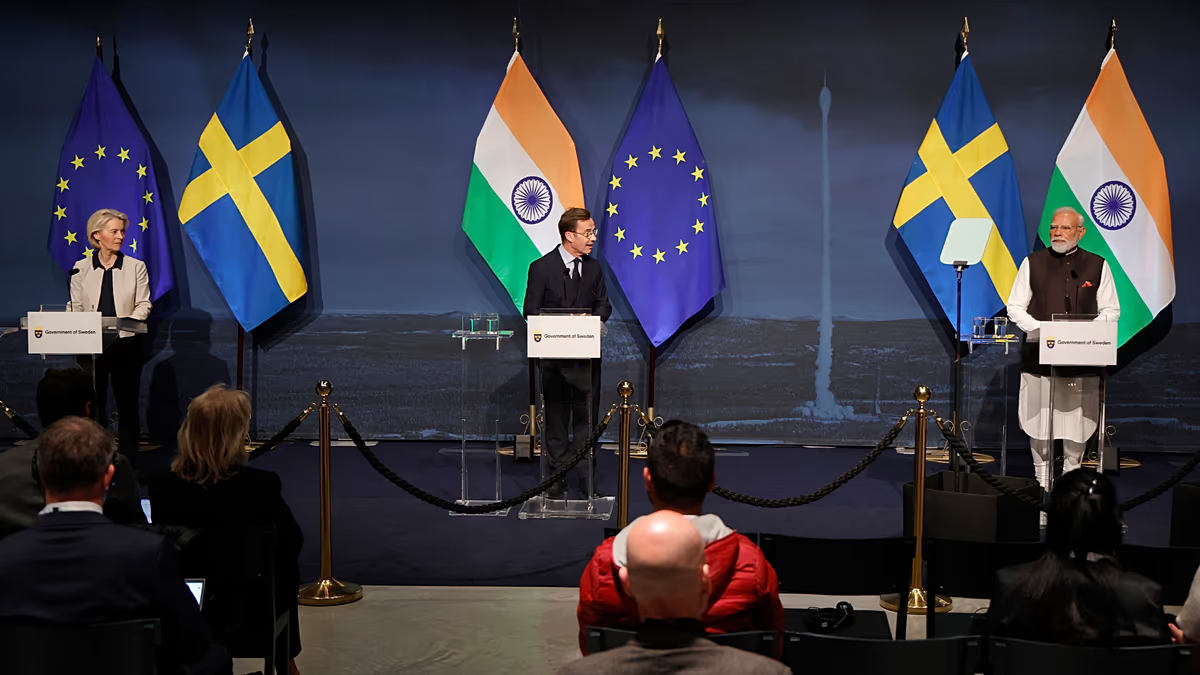
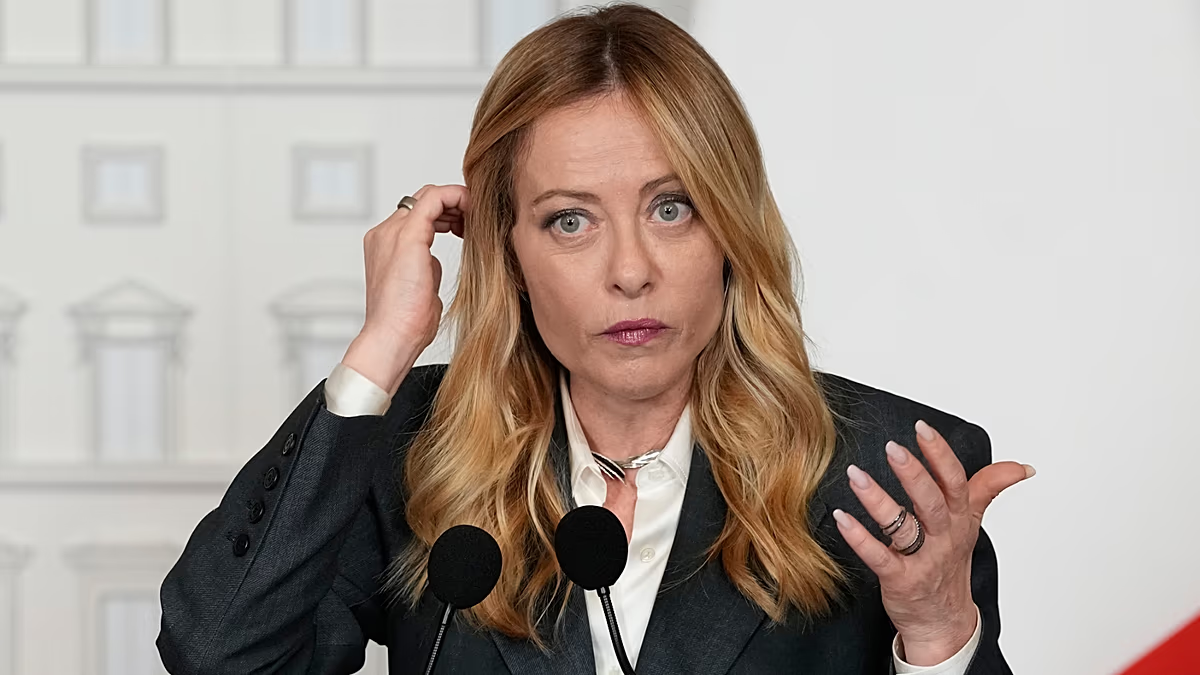



In a bold appeal to European leadership, Italian Prime Minister Giorgia Meloni has called for a fundamental shift in how the European Union manages economic policy during crises. Writing directly to European Commission President Ursula von der Leyen, Meloni argues that the existential threat posed by energy insecurity deserves the same urgent, flexible fiscal response that the EU has recently granted for defense spending. Her letter frames the issue as one of political courage and coherence, asking a poignant question: if the bloc can mobilize extraordinary financial resources to protect its external borders, why can it not do the same to protect its citizens and industries from economic collapse due to volatile energy markets? This request is not merely a technical budgetary adjustment but a plea for the EU to recognize that true security encompasses both military readiness and economic resilience.
The urgency of Meloni’s appeal is underscored by the darkening geopolitical landscape. With escalating tensions in the Middle East and growing fears over the security of critical chokepoints like the Strait of Hormuz, Europe is staring down the possibility of another severe energy shock. Memories of the crippling crisis triggered by Russia’s invasion of Ukraine—which led to factory shutdowns, rampant inflation, and costly government bailouts—remain fresh. Meloni contends that the EU cannot afford to be complacent. Her argument connects the dots between international conflict and kitchen-table economics, suggesting that a family struggling to heat its home is as much a security issue as a gap in military funding. She insists that security must be holistic, measured not just in tanks and treaties, but in operational factories, affordable bills, and stable national economies.
At the core of Rome’s request is a specific mechanism: the EU’s National Escape Clause. This provision, activated in July, temporarily loosens stringent budget deficit rules for member states, allowing them to increase defense investments in response to exceptional threats. Meloni points out that Brussels has already demonstrated a willingness to bend its own fiscal rules for the sake of military preparedness in the wake of Russia’s aggression. She now seeks a parallel acknowledgment that an impending energy emergency constitutes a threat of similar magnitude, justifying the same kind of fiscal flexibility. This would allow governments like Italy’s to deploy state aid, subsidies, and support measures for households and businesses without falling afoul of EU deficit limits, thereby acting as a pre-emptive buffer against economic turmoil.
However, Meloni’s push for energy-focused fiscal leniency is deeply intertwined with domestic political pressures. As the leader of the conservative Brothers of Italy party, she faces a public deeply concerned with the soaring cost of living. Advocating for increased defense contributions to NATO and the EU, while simultaneously asking citizens to endure another potential spike in energy costs, is a politically fraught position. Her letter makes this tension explicit, stating that it would be impossible to justify to the public why financial flexibility is available for “security and defence strictly understood” but not to shield them from an energy crisis that “risks hitting the real economy hard.” This appeal, therefore, is as much about securing political room to maneuver at home as it is about European policy, highlighting the delicate balance leaders must strike between international obligations and domestic discontent.
The stakes of this debate are magnified by Italy’s precarious fiscal position. Holding the eurozone’s second-highest debt-to-GDP ratio after Greece, Italy has very limited budgetary space to unilaterally launch large-scale relief programs without contravening EU rules. Meloni’s request is, in part, a quest for the legal and financial breathing room necessary to act decisively. Furthermore, she introduces a significant point of leverage, linking the issue directly to the EU’s ambitious new €150 billion joint defense fund, known as the Security Action for Europe (SAFE) programme. Meloni suggests that without “necessary political coherence” on energy security, it would be “very difficult” for Italy to justify participating in SAFE. This connection turns a request for flexibility into a potential negotiation point, implying that support for collective European defense projects may be contingent on receiving support for collective economic stability.
In conclusion, Prime Minister Meloni’s letter transcends a simple policy request; it is a strategic intervention in a defining European debate. She challenges the EU to expand its concept of security in an era of overlapping crises, where economic and military threats are inextricably linked. By framing energy stability as a pillar of national and European security equal to defense, she calls for a more adaptable and pragmatic union—one that can protect its citizens from both battlefield and market shocks. As the European Commission considers this appeal, its response will signal whether the bloc can evolve its governance to meet the complex, interconnected challenges of the 21st century, or remain constrained by rigid fiscal frameworks in the face of clear and present dangers. The outcome will resonate not just in budgets, but in the lived experience of millions of Europeans facing an uncertain winter.