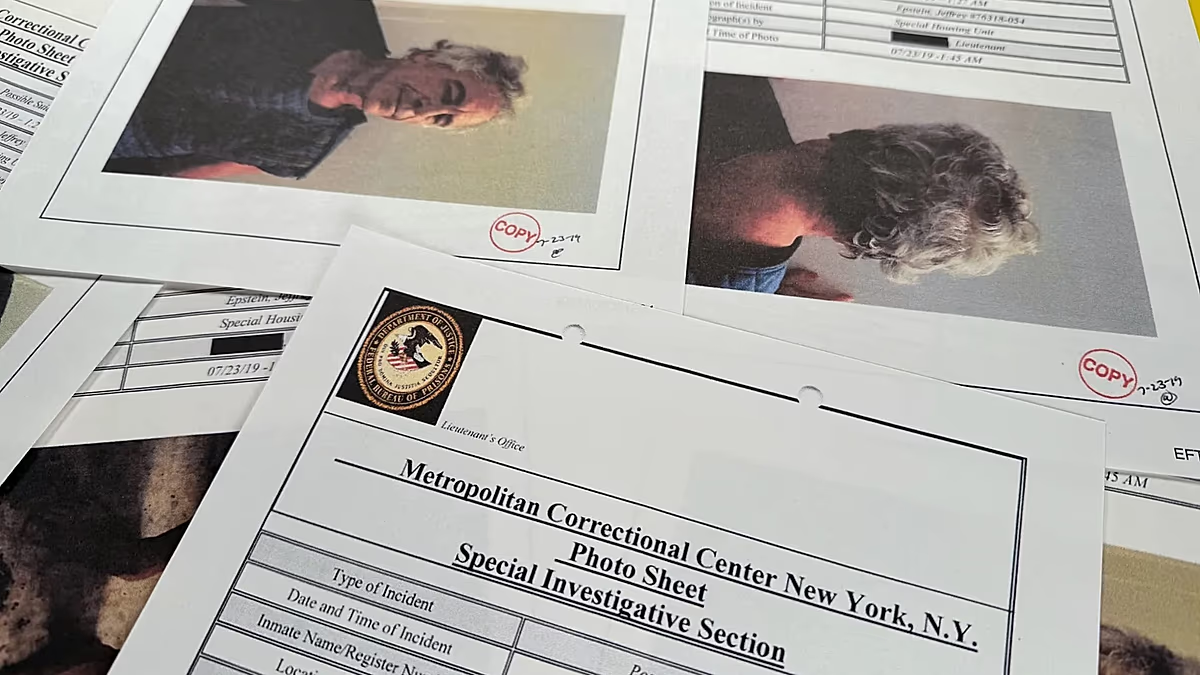


The shadow of Jeffrey Epstein’s crimes continues to reach across the Atlantic, with French authorities now deepening their investigation into his international network. Following the release of new files by the U.S. Justice Department in January, France opened a formal human trafficking probe, focusing on offenses committed within its borders or involving French perpetrators who facilitated the disgraced financier’s activities. This legal move underscores a global determination to unravel the full extent of the conspiracy, seeking justice not only for acts in the United States but for those entangled with European figures and locations. The Paris apartment, the modeling agencies, the connections to powerful individuals—all are now subjects of meticulous scrutiny by French magistrates.
In February, Paris prosecutor Laure Beccuau publicly urged potential victims to come forward, a call that has since resonated with tragic clarity. She recently confirmed that approximately twenty individuals have now made themselves known to investigators. Among them, about ten are entirely new voices—people previously unknown to the authorities who have decided, after years of silence, to share their stories. This is a painful but crucial step in mapping the network’s reach. The prosecutors have adopted a policy of patient listening, acknowledging the profound trauma involved. For some victims living abroad, arrangements are being made to facilitate their testimony in Paris, ensuring their journeys toward justice are accommodated with care and respect.
The investigation is a multi-faceted effort, combining these human testimonies with a forensic examination of the evidence. Investigators are meticulously scouring the so-called “Epstein files,” cross-referencing names mentioned by victims with the troves of digital data. They have once again pulled out Epstein’s computers, telephone records, and address books, constructing a digital map of his contacts. Furthermore, requests for international legal assistance will be issued, highlighting the probe’s cross-border nature. This work builds upon earlier actions, including a search of Epstein’s luxury Paris apartment in September 2019, conducted shortly after his death in a New York jail, demonstrating France’s long-standing attention to the case.
The French inquiry naturally intersects with other high-profile scandals within the country’s modeling industry, revealing a disturbing ecosystem of exploitation. Several suspected victims already known to investigators are women who testified in probes against former European model agency boss Gerald Marie and the late model agent Jean-Luc Brunel. Brunel was arrested in 2020 on allegations of sexually abusing minors and procuring victims for Epstein; he died in prison in 2022. Marie, meanwhile, faces renewed pressure, with fifteen women urging France in March to investigate his possible links to Epstein. Separate accusations against Marie from the 1980s and 1990s were closed in 2023 due to statutory time limits, a legal barrier that underscores the challenges of prosecuting historic abuse.
Individual stories paint a harrowing picture of grooming and manipulation. Two former models have told AFP that a modeling scout named Daniel Siad targeted them, with the aim of delivering one to Epstein in the 2000s and another to Gerald Marie in the 1990s. These accounts suggest a pipeline, where the allure of a modeling career was used as bait to draw young women into the clutches of predators. Within the current human trafficking probe, Prosecutor Beccuau noted that none of the potential implicated individuals have been formally questioned yet, indicating that the investigation is still in its foundational phase—gathering testimony and evidence before moving to confront alleged perpetrators.
This French initiative is a critical chapter in the ongoing global reckoning with Epstein’s legacy. His 2008 guilty plea for procuring a minor for prostitution, and his subsequent 13-month sentence, now seem a grotesque miscarriage of justice, a mere glimpse of a vast criminal enterprise. His death in 2019 left many questions unanswered, but the pursuit of truth continues through the courage of survivors and the diligence of law enforcement across continents. Each new voice that comes forward, each document analyzed, and each international cooperation request signifies a slow, steadfast effort to ensure that every facet of this network is exposed and that every victim’s experience is acknowledged, no matter how many years or borders separate them from the original crime.