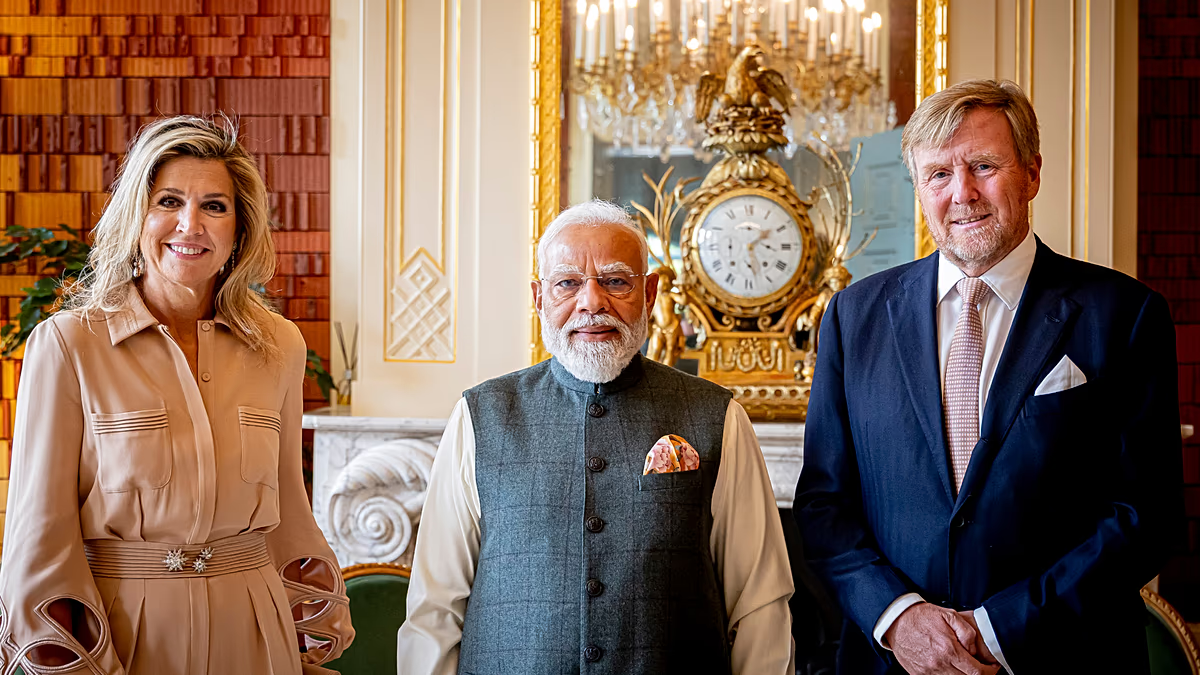



Indian Prime Minister Narendra Modi has embarked on a significant six-day diplomatic tour, bridging the Middle East and Europe, with a clear agenda of strengthening economic partnerships and strategic alliances. The European leg commenced in the Netherlands, where Modi was received at the Huis ten Bosch Palace by King Willem-Alexander and Queen Máxima. This meeting, rich in ceremonial respect, set the tone for a visit focused on deepening bilateral ties. Beyond the royal audience, Modi’s schedule included substantive discussions with Dutch officials, including Prime Minister Rob Jetten, centered on critical areas of mutual interest such as defence, security, clean energy, and technological innovation. The choice of the Netherlands as a first stop is highly strategic, acknowledging the country’s role as a vital trading partner for India, with two-way trade reaching a substantial USD 27.8 billion in the last fiscal year.
The Prime Minister’s engagement with the vibrant Indian diaspora in The Hague further underscored the human and cultural bridge between the two nations. In his address, Modi celebrated the contributions of the Indian community while highlighting the evolving nature of the bilateral relationship, which is rapidly expanding beyond traditional trade into the realms of high-tech innovation and sustainable solutions. This community event is a hallmark of Modi’s foreign policy, which often leverages the soft power of the global Indian diaspora to foster goodwill and underscore shared values. The conversations with Dutch business leaders that followed were a practical extension of this vision, aimed at translating diplomatic warmth into concrete commercial and collaborative projects that benefit both economies.
From the Netherlands, the Prime Minister’s itinerary proceeds to Sweden, marking another pivotal encounter. Here, Modi will sit down with Swedish Prime Minister Ulf Kristersson to comprehensively review the full spectrum of bilateral relations. The agenda is notably ambitious, reflecting the sophisticated nature of modern diplomacy where trade, technology, and geopolitics intersect. A key highlight of the Swedish visit will be a joint address with European Commission President Ursula von der Leyen to the European Round Table for Industry, a forum representing some of Europe’s largest companies. This provides a direct platform to showcase the India-EU partnership to the continent’s industrial leaders, signaling stability and opportunity for future investment.
The presence of President von der Leyen is particularly significant, coming just months after the successful conclusion of negotiations for a landmark free trade agreement between India and the European Union. This deal, aimed at slashing tariffs and simplifying bureaucratic processes, represents a monumental step in economic integration. Modi’s engagement with the EU’s top official during a multi-nation tour reinforces the message that this agreement is not an isolated milestone but part of a broader, deepening strategic engagement. The discussions in Sweden will likely build on this momentum, exploring ways to implement the agreement effectively and identify new sectors for cooperation, from digital infrastructure to green manufacturing.
Following the bilateral focus in Sweden, the tour shifts to a multilateral format with the third India-Nordic Summit in Oslo, Norway. This gathering brings Modi together with the leaders of Norway, Sweden, Denmark, Finland, and Iceland, representing a cohesive bloc of advanced, innovation-driven economies. The summit’s outlined agenda is forward-looking, concentrating on collaboration in cutting-edge fields like renewable energy, Arctic research, space technology, and defence. This engagement reflects India’s deliberate outreach to nations that are global leaders in sustainability and technological research, aligning with India’s own domestic ambitions in these areas. The Nordic model of innovation and social welfare offers unique lessons, and this forum allows for a synergistic exchange of ideas and the formation of partnerships that transcend traditional diplomatic exchanges.
The final stop on this extensive journey is Italy, where Modi will meet with Prime Minister Giorgia Meloni. This meeting will reaffirm and build upon the “Joint Strategic Action Plan” both leaders committed to in 2024. The plan encompasses a wide array of cooperation, notably in defence and security, while also addressing the sensitive and pragmatic issue of promoting safe and legal migration channels. Ending the tour in Italy symbolizes the interconnected nature of modern global challenges—from economic security and defence to human mobility. Overall, Prime Minister Modi’s European tour is a masterclass in nuanced diplomacy, blending ceremonial respect, community engagement, economic persuasion, and strategic dialogue. It paints a picture of an India that is confidently engaging with the world on multiple fronts, seeking not just transactional relationships, but durable partnerships built on shared technological, economic, and environmental futures.