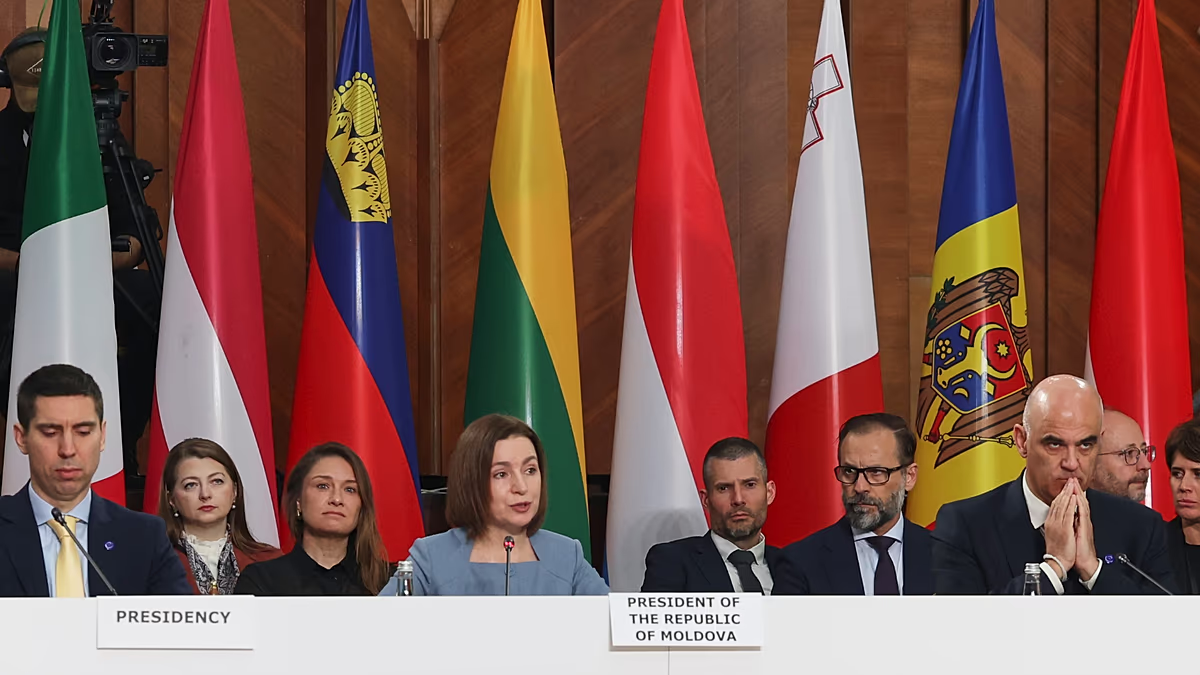



Paragraph 1: A European Gathering Amidst Ongoing Crises
In mid-May 2026, the historic city of Chisinau, Moldova, played host to a pivotal meeting of the Council of Europe’s Committee of Ministers, a body representing 46 nations united by the common principles of human rights, democracy, and the rule of law. Against a backdrop of persistent war in Europe and complex, continent-wide challenges, the agenda was weighty. The leaders convened to reaffirm their unwavering solidarity with Ukraine in its struggle against Russian aggression, to bolster what they termed “democratic security” against disinformation and foreign interference, and to grapple with one of Europe’s most divisive and enduring issues: the management of migration. The outcome of this summit, particularly regarding migration, signals a significant, and to some, a controversial, shift in how Europe envisions balancing its humanitarian obligations with its sovereign right to control borders.
Paragraph 2: A Landmark Declaration on Human Rights and Migration
Among the most consequential decisions reached was the adoption of a new declaration, advanced notably on Italy’s initiative, which offers a fresh interpretation of the foundational European Convention on Human Rights (ECHR). This document focuses specifically on Articles 3 and 8—which prohibit torture and inhuman treatment and protect the right to private and family life, respectively. The declaration opens a path for member states to more readily expel certain migrants, including through cooperative arrangements with countries outside Europe that could involve processing individuals in “repatriation centres” on foreign soil. Crucially, the text maintains that the ban on torture is absolute, but it introduces a degree of flexibility by noting that the assessment of what constitutes “inhuman or degrading treatment” is relative and must be considered on a case-by-case basis. On family life, it affirms that a state’s interests in areas like national security can outweigh an individual’s right to remain, suggesting that courts should grant governments considerable deference in such decisions.
Paragraph 3: The Italian Rationale: New Tools for New Challenges
The driving force behind this initiative was articulated by Italian officials, who framed it as a necessary modernization in the face of unprecedented migratory pressure. Undersecretary for Foreign Affairs Massimo Dell’Utri emphasized the need for “new tools to today’s challenges,” arguing that the declaration allows Europe to address irregular migration “effectively and promptly.” The Italian perspective views this not as an abandonment of human rights, but as a recalibration aimed at strengthening border protection, combating human smuggling networks, and ensuring national security, all while operating within a framework of international cooperation. The core idea is that by establishing partnerships with third countries for offshore processing, Europe can manage flows more orderly, deter dangerous journeys, and uphold the integrity of its asylum system for those most in need.
Paragraph 4: A Political Victory for Rome and the “Italy-Albania Model”
For Italian Prime Minister Giorgia Meloni, the Chisinau Declaration was heralded as a major political and diplomatic triumph. She took to social media to proclaim that the document “recognises the legitimacy for nations to pursue innovative solutions in managing migration flows, such as repatriation hubs in third countries, following the model launched by Italy in Albania.” This model, a bilateral agreement to process asylum applications in Albanian centres, had initially been met with scepticism and legal scrutiny. Meloni framed the Council of Europe’s endorsement as a watershed moment, transforming an Italian policy experiment into a “principle shared by the 46 member states.” She portrayed it as validation that her government’s stringent, sovereignty-first approach to migration has now decisively shaped the European mainstream.
Paragraph 5: Unwavering Solidarity with Ukraine and the Pursuit of Justice
While migration dominated headlines, the summit’s other central pillar remained the continent’s collective response to Russia’s war on Ukraine. The member states unanimously renewed their firm political, financial, and military support for Kyiv. Perhaps more significantly, they took a concrete step toward establishing accountability for the crime of aggression—the very act of launching an illegal war. Thirty-six nations, including Italy, alongside the European Union, adopted the founding decision to create a Special Tribunal for the crime of aggression against Ukraine. This move seeks to complement the work of the International Criminal Court (which handles war crimes and crimes against humanity) by creating a dedicated mechanism to hold top Russian leadership responsible for the invasion itself, signaling a long-term commitment to pursuing legal justice as a cornerstone of European security.
Paragraph 6: A Defining Moment for Europe’s Identity and Future
The Chisinau meeting, therefore, presents a portrait of a Europe at a crossroads, defining its priorities in a turbulent era. On one hand, it demonstrates profound unity and resolve in defending a member state against external aggression and in championing international law through the pursuit of a war crimes tribunal. On the other, it reveals a deepening consensus around a more restrictive and externally-oriented migration policy that prioritizes border control and offshore processing. This dual outcome encapsulates the tension at the heart of the modern European project: a commitment to universal human rights and solidarity, now increasingly filtered through a lens of pragmatic security and sovereign interests. The new interpretation of the Human Rights Convention marks a potential turning point, setting a precedent that will inevitably be tested in national policies and, ultimately, in the courtrooms of Strasbourg, shaping the lived reality of rights and protections for years to come.