



The Melody of Protest: Spain’s Stance on Eurovision and the Politics of Cultural Boycott
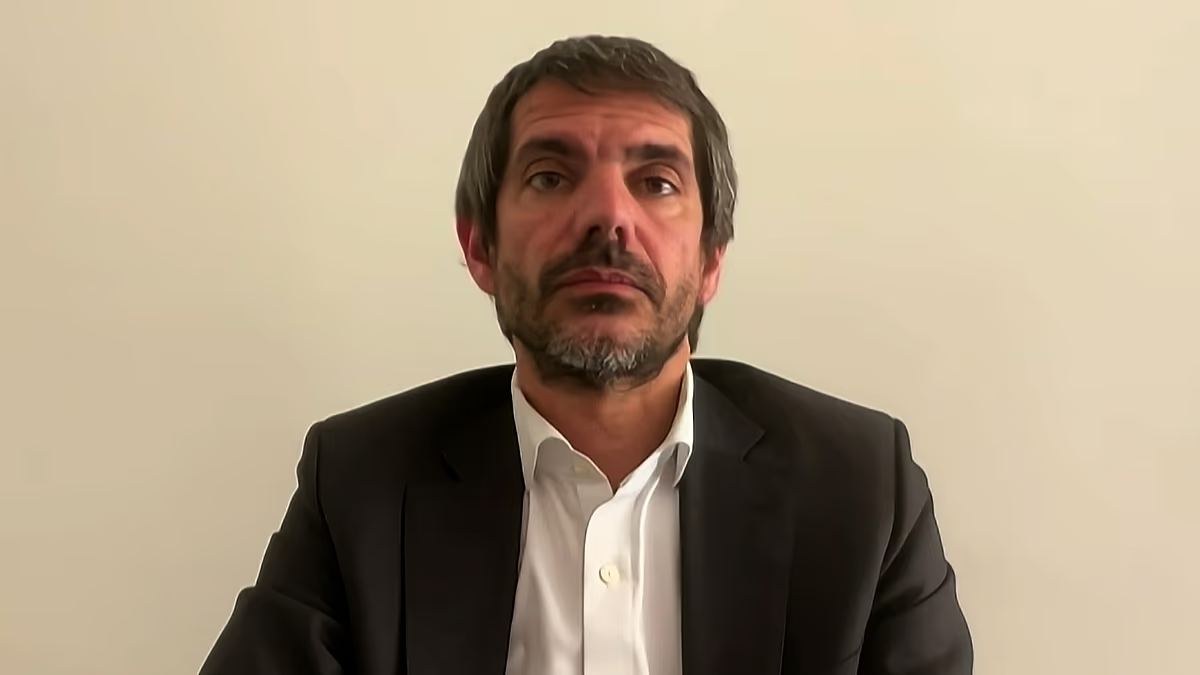
In a striking critique that pierces the celebratory veneer of one of the world’s most popular televised events, Spain’s Culture Minister, Ernest Urtasun, has launched a pointed accusation against the organizers of the Eurovision Song Contest. He contends that by permitting Israel to compete amidst the ongoing war in Gaza, the European Broadcasting Union (EBU) is effectively employing culture as a tool for “whitewashing” a devastating conflict. Urtasun’s argument, detailed in an interview with Euronews, centers not on the music itself, but on the profound ethical implications of inclusion. He asserts that the fundamental error lies in the EBU’s initial board decision to allow Israel’s participation, a move he believes injects a grave political reality into a space traditionally reserved for international harmony and artistic expression. This stance positions Spain at the forefront of a contentious debate about whether cultural platforms can, or should, remain isolated from global crises and allegations of human suffering.
Minister Urtasun is careful to delineate between the unifying power of art and the contentious nature of state representation. He emphatically states that music itself is not the divisive force; rather, it is the context of Israel’s involvement against the backdrop of its military campaign in Gaza that has sown discord. By drawing a direct parallel to Russia’s exclusion from Eurovision following its invasion of Ukraine, Urtasun highlights what he and many critics see as a glaring inconsistency in the EBU’s application of its own principles. When a contest is structured around national representation, he argues, it cannot artificially divorce itself from international law and morality, particularly referencing the International Criminal Court’s investigations. The act of inclusion, in this view, becomes a form of normalization, using the joyful, apolitical spectacle of Eurovision to gloss over the harsh realities of warfare and humanitarian crisis.
Spain’s position is not merely symbolic but has been translated into concrete action, with the country’s broadcaster withdrawing from the contest. Urtasun clarifies that Madrid’s criticism is squarely aimed at the EBU’s governing decision, not at the nations that choose to participate. He respects the sovereignty of other countries to make their own choices, while firmly explaining Spain’s. This decision, he reveals, is one taken “with pain,” given Eurovision’s massive and passionate following in Spain. However, he believes it reflects the conscience of the Spanish public, asserting that a vast majority of citizens are revolted by the violence in Gaza and reject what they perceive as genocide. Thus, the boycott becomes an act of painful principle, prioritizing ethical alignment over communal celebration, and framing cultural participation as a privilege contingent on a baseline of humanitarian respect.
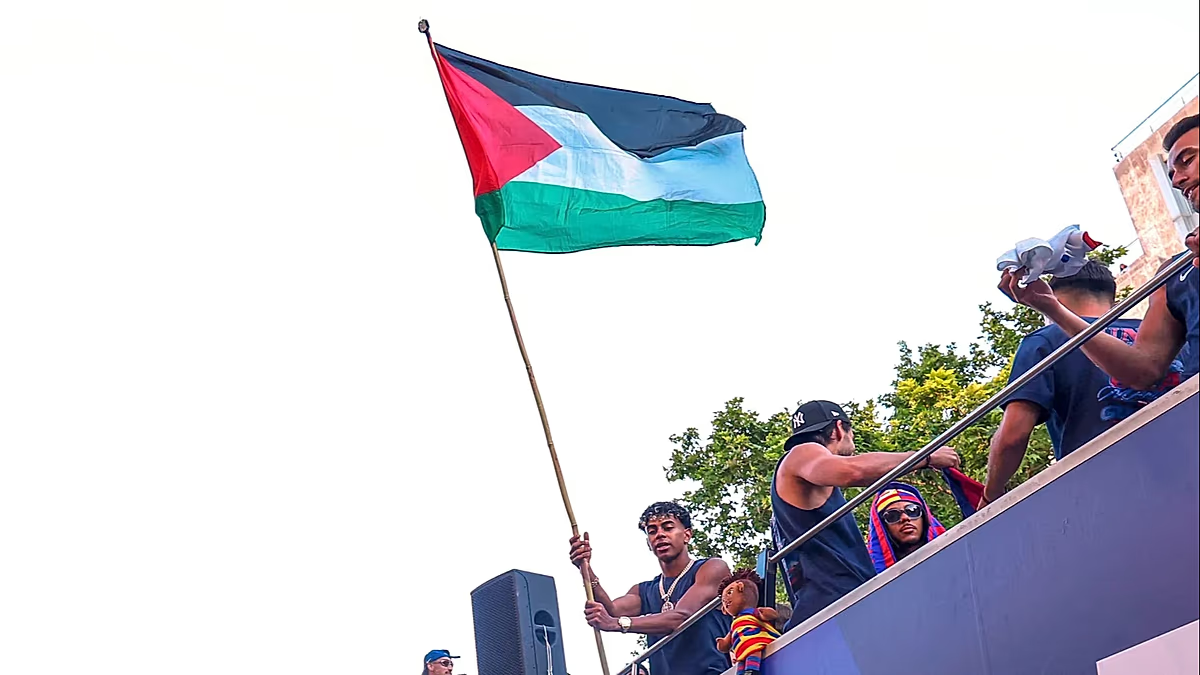
The controversy has erupted far beyond diplomatic statements, spilling onto the Eurovision stage itself and exposing deep fissures within the event’s community. During the semi-finals, Israel’s contestant was met with a mixture of applause, audible boos, and pro-Palestinian chants from the audience, while protests unfolded outside the venue. This palpable tension underscores how the EBU’s insistence on the contest being a non-political competition between broadcasters, not governments, is being severely tested by public sentiment. Broadcasters from several other European nations, including Ireland, Iceland, and the Netherlands, have echoed Spain’s concerns, with some threatening their own boycotts. This collective unease has transformed the 2026 contest into arguably the most politically charged edition in its long history, challenging its foundational myth of unity through music and revealing the immense difficulty of upholding neutrality when the world watches through a lens of acute moral scrutiny.
At the heart of the dispute lies the accusation of double standards—a charge the EBU has struggled to convincingly rebut. Critics consistently circle back to the precedent set with Russia: if a nation’s aggressive military actions warranted exclusion then, why not now? The EBU’s technical distinctions between broadcasters and governments have done little to quell the argument that the effect is the same: the flag and cultural identity of a state under intense international criticism are showcased on a global platform. Urtasun’s intervention gives official, governmental weight to this criticism, moving it from activist circles and open letters into the realm of inter-European cultural policy. The controversy has thus become a proxy for a wider, anguished European discourse on the Gaza conflict, with Eurovision serving as an unlikely but powerful arena for this societal clash.
Despite the firmness of its current boycott, Spain has left the door open for a return, contingent on a fundamental shift in approach. Urtasun concludes by affirming Spain’s historic love for Eurovision and its desire to participate, but only under the condition that the contest is not used to sanitize serious global conflicts. This final point encapsulates the minister’s core thesis: cultural spaces must not become instruments of political absolution. The episode ultimately raises profound questions about the responsibility of international cultural institutions in an increasingly polarized world. It asks whether true neutrality is ever possible, or if, in striving for it, these institutions risk becoming complicit through silence or selective engagement. The melody of protest now harmonizes with the pop anthems, ensuring that the legacy of this year’s Eurovision will be measured not only in votes and trophies, but in the enduring conversation it has sparked about art, ethics, and the price of inclusion.